Full Trident replacement or zero, says defence chief
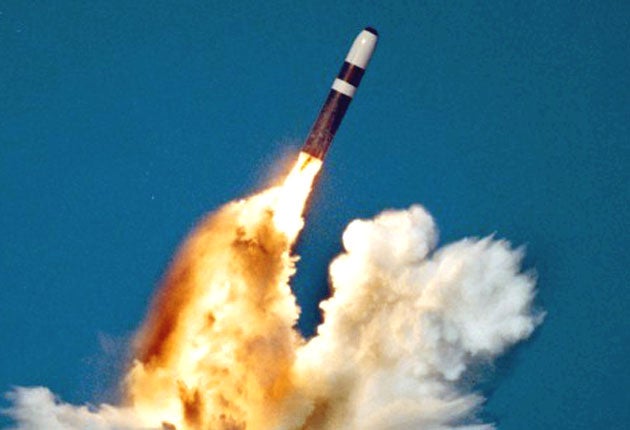
The outgoing head of the armed forces warned today that the Government might as well scrap Britain's nuclear deterrent if the decision is taken to downgrade it.
Air Chief Marshal Sir Jock Stirrup said any lesser replacement for Trident would not be "credible".
The comments came amid a growing row over the cost and shape of the UK's nuclear capability, with speculation that weapons might not remain continuously deployable in future.
Senior Tories have expressed alarm at reports that the Government could put off the final decision on whether to go ahead with the replacement of the four missile-carrying submarines - due to be announced in 2014 - until after the election in 2015.
Giving evidence to the Commons Public Administration Committee this morning, Sir Jock stressed that it was for politicians to decide whether the UK should have a nuclear deterrent.
But assuming the Government's commitment to that principle, the Chief of the Defence Staff said: "We have to have the minimum credible deterrent.
"If you are not going to have that, then you are better off having zero.
"Spending money on a less than minimum credible deterrent makes, to me, no strategic sense at all."
He went on: "I would be worried about any proposition that was untenable in the context of maintaining the minimum credible nuclear deterrent, which, to me, is continuous at-sea deterrence by a submarine."
Sir Jock, a former jet pilot who has been Chief of the Defence Staff since 2006, is due to leave his post later this autumn. He had been due to stay on for another six months, but soon after the coalition came to power, it was announced he was leaving early.
He told the MPs the two "critical issues" surrounding a Trident replacement were the ageing submarines and the need to maintain a submarine-building capacity.
But asked about a possible delay in the "main gate" decision - when the main spending on the project is triggered - he said: "I'm not aware that any decision has been taken along those lines."
The Prime Minister's spokesman said the decision to renew Trident had "already been taken", but the coalition was "examining the issue of value for money".
"The position is that we will maintain the nuclear deterrent," the spokesman said.
"Clearly, as part of that value for money review you would expect us to be looking at the profile of spending."
Pressed on what "profile" meant in the context, he added: "It means when you spend money."
Asked whether David Cameron shared Sir Jock's view that the only "credible" form of deterrent would be one that was continuously at sea, the spokesman replied: "The Prime Minister had made his view known on this. We are committed to an effective nuclear deterrent."
Moving to delay the replacement of Trident could ease both the pressure on the over-stretched defence budget and political tensions within the coalition, with the Liberal Democrats pressing for a cheaper alternative.
But Conservative MP Bernard Jenkin, a former defence spokesman and chairman of the Commons Public Administration Committee, warned that any postponement would be unacceptable to Tories.
He said that putting off the "main gate" decision would actually increase the long-term costs while casting doubt on the Government's commitment to maintain the nuclear deterrent.
"I don't think this will happen because it would disturb the Conservative Party very, very deeply," he told BBC Radio 4's Today programme.
"This would be the maddest decision of them all. It would immediately cast doubt on whether the Government has actually got the resolve to follow through with the programme at all.
"If you delay, you reopen the whole question, you create uncertainty about how viable our existing deterrent would be and you raise questions about whether we actually resolve to remain the power with global reach and influence throughout the world that we are today.
"It is about what sort of country you want to be."
But the prospect of a delay was welcomed by former Lib Dem leader Sir Menzies Campbell, who said it would provide an opportunity to look again at other weapons systems.
"We are in the midst of a wholesale defence review. You simply cannot proceed upon assumptions that had their origin in the Cold War," he told the Today programme.
"It seems to me that it makes a great deal of sense to allow us a breathing space to consider whether a like-for-like replacement - four boats, 192 warheads - is what is necessary for Britain's defence when we know there are other alternatives available."
Labour leadership contender Ed Miliband said the row underlined the political weakness of the coalition.
"This decision by the coalition looks worryingly like a Government putting off the difficult political choices because they are too weak and too divided to take them, rather than showing the leadership and strength to make tough choices in the long-term interests of our country," he said.
The Ministry of Defence said that while the Government remained committed to a submarine-based nuclear deterrent based on the Trident missile system, the programme timetable could be reviewed as part of the continuing strategic defence and security review.
A spokesman said: "Within the framework of the strategic defence and security review, a review is ongoing to ensure that the renewal of the deterrent provides value for money.
"It will consider the programme timetable, numbers of submarines, missiles, missile tubes and warheads, infrastructure and other support costs, and the industrial supply chain.
"Once the review has concluded, ministers will discuss and agree the optimum balance of capability and cost."
Join our commenting forum
Join thought-provoking conversations, follow other Independent readers and see their replies
Comments