Nicola Sturgeon: Scotland's First Minister seizes chance to play kingmaker at general election
Exclusive: Ms Sturgeon wants to build a 'progressive alliance' capable of propelling Ed Miliband into 10 Downing Street in May
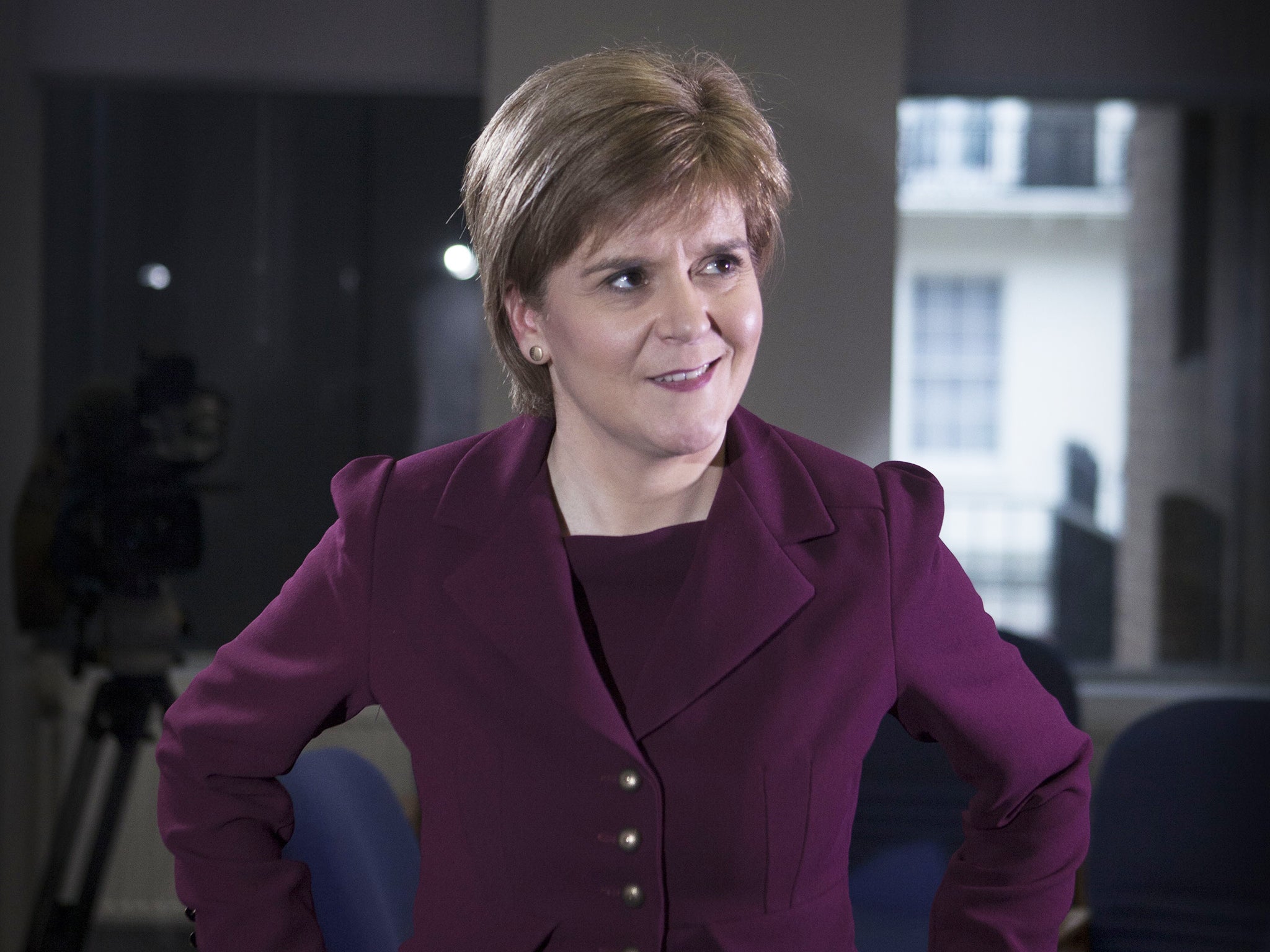
The SNP should be less confrontational and co-operate with political rivals – and the English, Scotland’s First Minister has said. Nicola Sturgeon wants to build a “progressive alliance” capable of propelling Ed Miliband into 10 Downing Street after May’s UK general election, she told i in an exclusive interview.
The SNP will very likely refuse to join a coalition with Labour, Ms Sturgeon said, if neither the Conservatives nor Labour wins a majority – the most probable result according to current polling. She would prefer to support a Labour minority government “on a case-by-case basis”, an arrangement known as “confidence and supply”, so long as Mr Miliband agreed to moderately increase public spending.
With the SNP predicted to win the majority of Scotland’s Westminster seats, Ms Sturgeon wants to persuade voters that her party can be a force for good around the UK, not only north of the border.
Asked how her leadership style differs from her predecessor, Alex Salmond, Ms Sturgeon, 44, said: “I’m manifestly not the same as Alex Salmond. I’m a different gender for example... I’m being flippant but maybe this is a partly gender-driven difference: I’m very keen that we find a way of reaching out across party divides to find things we agree on, as well as the things we disagree on.
“One of the things where the SNP could really make a difference, if we are a force in the next Westminster Parliament, is to build alliances for some of the progressive changes we would like to see.”
Scotland’s First Minister will go on a charm tour of England before polling day to try to convince the English public that the SNP is not out to “antagonise” them. She acknowledged that some people distrust SNP intentions: “I can understand that. But part of the reason I’m spending time in London and will be spending time in other parts of England is to make the case that that’s misplaced.”
Her mission to win over the English began in London this week, where she met i at the UCL Department of Chemistry, beneath an enormous periodic table. She will visit other English cities over the next 11 weeks.
The SNP wouldn’t enter into a coalition unless Labour was willing to scrap Trident renewal, she said – a position Labour will not countenance. What’s more, the fate of the current junior Coalition partners, the Lib Dems, alarms Ms Sturgeon. “I think it would be very unlikely to have the SNP in a formal coalition in Westminster. I’m not ruling it out entirely. I think it’s more likely if we were to be in this scenario, that the SNP would act in an issue-by-issue, confidence-and-supply arrangement.”
She could yet end up in the curious position of supporting a form of government she wants to see abolished. But Ms Sturgeon has a plan, of course. If the SNP wins a large block of seats and can put Mr Miliband in Downing Street, she intends to prise from him new powers for Scotland – and to push the case for Scottish independence again. “We will always seek to use the levers we have,” she said. “I’m not making any secret of the fact I still believe in independence. We’ll continue to argue the case.
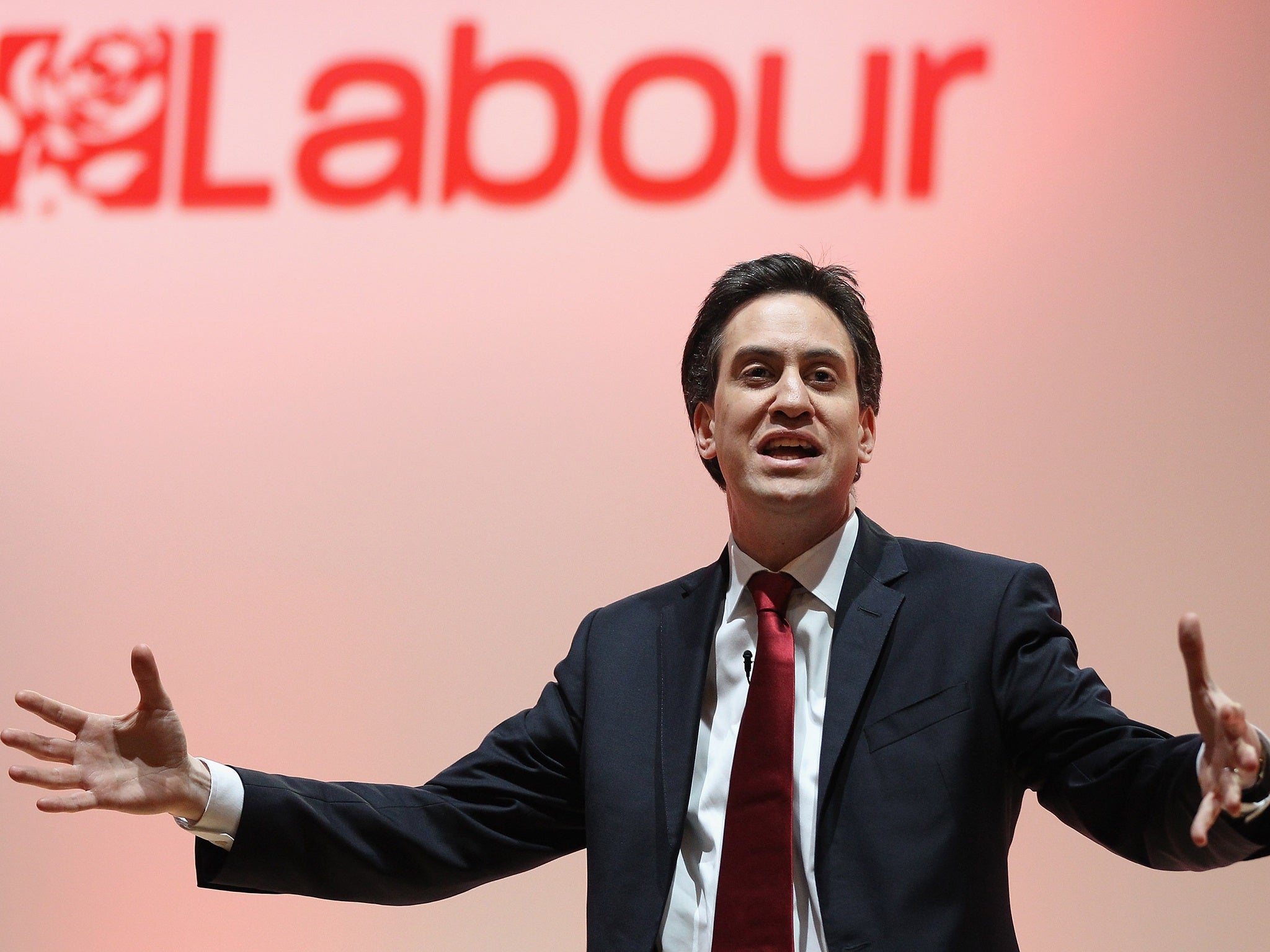
“But as long as Scotland is part of the UK, I want us to play a constructive, progressive role in how Westminster politics develops.”
Former SNP leader Mr Salmond is expected to win a seat in the House of Commons in May. Ms Sturgeon, though, intends to lead any bargaining from her office in Edinburgh. “Our MPs will take decisions on how they’re voting on a day-to-day basis. But I’m the leader of the party and in terms of our overall strategy and how we vote on key issues, then ultimately those decisions will be mine.”
Despite her willingness to back an Ed Miliband premiership, Ms Sturgeon said minutes later that he has “big questions” to answer over his leadership credentials. “He is in a rather peculiar position… as a leader of the Labour Party, that in Scotland right now, his approval ratings are worse than David Cameron’s. Now how a Labour leader gets into that position is odd. And so of course there are big questions.” She insists that she can’t remember the last time she spoke to him.
How will she feel if the SNP hands Downing Street to David Cameron by eating into Labour’s vote? “That won’t happen,” she snaps back. “SNP MPs are never going to be part of a majority for David Cameron.” Yet Mr Cameron would get the first opportunity to form a coalition if the Conservatives are the largest party. “I’m not sure that is written in tablets of stone ,” she quarrels, “that’s not necessarily the case...” before conceding finally: “It’s his incumbency as Prime Minister that arguably gives him that right.”
Her simple pitch to Scotland’s electorate is this: “Labour make this argument that you’ve got to vote Labour to keep out the Tories, it’s insulting people’s intelligence. They said it in 2010. People did vote Labour and we still got the Tories. If you want Scotland’s voice – almost regardless of who’s in government in Westminster – to be heard and Scotland’s interests to be up the agenda, the only way to do that is to send SNP MPs.”
Sturgeon’s view...
On women in politics and the boardroom
Quotas are necessary. They’re a blunt tool. But if we had a real meritocracy now we’d have a gender balance. Progress is painfully slow.
On Coalition welfare cuts
Women have been particularly hard hit along with the disabled, and the poorest 10 per cent. The cuts are a false economy. They [the Coalition] are not cutting spending, they’re just transferring responsibility for spending. We’re having to invest tens of millions of pounds to mitigate some of the effects… so it’s not an actual cut.
On comparisons with Alex Salmond
One of the things I’m just not going to do as SNP leader is obsessively look for differences with Alex Salmond – and almost in a way saying, “Oh I’d do this better than him.” Alex has been one of my closest colleagues for 20 years. He remains a huge part of the SNP team.
On deficit reduction
The whole approach the UK Government is taking is wrong. It’s cut at all costs. Slash and burn without thinking of the consequences. We need to be focusing on investing in infrastructure, innovation, and the challenges of productivity if we want the economy to grow sustainably and solidly. If we want to have public services that are able to deal with the ageing population we need to invest properly, and I don’t want to see an approach that penalises the poorest people in society.
On whether she or Alex Salmond will call the shots
Our MPs on a day-to-day basis will take decisions on how they’re voting. But I’m the leader of the party and in terms of our overall strategy and how we vote on key issues, then ultimately those decisions will be mine.
On Greece’s Syriza party
I wouldn’t model ourselves on them. But it’s part of a bigger movement.
On opposing the liberalisation of drugs laws
I think the evidence leads us to that view.
On using 'Westminster' like a term of abuse
Do I mention Westminster negatively? Guilty as charged. Westminster as an institution needs to be seriously shaken up, given the fright of its life.
Join our commenting forum
Join thought-provoking conversations, follow other Independent readers and see their replies
Comments