Goldsmith had doubts over legality of Iraq war
Attorney general was not bullied into backing invasion, says Blair's ex-chief of staff
Lord Goldsmith, the former attorney general, remained unconvinced that military action against Saddam Hussein was legal even after a crucial United Nations resolution was secured, it has emerged.
Resolution 1441, signed in November 2002, was cited by Tony Blair and the Bush administration as the legal basis for invading Iraq. It stated that Saddam would be in "material breach" of UN orders if he failed to co-operate with the terms it set out.
However, official documents seen by the Iraq inquiry team suggest that Lord Goldsmith, responsible for advising the government on the legality of the invasion, was not persuaded that the resolution had resolved the legal question marks in the months after it had been agreed.
Lord Goldsmith warned Mr Blair that invading Iraq could be illegal in a letter sent in July 2002. It is the first time that his doubts after the intervention of the UN have been revealed by Sir John Chilcot's inquiry. A further resolution, giving clear permission for an invasion, was never secured.
Sir John said Lord Goldsmith told Number 10 that "he would need some time to reflect" on the implications of resolution 1441 once it had been signed. "It appears from what we read that he did not feel convinced at that time... that standing on its own it would be a secure base," he said.
Shortly before the invasion took place in March 2003, Lord Goldsmith told the Cabinet that he was persuaded that there was a legal basis for toppling Saddam. However, the inquiry heard yesterday that he had only given equivocal backing just weeks earlier and had come under pressure to make a decisive judgement.
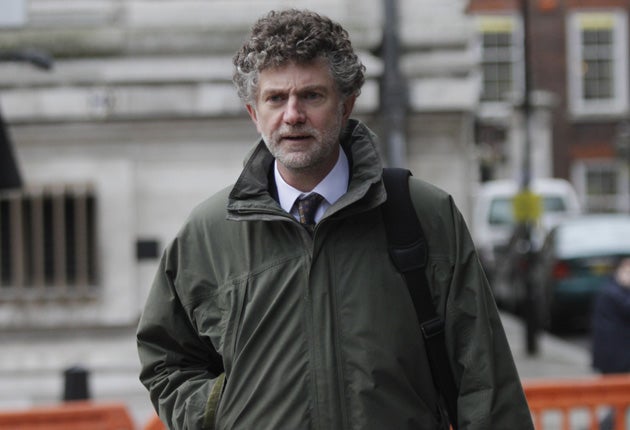
Jonathan Powell, who was the chief of staff for the former prime minister, said that Mr Blair ordered his attorney general to give a "definitive" answer on the question of legality but denied that Lord Goldsmith had been bullied into giving his backing to the war.
In early March, Lord Goldsmith had told Mr Blair that a "reasonable case" could be made that resolution 1441 gave the go-ahead for military action. However, he also warned that a further UN resolution would be preferable.
The inquiry heard that he was called to a meeting with Mr Blair four days later, as attempts to secure the explicit approval from the UN failed. "I don't know if he was asked for a definitive opinion before 11 March. He was certainly asked for a definitive view on March 11," Mr Powell said.
"My experience of lawyers is often you have an 'on the one hand, on the other'. But sometimes they have to come down on a decision one way or the other on an issue. You can't have it both ways, and I think that is what is happening in this period."
In response to demands for clarity from the head of the military, Admiral Lord Boyce, Lord Goldsmith issued a further page of legal opinion authorising the invasion three days before it took place. Mr Powell added: "You are not able to bully the attorney general but he was bearing a very heavy burden."
Mr Powell said that Mr Blair and his team realised that intelligence was not foolproof but took action on the assumption that Saddam remained a threat because he had used weapons of mass destruction (WMD) in the past.
He strongly rejected the suggestion made by the former ambassador to Washington, Sir Christopher Meyer, that Mr Blair and President George W Bush had "signed in blood" an agreement to go to war during a meeting in Crawford, Texas. "I was at Crawford," he said. "Christopher Meyer was not at Crawford. He was at Waco 30 miles away. There was not an undertaking in blood to go to war with Iraq. There was no firm decision to go to war."
The suggestion that Lord Goldsmith had legal doubts after resolution 1441 was secured will put further pressure on Mr Blair when he appears before the inquiry. It was finally announced yesterday that Mr Blair will be questioned on 29 January. He will give evidence during two three-hour sessions.
Geoff Hoon, the former Defence Secretary, will appear at the inquiry today. He is expected to be asked about claims that he blocked army officials from ordering vital equipment because he feared military planning would become public. Lieutenant General Sir John Reith told the inquiry on Friday that he had warned Mr Hoon that the last minute orders meant that Britain could miss the US deadline for any invasion.
Join our commenting forum
Join thought-provoking conversations, follow other Independent readers and see their replies
Comments