Hoon: Brown is to blame for Army shortages
Ex-Defence Secretary who tried to unseat PM tells inquiry: he refused to pay up
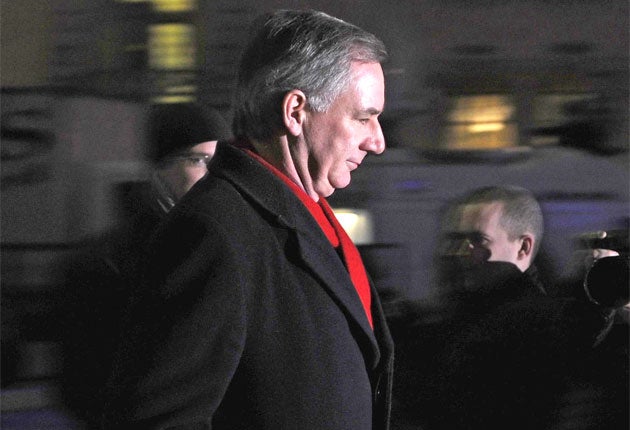
Gordon Brown withheld funds demanded by the armed forces in the months leading up to the invasion of Iraq, it was revealed yesterday.
Geoff Hoon, the defence secretary at the time of the Iraq war, told the Chilcot inquiry that the Ministry of Defence had "asked for significantly more money than we eventually received" from the Treasury in July 2002, less than a year before the invasion.
Mr Hoon, who was behind last month's failed putsch against the Prime Minister's leadership, added that spending cuts imposed on the military by Mr Brown had led to the shortage of helicopters experienced by British troops operating in Afghanistan.
Tony Blair was also left with new questions to answer as Mr Hoon revealed that the former Prime Minister had held him back from ordering crucial equipment. He said Mr Blair feared that the secret military planning would become public if orders were placed too early. Delays meant that troops were hindered by shortages of body armour, boots and desert uniforms.
In his evidence to the Iraq inquiry, Mr Hoon said that accounting changes introduced by Mr Brown six months after the invasion of Iraq had led to "difficult" spending cuts and a budget under "severe constraint". As a result, spending on helicopters was cut.
Troops in Afghanistan have had to rely on lightly armoured Snatch Land Rovers, putting them at greater risk from roadside bombs. "Had that budget been spent in the way that we thought we should spend it, then those helicopters would probably be coming into service any time now," Mr Hoon said.
Problems arose over funding the British operations in Iraq as the Treasury quibbled over providing the money needed for maintaining some new equipment and training troops to use it. "Once you acquire a piece of equipment it has to be supported and maintained – there has to be training," he said. "I think there were some discussions with the Treasury about whether the budget could be increased to allow for that maintenance and that was an area of difficulty."
Mr Hoon said that when he confronted Mr Blair over the need to begin ordering equipment, "the argument I was given from the prime minister and the foreign secretary was that it would affect our ability to get that [United Nations] resolution". He added that he had to wait for the Treasury to approve secret military spending. Funds for the "urgent operational requirements" he requested were finally rubberstamped in October 2003. "Only once the Treasury had approved the list could we go out and let the contracts," he said.
Delays occurred as a result, Mr Hoon said. But he added that army officials had informed him that providing more body armour was not a priority.
Liam Fox, the shadow Defence Secretary, said Mr Hoon's evidence had shown a "collective failure" of New Labour's management of the armed forces. "It is increasingly clear that the preparations to provide our troops with the necessary kit were hampered not only by political interference by Tony Blair, but also by the financial handicap applied by Gordon Brown as chancellor," he said.
Ed Davey, foreign affairs spokesman for the Liberal Democrats, repeated his demand for Mr Brown to appear before the inquiry before the next election. "We are being left with a huge Gordon Brown-shaped hole in the evidence," he said.
Documents published by the inquiry yesterday also revealed that Mr Blair's top legal adviser rebuked Mr Hoon for suggesting that an invasion of Iraq would be legal without "specific" permission from the United Nations. Lord Goldsmith, the former attorney general, chided Mr Hoon for putting him in "in a difficult position" over the legality of military action in a strongly worded private letter written a year before the invasion took place.
In the letter, Lord Goldsmith said Mr Hoon should not have claimed in a television interview that Britain and the US were not obliged to seek permission for any invasion from the UN. He also warned him that there were "considerable difficulties" in justifying the use of force on self-defence grounds.
Lord Goldsmith fired off his missive after Mr Hoon had made the claims during a lengthy interview with Jonathan Dimbleby. "As you are aware, the law officers' opinion has not been sought on the legality of possible action and I have not therefore offered any views on the legal position," he wrote.
"The clarity of your statement and the apparently authoritative way it was produced puts me, however, in a difficult position."
Mr Hoon told the inquiry that he did not think it would have been "appropriate" or "sensible" for the Cabinet to hold a vote or even have a debate on the legality of toppling Saddam once Lord Goldsmith had given his final opinion that military action did not break international law. Clare Short, the international development secretary who resigned shortly after the invasion, had asked Tony Blair for such a debate, but her request was rejected.
Join our commenting forum
Join thought-provoking conversations, follow other Independent readers and see their replies
Comments