Hundreds of thousands walk out – but the real battle is yet to come
The mass strike of public-sector workers passed without serious trouble. But unions are warning of far bigger actions in October
Sign up for the View from Westminster email for expert analysis straight to your inbox
Get our free View from Westminster email
Trade union leaders warned that yesterday's strike by teachers and civil servants would be followed by an "autumn of discontent" across the public sector unless the Government retreated over plans to cut their pensions.
The unions also turned their fire on Ed Miliband after he criticised the 24-hour strike which disrupted more than 11,000 schools and forced many parents to make emergency childcare arrangements.
Mary Bousted, general secretary of the Association of Teachers and Lecturers (ATL), won the biggest cheer at a Westminster rally when she declared: "The response of Ed Miliband has been a disgrace – he should be ashamed of himself. If our strike is a mistake, what has he done to oppose this devastating attack on our pensions? If the Opposition will not defend our pensions, we will."
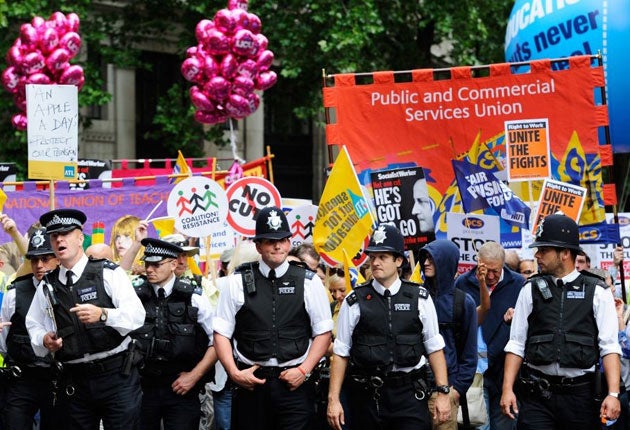
Protests were staged in about 80 towns and cities. After a march by 20,000 protesters in London, 37 people were arrested for offences including possession of drugs, criminal damage, breach of the peace and an alleged breach of a by-law at Trafalgar Square. One police officer and six members of the public have been injured but Scotland Yard said scenes have been "largely peaceful".
Downing Street said essential services had been maintained, with only a "minimal impact" on services such as courts, 999 calls, passport controls and job centres. The Government said 105,890 civil servants walked out, meaning that 80 per cent of the civil service worked normally. The Public and Commercial Services Union (PCS) insisted the figure was double that in its biggest-ever strike.
The Department for Education said 11,114 of the 21,500 state schools in England were affected, with 5,679 shut, and another 4,999 partially closed. Some 201 academies and city technology colleges were also shut, while 235 remained partially open.
Both the ATL and the National Union of Teachers insisted the figure was a lot higher, with 85 per cent of schools disrupted.
Mark Serwotka, the PCS general secretary, warned that the ranks of the strikers would grow to four million by the autumn unless ministers backed down. He said the action would be "much, much bigger and will involve more unions". PCS members began a month-long ban on overtime at midnight, which Mr Serwotka said would hit work in job centres, passport and benefit offices and government departments. He also attacked Mr Miliband, saying his personal ratings would "rocket" if he had supported the public-sector workers.
The Treasury wants a deal by November so that higher contribution rates, smaller pensions and a later retirement date can start to be introduced from next April. Hardline unions plan to build up the pressure during the TUC and Labour conferences in September and the Tory conference the following month.
However, other union leaders were more cautious about a wave of strikes last night, saying there would now be a "pause for peace" and a serious attempt at reaching a settlement on pensions when negotiations resume next week. They said the Government would have to make concessions to avoid alienating the general public.
Francis Maude, the Cabinet Office minister, said: "The vast majority of hard-working public-sector employees do not support today's premature strike and have come into work. I am not at all surprised by the very low turnout for today's action – less than half of PCS's own members chose to take part. Very few civil servants wanted this strike at all – less than 10 per cent of them voted for it – and they are right."
Brendan Barber, the TUC general secretary, said the level of disruption was not the key measure of the strikes. "The Government can say 'well it didn't have quite as much impact on services as it might have had,' but that's not what I see as the key measure. The key measure is that many, many hundreds of thousands of public service workers said, 'look, what the Government is doing is simply not working, not justified', and the Government should listen to that."
Speaking at a rally in Exeter, Mr Barber also took a sideswipe at Mr Miliband. "I think maybe Labour should be speaking up a little more powerfully to explain that that settlement [under the last government] was a sensible, fair-minded settlement and it is not justified to open it up in the way that the Government is seeking to do," he said.
Mr Miliband said the Government had been "high-handed and arrogant" and he understood the anger of workers who feel they are being singled out by a "reckless and provocative Government". But he told the Local Government Association conference in Birmingham: "I also believe this action is wrong. Negotiations are ongoing, so it is a mistake to go on strike because of the effect on the people who rely upon those services. And it is a mistake because it will not help to win the argument."
Manning the picket lines: A day of strikes
* Almost 100 tax collectors, VAT officers and administrative staff joined students and activists outside the HMRC office in Euston Road, central London, where UK Uncut fed the crowd a cooked breakfast.
* Michael Gove, the Education Secretary, slipped in the back door of his department to avoid civil servants picketing the building. PCS claimed that most of its 600 members in the Department for Education – more than half of its civil service workforce – had supported the strike. A small picket of about a dozen activists was mounted outside the building from 7am.
* Crown, county and magistrates' courts across the UK were disrupted. A trial at Southwark Crown Court did not sit after jurors refused to cross the picket line, while only five people turned up for work at Liverpool Crown Court, with all jury trials cancelled.
* More than 1,600 workers marched in Brighton and Hove, 1,500 in Sheffield, 6,000 in Newcastle and 5,000 in Manchester. The protests in Exeter culminated in a rally, where the singer-songwriter Billy Bragg performed.
* 95 per cent of police communication staff in London went on strike, with an additional 200 officers being bought in to cover, the Met announced.
* The NUT said 95 per cent of schools were closed in Brighton and Hove, while only five schools in Liverpool were unaffected by the strike.
* The Met said 37 people were arrested at the London rally for offences including breach of the peace, criminal damage and possession of drugs.
Sarah Morrison
Subscribe to Independent Premium to bookmark this article
Want to bookmark your favourite articles and stories to read or reference later? Start your Independent Premium subscription today.
Join our commenting forum
Join thought-provoking conversations, follow other Independent readers and see their replies