Labour and Tories woo kingmaker Nick Clegg
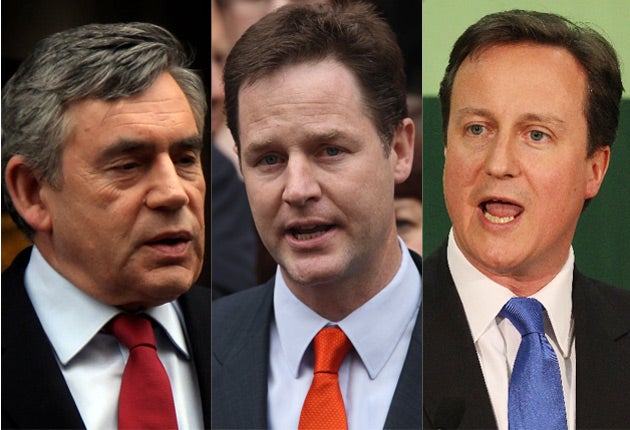
Britain was today plunged into uncertainty over its future government, as both Labour and the Conservatives competed for the support of the Liberal Democrats to form an administration.
Nick Clegg today held talks with David Cameron on the Tory leader's "big, open and comprehensive offer" to Lib Dems, which could see the third party provide ministers in a coalition Cabinet.
Liberal Democrat sources tonight said the two men had agreed they should "explore further" plans for economic and political reform.
But Gordon Brown - who remains Prime Minister until the resolution of the impasse caused by yesterday's inconclusive General Election - made clear that he was ready to deliver immediate legislation for a referendum on the Lib Dems' cherished goal of electoral reform if Mr Clegg signs up to a deal to keep him in Downing Street.
A dramatic day of offer and counter-offer was set in train by an election which produced the UK's first hung Parliament since 1974.
With a single seat left to declare, Conservatives had secured 306 MPs in the new House of Commons - an increase of 97 in their parliamentary representation, but 20 short of the 326 threshold for an outright majority. Labour were on 258, after losing 91 seats, and Liberal Democrats were down five on 57.
Despite admitting "disappointment" at his party's failure to translate the surge of support it enjoyed after the televised leaders' debates into votes and seats, Mr Clegg was thrust into the role of kingmaker.
He put the ball firmly in Mr Cameron's court by declaring that, as the party with most seats and votes, the Conservatives had the "first right" to seek to form a government. He challenged them to show themselves "capable of seeking to govern in the national interest".
But he was subjected to determined wooing from Labour, with first senior ministers like Lord Mandelson and Peter Hain making clear the party's readiness to offer a deal on electoral reform, and then Mr Brown himself making a direct overture.
In a statement outside 10 Downing Street, Mr Brown committed himself to immediate legislation for a referendum on a "fairer voting system" - with the public to decide what that system should be.
Less than an hour later, Mr Cameron made his own offer, including an all-party committee of inquiry on political and electoral reform to look at the possibility of changing Westminster's first-past-the-post voting system.
This led to telephone talks between Mr Cameron and Mr Clegg, understood to have lasted about 10 minutes, after which a Lib Dem spokesman said: "They agreed that they should explore further proposals for a programme of economic and political reform."
Mr Cameron said he was ready to head a minority Conservative administration on a "confidence and supply" agreement, under which smaller parties committed themselves not to bring the government down in return for assurances on key policy areas.
But he made clear he would prefer a "stronger, more stable, more collaborative" arrangement which would enable the country to have a settled government at a time of grave economic difficulties.
The pound plunged by 2% against the dollar and euro, while the FTSE 100 Index fell 2.6% over the day, as markets took fright at the prospect of a hung Parliament.
Shadow foreign secretary William Hague - Mr Cameron's effective deputy - made clear that the Tory leader was ready to consider anything from an informal agreement on co-operation to a fully-fledged coalition with places at the Cabinet table for Liberal Democrats.
Mr Hague is to form part of the Tory negotiation team, alongside shadow chancellor George Osborne, policy supremo Oliver Letwin and Mr Cameron's chief of staff Ed Llewellyn.
Speaking on the neutral ground of Westminster's St Stephen's Club, Mr Cameron said: "The Conservative Party has always been a party that puts the national interest first.
"And the best thing - the national interest thing - the best thing for Britain now is a new government that works together in that national interest and I hope with all my heart that is something that we can achieve."
He said a new administration should be in place "as quickly as possible for the good of the country" and gave short shrift to the idea that Mr Brown could remain in office, pointedly referring to the "outgoing Labour government".
The Tory leader signalled his readiness to drive through Lib Dem priorities, including scrapping ID cards, promoting green industries and helping poorer schoolchildren, and to work together on a version of Mr Clegg's flagship policy of taking earnings under £10,000 out of income tax.
But he assured Tory activists he would give no ground on Europe, the Trident nuclear deterrent, immigration or the need to start paying down Britain's record £163 billion deficit this year.
Tory sources described Mr Cameron's later phone conversation with the Lib Dem leader as "convivial".
Mr Brown said he respected Mr Clegg's decision to talk first to Mr Cameron, and said the two men should be given "as much time as they feel necessary" to sound out whether a deal between them is possible.
But he added: "Should the discussions between them come to nothing, then I would, of course, be prepared to discuss with Mr Clegg the areas where there may be measures of agreement between our two parties."
Lib Dems and Labour shared "common ground" not only on electoral reform but also on the economy, and the need for state support to continue until the recovery from recession is firmly in place, he said.
In a statement leaving no doubt that he has no intention of stepping down immediately as Prime Minister, Mr Brown said: "What all of us need to be mindful of is the imperative for a strong and stable government and for that to be formed with the authority to tackle the challenges ahead and one which can command support in Parliament.
"It is with this in mind that all of us should be facing the times ahead.
"I understand - as I know my fellow party leaders do - that people don't like the uncertainty or want it to be prolonged.
"We live, however, in a parliamentary democracy. The outcome has been delivered by the electorate. It is our responsibility now to make it work for the national good."
His Cabinet ally Ed Miliband indicated that informal discussions were already under way with Mr Clegg's party, telling BBC Radio 4's PM programme: "I'm sure there are contacts going on with the Lib Dems. I am not aware of the details of those."
But the shape of the new House of Commons makes it impossible for Labour and the Lib Dems to achieve an overall majority without the co-operation of smaller parties like the Welsh and Scottish nationalists, the SDLP and the UK's first Green MP. Scottish National Party leader Alex Salmond said his party and Plaid Cymru were ready to take part in talks on the future government.
Green Party leader Caroline Lucas's victory in Brighton Pavilion was one of the most memorable moments in an election night which delivered a number of surprises and removed several prominent MPs from Westminster.
Two former home secretaries, Jacqui Smith and Charles Clarke, lost their seats, along with a clutch of junior ministers including Shahid Malik, the first Muslim to hold a government post.
Prominent Lib Dems who suffered defeat included Lembit Opik, ousted by a massive swing to the Conservatives in Montgomeryshire, and Susan Kramer, who lost to environmentalist millionaire Tory Zac Goldsmith in Richmond Park.
And in Northern Ireland, Democratic Unionist leader Peter Robinson - damaged by recent revelations about his wife's private life - sensationally lost his East Belfast seat to the city's lord mayor Naomi Long, who becomes the non-sectarian Alliance Party's first MP.
The British National Party fell short of the breakthrough it was hoping for, with leader Nick Griffin trailing in third place in Barking. And the UK Independence Party's former leader Nigel Farage - recovering in hospital after an aircraft crash yesterday - failed in his bid to unseat Speaker John Bercow in Buckingham.
Join our commenting forum
Join thought-provoking conversations, follow other Independent readers and see their replies
Comments