Mandelson: Author of his own downfall ...
The war of words may have entertained the chattering classes for days, but publication of 'The Third Man', Lord Mandelson's memoirs, left him with scarcely a friend in the Labour Party
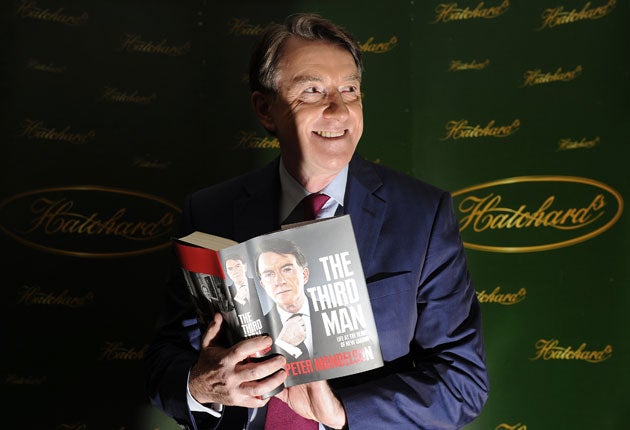
"This may seem an odd admission from someone who once embodied New Labour's reputation for spin and control freakery," Lord Mandelson says in the first paragraph of the introduction to his "frank, honest and revealing" memoirs, "but almost everything about this book is different from what I had imagined it would be."
Tell that to his friends, his enemies and everyone else in the Labour Party. They expected bitchiness, self-serving justification and cant and The Third Man gave it to them; they expected score-settling, distortions of the truth and a rewriting of Labour history, largely to the detriment of the author's many enemies, and he did not let them down. Or, rather, he did. Irretrievably.
Mandelson has come a long way within Labour: he has suffered general opprobrium and two cabinet resignations. But he did contribute to three election victories. Once, colleagues were conflicted about the Prince of Darkness – appalled by what he stood for, yet grudgingly appreciative of his talents. But now, after a week of all-out in-fighting, they feel free to revile him wholeheartedly. And it is all his own fault.
The spinmeister always stressed to his enemies in the party that he was at least as traditionally Labour as them. The second chapter of his book is entitled "Born into Labour".
"I was conscious of feeling somehow special," he recalls of a visit to Downing Street when a family friend, Harold Wilson, was prime minister. "Conscious, too, that part of that feeling had to do with the fact that my bond with Labour really began with my family. My mother was the only child of Herbert Morrison, the founding general secretary of the Labour Party in London, a minister in Ramsay MacDonald's 1929 government and the first Labour leader of the London County Council in the 1930s."
It never quite convinced, however, perhaps because his attachment appeared to be with Labour nobility rather than its grassroots. The dalliances with the rich and famous, with the Hindujas and the Deripaskas, served only to underline the distance between him and the party.
Even the Labour grandee Denis Healey, who was drawn to Mandelson by his family connections, now admits he has never been a fan. "I took an interest in him, due to his relationship to Herbert Morrison, who I knew very well," Lord Healey said. "I've read reviews of [the book] and little bits quoted in the papers, but he is not a chap who ever attracted me. I like people who are straightforward and pragmatic."
This was a view shared by many within Labour, albeit with more conviction – until, at their conference last year, Mandelson was presented with what he describes as "an unlikely last chance" to convince the party of his good intentions. "It was not just a matter of fulfilling Tony's memorable test for the success of New Labour: teaching the party to 'love Peter Mandelson'," he writes. "What I wanted to get across most of all was my own love for Labour, [and] my experience of its highs and lows over the past quarter of a century.
"From the first burst of applause, I knew that my genuine sense of homecoming was getting across and that the party – my party, from the moment I had first cared about and been entranced by politics – felt it too." Lord Mandelson recalls the delirium of his standing ovation, and the next day's papers, including a now-treasured Mirror front page declaring "We Love Mandy".
He adds, with epic self-satisfaction: "Improbable though it seemed, Labour had, at long last, learned to love Peter Mandelson."
But now, over two months, countless self-regarding interviews and 566 pages, Labour has conclusively managed to unlearn that lesson.
Mandelson has finally managed to put himself beyond the pale. Not only has the bulk of the Labour Party decided that he can safely be regarded as a pariah, but even his friends have joined the sniping. That Lord Prescott was "furious" about the book is no great surprise, but Mandelson's original mentor, Lord Kinnock, was described as "spitting". "It is a compendium of quotations for the enemy and a way of fixing a bank balance," the former Labour leader declared.
Tony Blair, meanwhile, is reliably described as "livid" – as much over the book's timing, before his own reaches the shops, as its content.
Mandelson's removal from New Labour's high command is complete. David Miliband has called the book "destructive and self-destructive" and his brother, Ed, declared it as "damaging to Peter, not just to the Labour Party". Andy Burnham said: "Peter loves the spotlight but it's time to leave the stage."
All of which raises the question of whether the man born into Labour really cares about the party anymore. Out of government, out of the Commons and with little hope of returning to either, it appears Mandelson has decided to decouple himself from the constraints of party politics and move on to the next stage of his life.
He might prefer to go back to Europe, but his book and interviews in recent days have raised the tantalising possibility of him becoming involved in David Cameron's big tent politics. The peer was less than excoriating when talking about the Tory leader last week (a good politician, albeit with no ideology) and has not ruled out working with him ("The Prime Minister? What would he do with me?").
He may at last be prepared to leave Labour to the Labourites, who are now involved in attempts to get past the Blair-Brown-Mandelson era (as he calls it) with a leadership election in the autumn. The final chapter of the book is called "The End of New Labour?". It might well be – although the list of young modernisers in the race suggests a return to Old Labour is implausible. More likely, it is the end of Peter Mandelson's lifelong attachment to the heart of the party.
Additional reporting by Mark Jewsbury, James Burton, Lyndsey Fineran and Claudine Harris
Join our commenting forum
Join thought-provoking conversations, follow other Independent readers and see their replies
Comments
Bookmark popover
Removed from bookmarks