Mandelson calls for more state activism to replace 'light touch'
Business Secretary admits Labour was 'spooked' about regulating the City
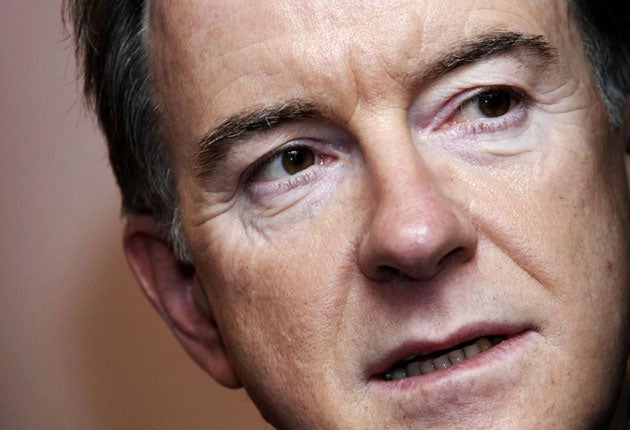
The Government will have to intervene more in the business world after the recession to ensure Britain equips its industries for the future, Lord Mandelson said last night.
The Business Secretary said New Labour had been too cautious about interfering in the private sector when it took power in 1997 as it tried to prove its economic credentials. He said Gordon Brown's ill-fated "light touch" City regulation would have to be replaced by a more active "right touch" system as he called for "a new balance" between the state and the private sector.
Lord Mandelson's blueprint for "industrial activism", outlined to a City audience at the Mansion House, is bound to provoke criticism that he seeks a return towards an Old Labour agenda in which Labour governments in the 1960s and 1970s intervened directly in business. He denies wanting the state to "pick winners" but believes that the Government will need to invest in hi-tech firms and growth industries to fight back after the downturn.
Insisting that the recession could provide a huge opportunity for Britain plc, he argued: "We will restore and rebuild, and we will emerge stronger and better. But we will emerge a different country. The shape of our economy, the drivers of its growth, our approach to the relationship between the private and public interest. These need to change."
Lord Mandelson said Britain would "fight its way back" by focusing on its strengths in hi-tech manufacturing, aerospace, automotive, biosciences and precision engineering; business, computer and financial services and the strongest creative sector in the world. "Kate Winslet was just the beginning," he said. While he rejected "British protectionism and economic nationalism", he said Labour would need to use the strategic role of government better to ensure high-value jobs and economic growth. "We've too often devalued our ability to build a stronger private sector through activist public policy," he said, "deferred to private-sector expertise without the balancing assumption that government must have a parallel expertise in shaping the world in which private enterprise operates. We've been so spooked – often rightly – by the very idea of 'state intervention' that we've been too cautious in asking what more we can do as a country to equip ourselves to compete in a global economy."
Calling for "responsible capitalism", he said it would require "a new sense of public responsibility and of the public interest in Britain. A sense that the same basic rules of responsibility and merit apply across the board. That a dynamic capitalist economy is not an end itself but a means to a stronger and more cohesive and prosperous society. A capitalism that builds for the long term as well as rewarding in the short term."
For banking, that would mean "a sounder, more sober model that would shape the expectations of a generation of businesses, especially small firms.
He promised a renewed focus on public sector reform and productivity, such as his controversial plan to sell off 30 per cent of the Royal Mail.
Then and now
"The case for economic reform rightly stresses the virtues of market opening, competition and liberalisation – pursuing the classic liberal consensus of 1990s Europe." Speech in Warsaw, 2002
"We used to talk about light touch: now it's going to be about the right touch... A dynamic capitalist economy is not an end itself but a means to a stronger and more cohesive and prosperous society." Mansion House speech last night
Join our commenting forum
Join thought-provoking conversations, follow other Independent readers and see their replies
Comments
Bookmark popover
Removed from bookmarks