Miliband backs Blair for EU presidency
Foreign Secretary denies he is candidate for key role in new Brussels leadership
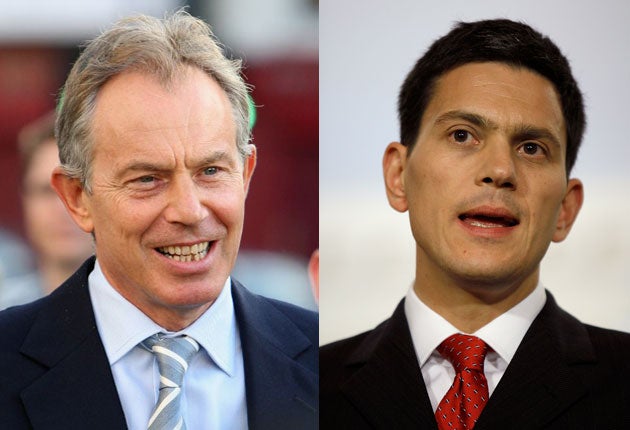
The EU needs a new president like Tony Blair, a big name whose arrival in a foreign capital would "stop the traffic", the Foreign Secretary said yesterday. David Miliband has been tipped in some European capitals to be the EU's first foreign minister, an appointment that would eliminate Mr Blair's chances of occupying the presidency, because it is unthinkable that both posts could be occupied by politicians from any one EU country.
But Mr Miliband made it plain that he would rather see Mr Blair in the top job. Asked about the second of the new jobs, he said: "I am not a candidate for that. I am not available."
The question of whether other EU countries want Mr Blair as their first president is looming larger since the Czech President, Vaclav Klaus, appeared to drop his opposition to the Lisbon Treaty, which could be ratified by the time EU leaders meet in Brussels on Thursday. The treaty, if Mr Klaus signs, will create the two new jobs, which eurosceptics see as another step towards the creation of a European superstate.
The Conservatives oppose the treaty outright, and have said they will call a referendum on it if they come to power before it is ratified. If it has been ratified, David Cameron will be under pressure from the eurosceptic right of his party to call a referendum anyway.
Opponents had been relying on President Klaus to hold out for them and prevent ratification. He opposed the treaty on the grounds that it might open the way for compensation claims from Germans whose families were deported after the Second World War. This objection was ridiculed yesterday by the former Chancellor, Ken Clarke, a long standing supporter of the EU, who described it as "the most nonsensical argument about the treaty I've ever heard".
Speaking on the BBC's Politics Show, Mr Clarke said: "He's the Boris Johnson of central Europe. Like Boris, he's intelligent and he's a rather huge personality. He also loves making mischief. But I suspect Czech politics and the Czech constitution will determine how far he can carry on delaying the treaty."
As a member of David Cameron's shadow Cabinet, Mr Clarke formally supports party policy in public, though it is well-known that he privately backs the treaty.
The government of other small EU nations which support the treaty oppose the idea of having a major political figure as president. They have a preference for a low-profile candidate who would do little more than chair meetings.
Mr Blair has not yet said whether he wants the job, if offered, but Mr Miliband, an ally and former adviser to the ex-prime minister, said that his decision was likely to depend on the nature of the job. "It is important for Europe that it has a strong figure in that role, that it has someone able persuasively to advocate the case that is decided by the 27 member states of the EU," he said. "It would be good for Britain as well as very good for Europe if Tony Blair was a candidate and was chosen.
"We need somebody who can do more than simply run through the agenda. We need someone who, when he or she lands in Beijing or Washington or Moscow, the traffic needs to stop. Europe has suffered from the lack of that clarity."
His comments drew a scathing reaction from the Conservatives. Mark Francois, the shadow minister for Europe, said: "David Miliband has shown that securing jobs for the boys is more important than respecting the democratic wishes of the British people."
Join our commenting forum
Join thought-provoking conversations, follow other Independent readers and see their replies
Comments