Nicolas Sarkozy tells David Cameron to 'shut up' in euro clash
Germany and France go some way towards détente, as Sarkozy targets the bulk of his anger at 'interfering' UK Prime Minister
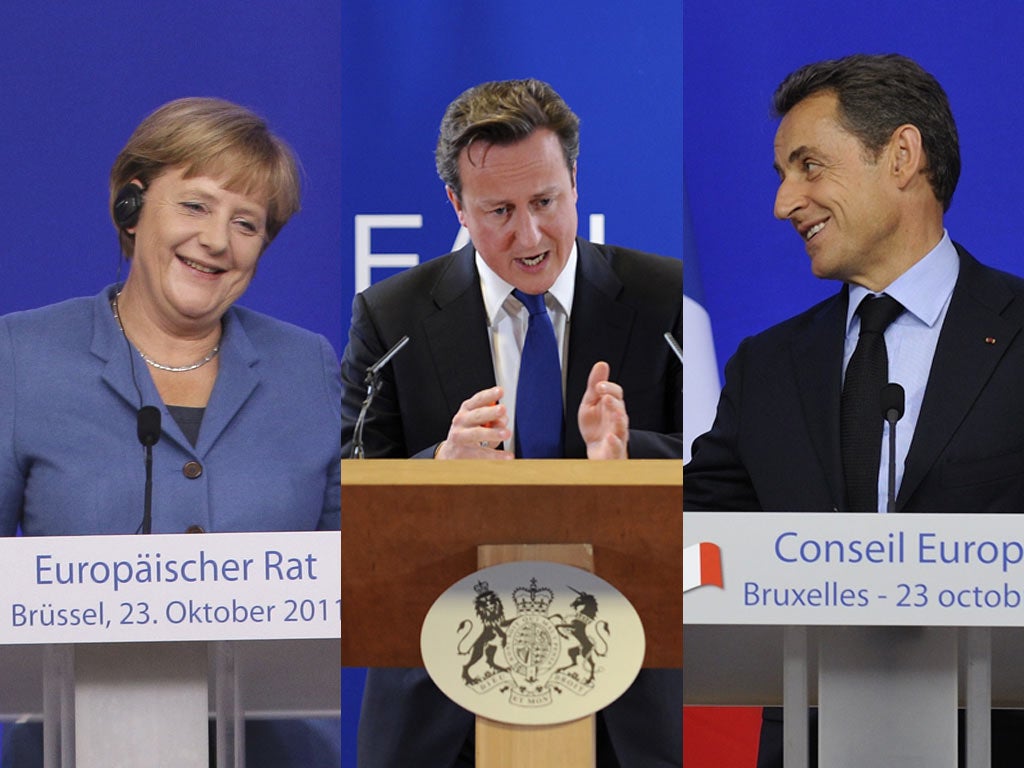
David Cameron was given a vicious dressing down by French President, Nicolas Sarkozy, yesterday as tensions reached boiling point among European leaders arguing over how to save the euro.
Mr Sarkozy was reported to have told the British Prime Minister that he should "shut up" during a meeting of the European Union's 27 leaders.
"We are sick of you criticising us and telling us what to do," he was quoted as saying by EU officials, losing patience at what he perceived to be Mr Cameron's hectoring from the single currency's sidelines. "You say you hate the euro and now you want to interfere in our meetings."
The personal frustrations came to the fore last night as they clashed over whether a second summit on Wednesday, when the final deal will be made, should include all EU states or merely the 17 Eurozone members.
Eventually a compromise was reached, whereby the UK will be included in a preliminary, one-hour meeting of the full EU contingent, before the final arrangements are hammered out by the Eurozone 17.
It was Mr Cameron's call for the Eurozone countries to "take responsibility" in the lead-up to yesterday's six-hour meeting that appeared to have angered Mr Sarkozy. But, beyond the row, Europe did move slowly towards a complex new system to prevent the debt crisis from destroying the Euro and tipping the world into recession, making progress towards the kind of comprehensive "Big Bazooka" deal which Britain and other countries have called for.
A more important stand-off, this time between France and Germany, over how to increase the fire-power of Euroland's dwindling €440bn bail-out fund, was resolved yesterday on German terms.
However, leaders of the 17 Eurozone nations called for more detailed study of two possible "models" for boosting the value of the European Financial Stability Facility (EFSF) to at least one trillion euros. These included inviting other countries, or private investors, including China, to invest in a new fund to insure, or guarantee, the debts of larger EU nations such as Italy or Spain.
Officials will try to reach an outline agreement which will be revealed to the German parliament tomorrow or the next day. European leaders will then return to Brussels on Wednesday night to try to complete the package.
This is expected to include a further partial, "orderly" default on Greek sovereign debt of up to 60 per cent, as well as a demand that European banks should increase their capital reserves by €108bn by next June.
The fourth element of the package will be an attempt to strengthen the fiscal rules governing the Eurozone, to reassure markets that similar debt crises cannot happen in the future.
European Council president, Herman van Rompuy, said that officials would try to resolve remaining differences today and tomorrow. Yet it remained unclear if this would prevent a meltdown on Asian markets overnight and European markets this morning.
In a symbolic gesture after reports of a poisonous break-down in Franco-German relations, President Nicolas Sarkozy and Chancellor Angela Merkel held a joint press conference in Brussels.
On the question of a big increase in the firepower of the European debt bail-out fund, Mr Sarkozy said "a rather broad agreement" was "being drawn up".
Chancellor Merkel said bluntly that the approach originally demanded by France – turning the EFSF into a bank which could borrow or print unlimited funds – would be "illegal".
Work would therefore continue on the "two other options" identified by EU finance ministers on Saturday.
These are understood to include the German idea that the EFSF should become not a bank but a kind of insurance company.
EU exit: The changes
Politics
Critics argue that the UK could withdraw and be exempt from the Union's political remit, while maintaining its economic links. But, in order to enjoy the economic benefits of the single market, other EU members would demand that Britain abide by almost all of the EU's existing body of laws. Pro-Europeans say that, without the EU, Britain's voice in international affairs would be increasingly irrelevant.
Oliver Wright
Environment
The legislation which has driven UK wildlife conservation and pollution control over the last four decades, from bird protection to the quality of bathing waters, has nearly all emanated from Brussels, in a series of very tough EU directives which have been far stronger than previous domestic laws. Even though they have been transposed into British law, withdrawal from the EU might well cause them to be scrapped.
Michael McCarthy
Economy
The economic benefits of Britain pulling out of the EU are simple to quantify. We would no longer have to make a net contribution to the budget of around £6bn a year (less than 0.5 per cent of our GDP). The costs of such a rupture are much more uncertain, but that doesn't mean they're not significant.
The EU is by far Britain largest trading partner. Some 57 per cent of our exports go there and 55 per cent of imports come from there. If Britain were to pull out, we would presumably negotiate a free trade agreement, but would have no input on the regulations that govern the single market. And the EU is good for consumers as well as businesses.
Ben Chu
Travel
Restrained joy: that would be the response from much of the travel industry to Britain's exit. That is not because you will find significant anti-European feelings; rather, it is because of two small words.
"Duty free" is music to the ears of the travel business. More than a decade after cheap cigarettes and alcohol were ended for intra-EU journeys, airports and airlines are still feeling bruised. Passengers to Switzerland, Croatia and Turkey still benefit from what is effectively a subsidy from the Exchequer. Restoring the traveller's rights to spirits and wine, plus 200 cigarettes, would lead to a surge in sales – and profits for the industry.
Simon Calder
Join our commenting forum
Join thought-provoking conversations, follow other Independent readers and see their replies
Comments