Osborne's watchdog sounds alarm on economy
UK unlikely to meet its growth targets, warns OBR chief
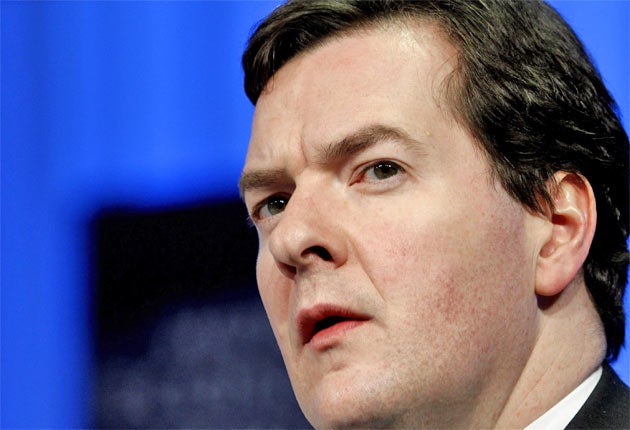
The head of the Government's fiscal watchdog, the Office for Budget Responsibility, has all but admitted that the official growth target for this year, announced in George Osborne's March Budget, will be missed, and that current growth could be "relatively weak".
Click HERE to view graphic (92k jpg)
Robert Chote, chairman of the OBR, indicated in an interview with The Independent that the Chancellor will almost inevitably downgrade growth again when he makes his Autumn Statement – the fourth such cut since Alistair Darling delivered the last Budget of the Labour government in 2010.
Mr Chote's remarks will fuel an increasingly acrimonious political debate about whether the Government is "cutting too fast and too deep", and damaging the recovery unnecessarily, as Labour claims. Calls for the Treasury to produce a "Plan B" or even a "Plan A+" have so far failed to provoke a positive response, and No 10 is increasingly restive about the lack of a credible "plan for growth".
Mr Chote said: "Back in March our central forecast was for 1.7 per cent growth this year, which at the time was fractionally more pessimistic than the average of the outside forecasters.
"Since then obviously we've had weaker out-turns in the first and second quarters than most people, including us, anticipated. For the second quarter the ONS [Office for National Statistics] explained a variety of one-off factors that contributed to that.
"As a simple matter of arithmetic, in order to get to 1.7 per cent now you'd be looking for quarter-on-quarter growth rates of 1 per cent in the second and third quarters of 2011, and there aren't many people out there expecting that."
He added: "Looking forward to the next quarter, in the March forecast we had 0.5 per cent for the third quarter. Now there are various indicators saying the third quarter will be relatively weak, but on the other hand there were special factors in the second quarter so there may be bounce-back there. There are potential pressures in both directions."
Official data shows the economy has "flatlined" for the past nine months. The IMF this week warned that Britain faces a "bumpy and uneven" recovery and chopped its growth forecast from 1.7 to 1.5 per cent.
Many economists have said that such sluggish growth – the slowest economic recovery in a century – means that the Chancellor will also fail to hit his borrowing targets.
The National Institute for Economic and Social Research this week said Mr Osborne will miss his target of balancing the cyclically adjusted current budget by 2015-16 by around 1 per cent of GDP.
It added that "in the short-term, fiscal policy is too tight, and a modest loosening would improve prospects for output and employment with little or no negative effect on fiscal credibility".
However Mr Chote believes that the public finances may remain on track because tax revenues move in step with inflation, which has proved higher than expected.
The OBR chief commented: "If you do have a combination of somewhat weaker growth and higher inflation, that potentially may explain why you haven't seen much impact of weaker output growth on tax revenues and on public finances, but it's very early in the financial year to take a view on that."
He stressed that the OBR was not producing any new forecast until later in the year, whenever the Chancellor chooses a date for his Autumn Statement. Last year it took place in November, but the longer the OBR sticks formally to its existing numbers the more out of touch it appears, though Mr Chote's remarks yesterday indicate he is well aware of developments in the economy.
There was some good news for ministers, with the release of data showing relatively strong confidence in the service sector, some 70 per cent of the economy.
The industrial revival appears to have run out of steam, however, and British business is currently sitting on a £60bn cash pile, unwilling to invest in the future at a time of acute political and economic uncertainty.
The extent of the continuing crisis in the eurozone – now threatening to engulf Italy and Spain – and the debt ceiling wrangle in Washington are just two of the dangers facing the economy that were not completely foreseen at the time of the Budget in March.
Next week the Bank of England unveils its definitive view of the nation's prospects. The Bank will announce its latest move on interest rates and quantitative easing today, with both expected to be left on hold.
A Treasury spokesman said: "The economy is growing and creating jobs. The service sector has been showing continual growth and July's figures showed its strongest level for four months.
"The difficult decisions the Government has taken to reduce the deficit is essential for sustainable growth."
Join our commenting forum
Join thought-provoking conversations, follow other Independent readers and see their replies
Comments