Police raid that sparked a constitutional crisis
It started with a phone call but exploded into a crisis that threatens to engulf the Speaker and Britain's top police officer
One of the lowest of the low points in the fortunes of Gordon Brown's government came last November when highly damaging documents leaked out of the Home Office. They showed that 5,000 or more illegal immigrants had been allowed to work as security guards.
Worse than that, the Home Secretary, Jacqui Smith, had known about the scandal since July but had ordered her officials to keep it quiet because she did not have an explanation "good enough for press officers or ministers to use". It appeared that she had been caught red-handed, suppressing sensitive information while the Prime Minister was considering whether to call a quick general election.
The question that troubled its top civil servant, the Permanent Secretary Sir David Normington, was how the information got out. Whitehall mandarins take professional pride in their discretion. They see, they hear, but they never tell.
The Home Office went through an embarrassing experience four years ago, when confidential documents found their way to The Sunday Times. The leaks ended when police arrested a 23-year-old woman working in the Cabinet Office, who had an ambition to be a journalist. The fear that crossed Sir David's mind was that someone else whose career ambitions lay outside Whitehall had entered its portals to give away secrets.
According to Home Office sources, there were about 20 leaks in 15 months; but the list of people who had sight of the documents was too long to pinpoint the source. So Sir David and his senior officials waited for the culprit to slip up. That slip-up was made, it now appears, in August, when the Tories were passed a document that seemed to be a letter from Ms Smith to Mr Brown, warning that crime figures would rise in the coming recession. According to the Home Office, that document was only a draft; the letter was never sent, and Ms Smith had not agreed its contents. That narrowed down the number of people who had sight of it.
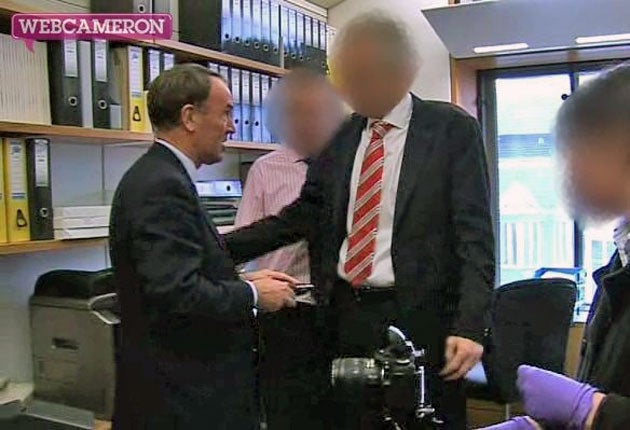
Neither the Home Office nor the Metropolitan Police will say exactly when Scotland Yard was called in to catch the leaker but it is quite likely that Sir David waited until his officials had a good idea who it was and needed the police to find proof. In that case, the inquiry was made all the more complicated by the instability at the top of Scotland Yard. The former Metropolitan Police Commissioner, Sir Ian Blair, had handed in his resignation. Applications for his job were due on Monday of this week. As expected, the 11 applicants included Sir Paul Stephenson, the acting Commissioner, and Bob Quick, head of the anti-terrorism squad – the two men charged with helping find the Home Office mole. At 5.50am, on 19 November, officers from Mr Quick's anti-terrorist squad arrested Christopher Galley, a 26-year-old Home Office civil servant. They questioned him for 17 hours, during which he admitted he had approached the Tories in May 2006 because he was not impressed with the way the Home Office handled immigration; that six months later, he had applied to the Conservative immigration spokesman, Damian Green, for a job but had been turned down, and that he had regularly supplied him with documents. As his interrogators listened, they became increasingly interested in the part played by Mr Green. Though it is not an offence to be the passive recipient of leaked documents, anyone who incites a public servant to break a confidence is risking prosecution. The police decided it was "time that Mr Green had his collar felt".
For an MP to be arrested for carrying out his political work is almost without precedent in Britain since the reign of Charles I. Sending three police officers to search his Commons office was every bit as sensitive, given the English civil war was fought over the principle of whether the King's men should be allowed to barge into the Commons. To cover his lines, Sir Paul made three phone calls shortly before Mr Green's arrest. At 10am on Thursday, he rang the London Mayor Boris Johnson, who also chairs the Metropolitan Police Authority, to say an MP was to be arrested. At 1.20pm, he rang Mr Johnson again, and told him who the MP was. Mr Johnson exploded and went public in his criticism of the operation. Twenty-five minutes after that conversation, Sir Paul rang Sir David to impart the same information. Sir David then tried to contact Ms Smith but the Home Secretary was in a meeting in Brussels. She got the message at 2.15pm – about 20 minutes after Mr Green's arrest.
Meanwhile, Mr Quick visited Parliament on Wednesday, to tell the Serjeant-at-Arms, Jill Pay, that they wanted to search an MP's office the next day. She apparently said to the Clerk of the Commons, Malcolm Jack, that Mr Quick had told her that the Director of Public Prosecutions, Keir Starmer, had approved the next day's police raid. Whether the policeman really said that, or whether she misunderstood him, the statement was simply untrue. Mr Starmer was not told in advance. It appears that the Clerk of the Commons approved the raid under a misapprehension.
We will hear what the Speaker, Michael Martin, has to say today, but reportedly his line is that he was "informed" in advance but was not asked to give his approval, as if he had no opinion about the prospect of detectives raiding an MP's parliamentary office. How – some MPs are asking – can they go on digging out information to hold the Government to account, if they risk having their homes and offices raided by the police? If Mr Martin cannot reassure them, he need not be too surprised if some MPs start saying that they want a Speaker who can do a better job of standing up for them.
Molehunt: The players in a Westminster drama
Christopher Galley
The young civil servant may have been acting simply because he did not think the Home Office was properly run. But he had previously attempted to secure a job with the Conservative Party.
Damian Green
He was a Tory high flyer but backed the wrong candidates in successive Tory leadership contests. Perhaps this furore will earn him a place in the Shadow Cabinet, which some think he could have been awarded long ago.
Michael Martin
Has been accused of being too tribally attached to Labour to put Parliament's interests above the government's. Today, MPs will be listening to hear whose side he is now on. Some want to get rid of him.
Sir Paul Stephenson
The acting Commissioner was the front-runner to succeed Ian Blair until the row over the arrest of Damian Green blew up. Now the bookies' odds on his success have lengthened.
Join our commenting forum
Join thought-provoking conversations, follow other Independent readers and see their replies
Comments
Bookmark popover
Removed from bookmarks