UK

Mostly Cloudy with Showers 8° London Hi 8°C / Lo 4°C

Poll of polls shows Labour at its most unpopular since 1935
By Nigel Morris, Home Affairs Correspondent
Wednesday, 6 August 2008

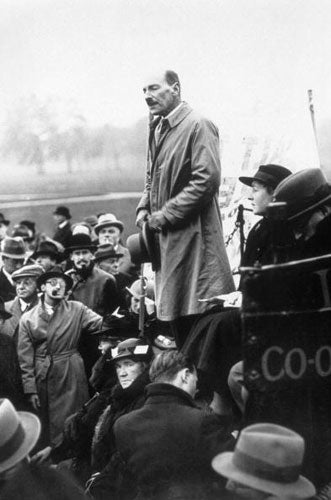
Clement Attlee, the Labour leader from 1935 to 1955, addresses a crowd in Hyde Park during the 1935 election campaign

HULTON/GETTY

Clement Attlee, the Labour leader from 1935 to 1955, addresses a crowd in Hyde Park during the dark days of the 1935 election campaign

Gordon Brown is leading Labour to its worst electoral defeat since the 1930s, according to a new "poll of polls" for The Independent. On current levels of support, Labour would lose almost half its MPs at the next election and David Cameron would become Prime Minister with an overwhelming majority.

The backlash against Labour has left the party with the support of just 27 per cent of voters, the weighted average of last month's polls for The Independent shows. The Tories are on 44 per cent, with the Liberal Democrats on 18 per cent. If that were reflected in a general election, the Tories would have 391 MPs and Labour would be banished to its heartlands with just 195 MPs. The cabinet ministers Alistair Darling, Jacqui Smith, Ruth Kelly and John Hutton would be among the prominent figures to lose their seats. The last time so few Labour candidates were returned in an election was in 1935.

Mr Cameron's majority would be 132 – close to Tony Blair's margin of victory in the 1997 and 2001 Labour landslides – almost certainly enough to assure a decade of Conservative government.

The Liberal Democrats, under threat from a reviving Tory party in dozens of seats, would fall from 63 to 33 seats, piling pressure on Nick Clegg's leadership.

The figures confirm the trend of the past three months, during which Labour has been defeated in two by-elections in previously safe seats and lost hundreds of councillors in the local elections. They provide further ammunition for Labour rebels planning an attempt to remove Mr Brown from office next month.

The Prime Minister's popularity ratings continue to plumb the depths, with Michael Foot the only recent Labour leader to be as unpopular. Critics will argue that public opinion of his abilities is so low that he cannot recover.

As Mr Brown plans an economic recovery package, the research demonstrates that the Tories consistently outpoll Labour for perceived economic competence.

But in a further blow for Mr Brown, it was reported last night that David Miliband had lined up the former cabinet minister Alan Milburn to be Chancellor of the Exchequer if he takes over from Gordon Brown as Prime Minister. The Daily Telegraph claimed the Foreign Secretary had been holding talks with the former health secretary about a senior role in a Miliband government.

John Curtice, professor of politics at Strathclyde University, who compiled the "poll of polls", said: "Claims by Labour that Mr Brown is best able to steer the country through the economic crisis are simply not believed. Labour's reputation for economic competence has been torn to shreds." Professor Curtice said the Tories were viewed as a government-in-waiting for the first time in 10 years. "Labour now finds itself facing a serious and respected opposition for the first time."

Less than 20 per cent of voters think Mr Brown is doing a good job and about the same number are dissatisfied with Labour's record. Levels of disillusionment with the Government are as high as they were with Margaret Thatcher's administration shortly before she was deposed in 1990. By contrast around half are expressing approval of the Tory leader. Professor Curtice said: "Mr Cameron remains relatively popular, and is thought more capable than Brown, but not all the stardust has transferred to his party."

Alistair Darling, the Chancellor, admitted yesterday Labour had lost the "conviction and zeal" that helped it win three elections under Tony Blair. But he insisted Mr Brown was the right person to lead the party.

The party's darkest days

The prospect of winning fewer than 200 seats will revive memories of Labour's darkest days in the 1930s. Following the great depression, the second Labour government imploded in 1931 after two years' rule when Prime Minister Ramsay MacDonald joined a National Government.

He was expelled from Labour and the events almost destroyed the party. Almost 80 per cent of Labour MPs, including their new leader, Arthur Henderson, lost their seats at that year's election with only 52 surviving the electoral massacre as theNational Government under MacDonald took power.

Labour was then beset by bitter rows over foreign policy which led to a party split. Henderson was succeeded as leader by George Lansbury, who was in turn replaced by his deputy, Clement Attlee. Under Attlee, the party managed a partial recovery in the 1935 election, when it won 154 seats with 38 per cent of the vote, as a National Government now led by the Tory Stanley Baldwin held on to power. Eight more were returned under the National Labour banner, along with four who stood for the Independent Labour Party.

Since then, the party has never had fewer than 200 representatives in the Commons, although it came close in the 1983 election when, under Michael Foot's leadership, it could only manage 209 seats at the height of Margaret Thatcher's Tory administration.

Interesting? Click here to explore further

Comments

50 Comments

Labour deserve everything they get for three terms of misrule and I, like many hope they're banished for at least ten years for all the damage they've done to the country. Labour apologists that claim the Tories are just as bad are totally missing the point by suggesting Labour should stay in power. You don't reward an incompetent, corrupt and ideologically flawed party by voting them back into power, you stomp on them hard until they learn some cold hard facts of life. Whether the Tories will prove to be as bad as the likes of Blair, Brown and all their sub normal sycophants is pure speculation but democracy is about giving them a chance. The country needs time to re-balance society away from the vindictive social engineering projects we've seen from Brown, Harman and all the other fascists inside the Labour party. For too long we've seen the trashing of everything we held dear in this country just to feed the egos & twisted policies of Labours mentally disturbed ministers.

Posted by Mike | 10.08.08, 17:38 GMT

Post a complaint

Please note all fields are required.

Contact details

There is serious talk here in Germany about ditching the PR system for elections and going for thhe British FPTP system. PR seems to lead to unrepresentative coalitions where the small parties hold the major parties to ransome.

Posted by Reggie von Zzugbach | 10.08.08, 14:42 GMT

Post a complaint

Please note all fields are required.

Contact details

Labour is down to its base core support. The ineveitability of a lamentable decade in power leading as usual when Labour exits power, national finances in a parlous state. History repeats itself.

Posted by Ian | 09.08.08, 20:29 GMT

Post a complaint

Please note all fields are required.

Contact details

Are we really surprised at this news!? I don't need a poll to tell me this NuLabour government are almost the worst, next to the last Labour government of the seventies, they screwed it up then too.

Posted by Lark | 09.08.08, 09:13 GMT

Post a complaint

Please note all fields are required.

Contact details

"The cabinet ministers Alistair Darling, Jacqui Smith, Ruth Kelly and John Hutton would be among the prominent figures to lose their seats."

At least there's a silver lining.

Posted by Michael | 07.08.08, 03:55 GMT

Post a complaint

Please note all fields are required.

Contact details

stuart

In UK terms, I think you might be looking at a Nationalist grouping as taking 3rd place at westminster.

Posted by Dave Taylor | 07.08.08, 02:38 GMT

Post a complaint

Please note all fields are required.

Contact details

Bill & Hazel

it would be a shock if gordon brown lost his seat but this is not out of the question with such an unppular govenment and as you say 100 to 150 seat in the next parliment would not be out of the question as i have stated my self the most likely outcome is labour at around 170 to 180 seats conservative 400 to 415 seats and ld's any seats would be good for them, but i do not think they will be in 2nd place after the next election maybe a good 3rd ith 10 or 20 more seats but not second by any margin

Posted by stuart gregory | 07.08.08, 00:27 GMT

Post a complaint

Please note all fields are required.

Contact details

Bill and Hazel

The Scottish figures were disaggregated from the recent YouGov poll. The sample was so small (175) as to make the results fairly meaningless. However, you may like to know that (if correct) the party share would be SNP 37% (35 MPs) Labour 27% (13 MPs) Tories 17% (5 seats) LibDems 14% (6 seats) Others 5% (0 seats) - even the SNP don't believe that this will be the actual result!

It makes no sense for the pollsters to continue sampling some imaginary "GB" political entity, when there are 3 distinct political structures. I quote the disaggregated data only to show the need for proper polling.

Posted by Dave Taylor | 06.08.08, 23:36 GMT

Post a complaint

Please note all fields are required.

Contact details

Typo alert! 'Politicians'............apologies for missing that.

Posted by silent hunter | 06.08.08, 23:28 GMT

Post a complaint

Please note all fields are required.

Contact details

Respectfully we would dispute these figures from the learned scholar, unless they are not quite explained in the best manner.

Better data would perhaps be obtained by breaking out the Scots and Welsh figures - looking at them seperately.

If this is done right at the polling data reception point, a breif and approximate scan of corrected data would show Labour support in England significantly lower than thought.

It is entirely posible this would in reality transpose to somewhere between 100 and 150 Labour seats in the next Parliament with the Lib Dems approaching being the formal opposition.

The "generally acknowledged" chief opposition party would not then emerge in shining glory until after the subsequant election. Who it would be will likely depend upon personalities and policies at that time. Only one thing is certain - at that time it will be a VERY different political, and possibly national landscape.

Posted by Bill & Hazel | 06.08.08, 22:54 GMT

Post a complaint

Please note all fields are required.

Contact details

50 Comments


Preparing for power

Article Archive

Day In a Page

Sun | Mon | Tue | Wed | Thu | Fri | Sat

Select date