The Big Question: What has Ken Livingstone achieved in eight years as Mayor of London?
Why are we asking this now?
The race to choose the next Mayor of London has begun. The main candidates are in place. This week, Ken Livingstone made his first manifesto pledge, that if he is re-elected, London's pensioners will be allowed free travel on public transport 24 hours a day. He has had his first head-to-head debate with his main rival, Boris Johnson.
He is also being targeted by a sustained media campaign, led by London's main newspaper, the Evening Standard; it is a rare day when it does not devote two or three pages to trashing Livingstone's reputation. On Monday, Channel 4 will join in, with a Dispatches programme which is expected to be filled with old and new allegations against London's Mayor.
Why is Livingstone so reviled?
The Mayor is the very opposite of the sort of bland politician who survives by taking no risks. He speaks his mind, he can be astonishingly rude, his private life has been through bad patches, and there are days when he seems to delight in stirring up controversy, drawing right-wing fury on his head like a man addicted to public disapproval.
What is he accused of?
The Standard's latest crop of allegations is directed at one of Livingstone's advisers, Lee Jasper, who is accused of putting pressure on the London Development Agency to award grants to friends and associates. He is not the first person connected to Livingstone to be caught in a media storm. The Metropolitan Police Commissioner, Ian Blair, and the London transport boss, Bob Kiley, whom Livingstone appointed to sort out the London Underground, are other examples.
Unlike Tony Blair, who abandoned ministers or advisers who were becoming an embarrassment, Livingstone always sticks by his allies when they are in trouble. That means that if Jasper is guilty of any wrongdoing, Livingstone will be dragged in.
What about his other connections?
Livingstone has also courted controversy by inviting the Egyptian scholar Yusuf al-Qaradawi to London. The gay rights campaigner Peter Tatchell, who has admired Livingstone for years, was shocked that he should associate with someone whom Tatchell and others regarded as anti-Semitic, anti-gay, misogynist and, at best, ambivalent on the issue of suicide bombings. Livingstone has also acted as host to President Hugo Chavez, of Venezuela, with whom he did a deal for cheap oil.
And he likened a journalist named Oliver Finegold to a concentration camp guard, refusing to back down when Finegold pointed out that he was Jewish and therefore found the comparison particularly offensive. This exchange earned Livingstone a four-week suspension from office, imposed by a previously unheard of body called the Adjudication Panel for England. The suspension was overturned on appeal before it took effect.
Does Livingstone do anything apart from court controversy?
Livingstone's eight years as Mayor have been like his period as GLC leader in the 1980s when his achievements were buried in an avalanche of hostile publicity generated by a few of the things he said and did (many of which were more controversial then than they sound a generation later).
The polls suggest that most Londoners are much less interested in Livingstone's views on the Middle East than in street crime, and traffic congestion.
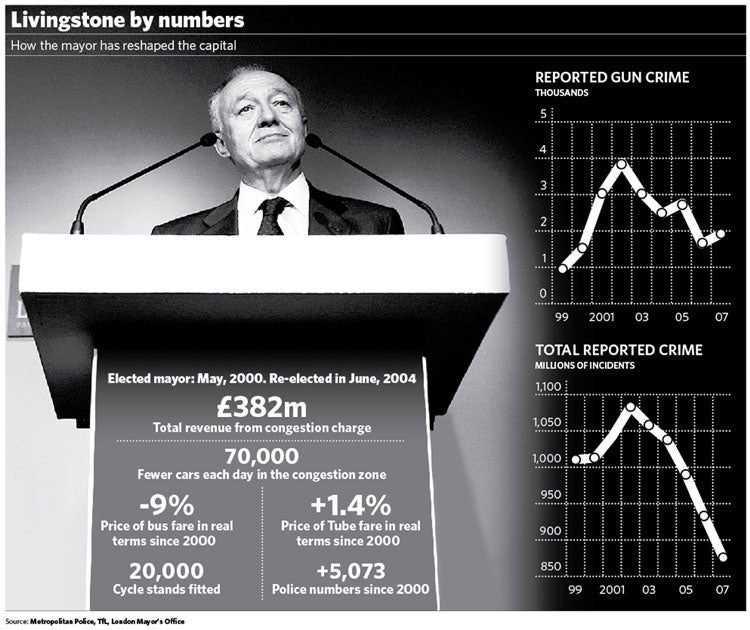
London was one of the world's most congested cities when Livingstone became Mayor in 2000. The one measure that really put people off driving into central London was the congestion charge, which was entirely Livingstone's achievement.
No government was going to risk an experiment that could incur the enmity of hundreds of thousands of car owners. Now that the charge is there, all the major parties are in favour of keeping it. New York City is thinking of copying it.
The issue in the current election is whether to leave it as is – as Livingstone proposes – or to rescind the extension of the zone into wealthy, Tory-voting west London.
The other way to cut congestion is through better and cheaper public transport. There are nearly two million more bus journeys made in London now than in 2000. Pensioners and schoolchildren have free travel. Bus and Underground fares have gone up, but passengers can avoid the worst increases by using an Oyster card. All of this has happened under Livingstone's stewardship.
Isn't Livingstone anti-police and anti-business?
Given his left-wing reputation, it surprises some people how Livingstone goes out of his way to back the Met Police and its much criticised commissioner, Ian Blair, whatever the political weather. On Livingstone's watch, police numbers have risen from 25,000 to 31,000. This has brought London's crime rate down. Despite the horrific stories about members of London teenage gangs killing one another, even the murder rate is down 28 per cent since 2004.
Livingstone has also put aside a lifelong antipathy to the capitalist system to join forces with the business community to draw investment into London and get houses built to help tackle the capital's housing problem.
What about the cost of running the mayor's office?
A recent report by the right-leaning think tank, the Centre for Policy Studies, claimed that in 2000, the mayor cost a Band D council tax payer £123. This year, the bill will be £289. And the cost will keep increasing next year if Livingstone is re-elected, the report claims. It adds that the wage bill at city hall has also been growing. Staffing costs have nearly trebled since his election victory in 2000, from £12m to £33m in 2005-06. Livingstone has also been criticised for making costly trips abroad.
So who's going to win the mayoral election?
There will be quite a long list of candidates in May. The Liberal Democrats have a strong candidate in the former Brixton police chief, Brian Paddick, but a YouGov poll published earlier this month put him on only 7 per cent, with 4 per cent for all other fringe candidates combined. The poll's most interesting findings were that Livingstone was on 45 per cent, and Boris Johnson on 44. This implies that the contest is too close to call, and that the outcome will depend on how the second preference votes of those who voted for other candidates are distributed. In the previous two mayoral elections, in 2000 and 2004, it was pretty clear from the outset that Livingstone was going to win. Now he is fighting for this political life.
So has Livingstone been a good thing for the capital?
Yes...
* Other candidates say they will cut London's crime rate. Livingstone has done it
* He was the first politician with the courage and vision to tackle London's traffic congestion
* He is a lifelong Londoner with strong ideas about how the capital should be run
No...
* His relations with radical Muslims and his attention-grabbing views make him unfit to speak for London
* Whatever he says about crime figures, Londoners do not feel any safer
* Livingstone has been Mayor for eight years, and is now 62. It's time for a change
Join our commenting forum
Join thought-provoking conversations, follow other Independent readers and see their replies
Comments