A pilgrimage to the end of the Northern line
Persecuted in Pakistan, followers of the 70-million strong Ahmadi Muslim sect will gather in London for the centenary of their leader's death. By Jerome Taylor
Jesus survived the crucifixion, went to find the lost tribes of Israel in Kashmir and died incognito at the age of 120. At least that's what followers of the Ahmadi Muslim sect believe.
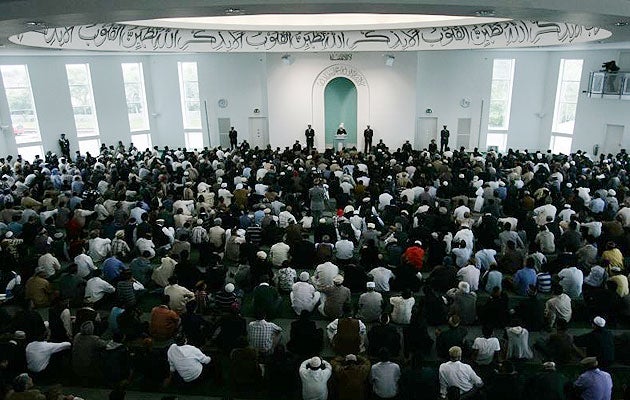
And this week representatives of the 70-million strong, pacifist global community are gathering at their global headquarters – the Baitul Futuh mosque in Morden, south-west London.
Since its construction five years ago the so-called "House of Victories", a flamboyantly converted dairy factory that towers over the suburbs, has been the primary place of worship for the world's Ahmadiyyas.
The Ahmadis are deemed heretical by many hardline Islamic authorities because of their belief that their 19th century founder was none other than the Mahdi – Islam's equivalent of the messiah – and the successor to the Prophet Mohamed.
With little aplomb or public fanfare, an estimated 40,000 Ahmadi pilgrims from more than 100 countries are making their way to the Baitul Futuh before heading into the Hampshire countryside this weekend for a exuberant three-day festival celebrating the centenary of their controversial founder's death.
That few people are even aware of their existence is partly due to the Ahmadis' desire to keep a low profile since their leaders were kicked out of Pakistan in the 1980s and sought refuge in the UK. The community's motto, "Love for all, hatred for none", emblazoned across the front of the mosque, shows their desire for a tolerant and inclusive world following decades of persecution.
But concerned by the rising levels of intolerance among both Muslims and non-Muslims, Britain's 15,000 Ahmadis are increasingly turning their sights on the small number of groups and imams who preach violent or extremist messages. In a rare interview, the community's fifth Khalifa (leader), Hadhrat Mirza Masroor Ahmad, told The Independent that he believed Ahmadism could help Muslims turn against extremism.
"Love for all, hatred for none is not just some slogan, we must practise it," he says. "The Holy Prophet –peace and blessings of Allah be on him – had said that there will be a time when lofty mosques will be built but they will be devoid of guidance. A mosque is truly useful when in it the dues of Allah and the dues of people are paid. Otherwise there are many mosques around the world which do not serve these purposes. They are mosques devoid of the lessons of love and peace."
Surrounded by bodyguards and dressed in a long grey tunic with a bright white turban, the Khalifa looks wedded to his Pakistani homeland where, under blasphemy laws, Ahmadis are banned from preaching because they are legally declared non-Muslims. "I still hold a Pakistani passport," he admits.
"It is a sad situation for me. We have a very big community in Pakistan but I cannot ever go there."
Founded in 1889by a charismatic Indian mullah, Had-hrat Mirza Ghulam Ahmad, Ahmadism became a controversial schism from the start because of his messianic claims.
The most concerted backlash began in Pakistan. Ahmadis had been instrumental in the movement to create Pakistan – the country's first foreign minister was an Ahmadi and a firm friend of Pakistan's founder Muhammad Ali Jinnah – but they soon fell foul of the hardline mullahs.
Both the supposedly moderate prime minister Zulfikar Ali Bhutto and the dictator General Zia-ul-Haq brought in increasingly oppressive legislation until Ahmadis were eventually banned from praying or issuing the Muslim "salaam" greeting. In 1984, with Zia threatening to arrest its leaders, the fourth Khalifa fled to Britain and began leading the world's Ahmadiyya community from the Fazal Mosque in Putney, London's oldest.
Cut off from its largest grouping of followers, the expulsion of Pakistan's Ahmadi leadership could have killed off the sect but satellite television and a modern marketing strategy saved it. Free to propagate their creed they set up their own TV station, MTA, and began broadcasting the Khalifa's Friday sermons in multiple languages. The internet has spread their message further, with audiences in west Africa in particular attracted to its tolerant message.
"We have always rejected the dogmatic approach to Islam that the extremists adopt," says Nasser Khan, one of five vice-presidents who, alongside an elected president, run the administrative affairs of Britain's Ahmadi community.
He proudly displays the Bibles and Ramayanas that sit next to the Korans in the Baitul Futuh's library. Pointing to a full set of the Zohar, one of Judaism's most important works of mysticism, he says: "A rabbi recently visited the library here and couldn't believe we had the full Zohar. He told me that he didn't even have a complete Zohar."
Sitting outside the library, Quasar and Usman, two of the 100 or so trainee-imams, are waiting to hear the Khalifa's latest sermon. Both of them emphasise the need to have British-born, streetwise imams who are capable of leading and understanding the next generation.
"My friends were surprised when I told them I wanted to become an imam," says 19-year-old Quasar, from Southall. "But it's important that people from my generation become imams, we understand the psychology of our own kind."
Dressed in Nike trainers and a hooded top, 17-year-old Usman agrees. "I was born and bred in Tooting," he says. "If I see kids messing about in the street I can go talk to them like a kid from the street."
Who are the Ahmadis?
Ahmadis are a messianic sect of Muslims who belong to the Sunni tradition but believe their 19th-century founder, Hadhrat Mirza Ghulam Ahmad, was the Mahdi (Islamic messiah) and a prophet following in the footsteps of Mohamed.
Like mainstream Muslims they believe in the five pillars of Islam and adhere to the fundamental tenets of the religion but their founder's claim to be a prophet puts them at odds with mainstream Islamic tradition which dictates Mohamed was the final prophet.
Following their founder's death in 1908 the community has been led by a series of elected "Khalifas". The current and fifth Khalifa, Hadhrat Mirza Masroor Ahmad, right, lives in London.
The founder believed an Islamic renaissance was needed to reacquaint the world' s Muslims with the true meaning of the Koran. Ahmadis also believe in the continuation of divine revelation through their Khalifas.
Join our commenting forum
Join thought-provoking conversations, follow other Independent readers and see their replies
Comments