Day the Vikings got their comeuppance
Discovery of 1,000-year-old mass grave in Dorset sheds light on brutal Anglo-Saxon victory over invaders
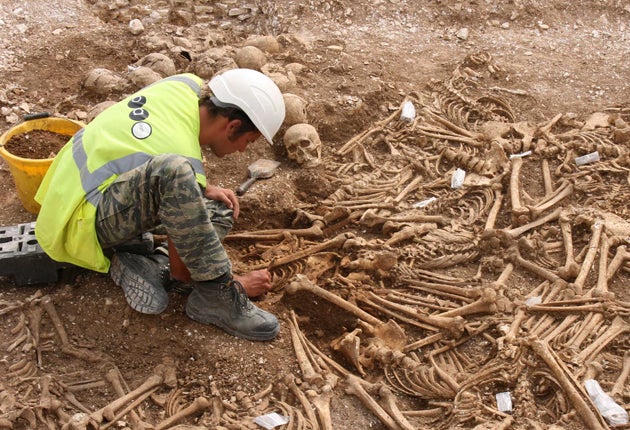
They were notorious for their ruthless attacks on England but the Vikings were also victims of Anglo-Saxon barbarism, new archaeological evidence from Dorset has revealed.
Detailed forensic examination of human remains found in a mass grave four miles north of Weymouth has found that 55 Viking warriors were executed and mutilated, almost certainly by an Anglo-Saxon death squad some time in the 10th or early 11th century. It is one of the most significant archaeological discoveries ever unearthed in Britain and is of international importance.
The most likely date the find dates back to is 1002, when the English king, Ethelred the Unready, deliberately broke a peace agreement and ordered his troops to kill any Viking soldiers they could find, specifically in south-west England. The slaughter, known as the St Brice's Day Massacre, took place on 13 November of that year.
The archaeological and scientific investigation of the Dorset mass grave material, carried out by specialists from Oxford Archaeology on behalf of Dorset County Council, suggests that the Viking warriors were taken completely by surprise, were probably forced to strip (no trace of any buckles, pins or other clothing-related items have been found), and were then decapitated (from the front – so they could see their executioners).
Most of their faces and many of their right ears were violently mutilated, probably with the same swords they had been killed with, said Angela Boyle, the osteologist who examined the bones.
Their bodies were then thrown into an empty quarry pit and their severed heads placed in a pile near the side. The improvised mass grave was then sealed with a layer of earth.
The scientific examination of the material has revealed that all the victims were tall, well-fed young males, mostly aged 17 to 25, with a small number of slightly older individuals. Isotopic examination of their teeth suggests that they all came from Scandinavia and immediately adjacent areas. One may have been from Iceland.
The St Brice's Day executions took place against a complex political background. In the mid- to late 990s, groups of Scandinavian mercenaries settled in Devon with English government agreement. Some rebellions and invasions followed until 1002, when the English government signed a peace agreement with the rebel West Country Vikings – who were allowed to re-settle in south-west England.
But Ethelred issued orders in November 1002 to kill every Viking mercenary who could be found.
One of the victims of St Brice's Day (although not one of those found in the Dorset pit) was the probable half-sister of the Danish/Norwegian king, Swein Forkbeard, who sought revenge by launching multiple attacks. In 1013, he succeeded in conquering England, forcing Ethelred to flee, and made himself king. Apart from a gap of two years, England remained part of the Danish empire until 1042 and continuing Danish claims to England led to a Danish invasion of northern England in 1066, which fatally distracted the English and helped hand ultimate victory to William the Conqueror.
"The Dorset discovery is extremely important – not only from an archaeological perspective but also from a historical one. For the St Brice's Day Massacre triggered a series of events which not only led to the Danish conquest of England but also helped bring about the Norman Conquest many years later," said the historian Dr Ian Howard.
"Any mass grave is a relatively rare find, but to find one on this scale, from this period of history, is extremely unusual," said David Score of Oxford Archaeology.
Join our commenting forum
Join thought-provoking conversations, follow other Independent readers and see their replies
Comments