Last reunion for war heroes who came home to fight the fascists
A brave band of British Jews returned after defeating Hitler to take on a new battle – against Mosley’s Blackshirts. Mark Gould reports

For free real time breaking news alerts sent straight to your inbox sign up to our breaking news emails
Sign up to our free breaking news emails
They returned from war hailed as heroes. But the demobbed British Jews who won medals defeating Hitler were horrified to see fascist salutes on the streets of Britain.
Oswald Mosley, whose British Union of Fascists preached anti-Semitism before the war, was released from internment in 1946. His Blackshirts, dressed like Nazi stormtroopers, were revived. Jewish houses were daubed with the letters PJ – Perish Judah. Jews were beaten and taunted in the streets: “Not enough Jews were burned in Belsen.” Something had to be done.
In April 1946, 43 men and women – war heroes including Gerry Flamberg, who won the Military Medal at Arnhem, and Tommy Gould, a submariner who won the Victoria Cross – formed the 43 Group.
Morris Beckman, another founder member, now 88, explained. “The authorities were doing nothing; we were seeing newsreels of Auschwitz. We decided that as trained troops we would ‘out-fascist the fascists’.”
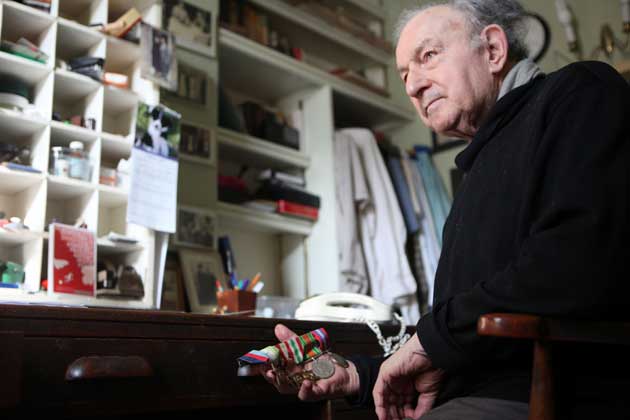
Last week, around 40 of the surviving street-fighters who fought British fascism to a standstill in a five-year guerrilla war held a last reunion to consider their achievements.
At a Jewish cultural centre in west London they displayed memorabilia, including Mosley’s prized personal standard and some of the graffiti that appeared on synagogues.
Mr Beckman recalled bloody battles in Ridley Road market, in what was then a Jewish area of Hackney, in east London. Mosley would stand on a van, nicknamed “the Elephant” because of its two massive ear-like loudspeakers, and stir up crowds with talk of the “alien” menace. “We would salt the crowd with groups who would fight among themselves, the police would be diverted and two wedges of commandos, the tough guys – ex-marines, guards and paras – would make for the platform and overturn it.”
By 1947 the group had more than 1,000 members: mainly in London, but also in Manchester, Birmingham, and Newcastle.
Maurice Podrow, 81, who was still in the RAF when he joined the group, admitted that at the time he was “very violent”. “At a meeting at Hyde Park Corner we couldn’t get at Mosley, so we picked on this big South African, one of his right-hand men,” he said. “I was pictured on the front of the Daily Mail punching him. My wing commander wasn’t very pleased.”
He wore a Polish army belt with a thick brass buckle “sharpened so it was a four-sided blade”. Knuckledusters, coshes, steel-capped boots and knives were used on both sides. The Blackshirts threw potatoes studded with razor blades.
Prominent Jews such as the boxing promoter Jack Solomons, who could not be seen to support street-fighting, sent donations. Every month the comedian Bud Flanagan sent a cheque for £30. Mr Beckman added that the actor Sydney Tafler helped the cause by mimicking Mosley’s hate rhetoric on a recording played to a group of Jewish businessmen. “They reached for their chequebooks, some of them donating £1,000.”
The group even considered kidnapping Mosley, stripping him and dumping him in Piccadilly Circus. Some non-Jewish supporters helped by infiltrating Mosley’s headquarters so the group knew in advance of his next meetings. Mr Beckman estimates that hundreds of meetings were broken up as a result. With support for Mosley dwindling, the 43 Group was disbanded in 1950.
The group was not without its critics, however. Some said its tactics perpetuated fascism and suggested that by ignoring Mosley his support would have faded sooner. But Mr Beckman is insistent: “In 1946 there were only two countries in Europe that allowed fascist parties – us and Franco’s Spain. Why did the authorities allow Mosley to go unchecked? Somebody had to do it, so we did.”
Subscribe to Independent Premium to bookmark this article
Want to bookmark your favourite articles and stories to read or reference later? Start your Independent Premium subscription today.
Join our commenting forum
Join thought-provoking conversations, follow other Independent readers and see their replies