'No one understood why I took my wife's surname'
When Kris Dyer chose to become Mr Myddelton, his friends turned against him
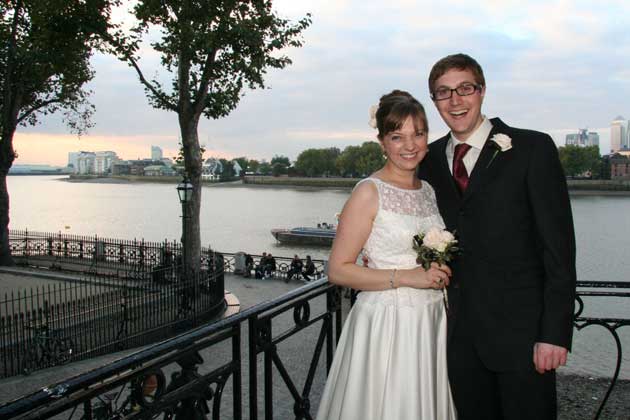
"Deny thy father and refuse thy name," sweetly demanded Shakespeare's most famous heroine. Yes, Juliet may have been rather pushy for a fictional prepubescent girl living in 16th-century Italy, but fast-forward to 2008 and a growing number of men are doing just what she asked.
When 29-year-old scriptwriter Kris Myddelton (né Dyer) married Jo last October, there was no question of who was wearing the trousers: it was him (she was in the traditional floor-sweeping white satin). But it was he who took her surname. "It may not be very butch," admits the groom, "but it is rather pleasantly twee."
If you're picturing a downtrodden, emasculated new-age hippie, you'd be wrong. Myddelton is keen to point out that the main reason behind their decision was simple: "My surname was rubbish and hers wasn't." In addition, Jo is an only child, so they decided that carrying on the family name seemed a "nice thing to do".
"I don't consider myself particularly avant-garde," he continues, "and I'm not flying the flag for metrosexuality – it just seemed a sensible idea at the time. What we hadn't prepared ourselves for is just how old-fashioned the rest of the world is."
Ignoring the drift of post-wedding cards addressed to Mr and Mrs Dyer, last May Myddelton paid £34 to change his name by Deed Poll. "There was no other way to do it," he says, "no box to tick on the marriage certificate [as there is for a woman taking a man's name]." Instead, there were several months of administrative hell: when the new Mr Myddelton sent letters to banks and mobile-phone companies to notify them of his name change, he was greeted with confusion. "It didn't seem an option. Instead, my wife started receiving mysterious letters congratulating her on her marriage and name change."
It was their friends who proved the fiercest reactionaries. "I always considered my friends to be pretty metropolitan, but they too seemed to have problems coming to terms with it," says Myddelton. "They thought I was joking; eventually I had to show them my new bank cards to get them to believe me. They kept asking 'Why?' People seemed vaguely disapproving, as if we were breaking a sacred rule."
Since weddings are increasingly non-traditional – from humanist ceremonies to female best "men" – such opposition is surprising. So why is this one element still such a sticking point?
Although surnames didn't even exist in Britain until the 13th century, the biblical story of Eve being formed from one of Adam's ribs cemented the idea of a woman as an "appendage" to her companion. That surnames came to follow this pattern is no surprise. Until the mid-20th century, marriage was a complex patriarchal exchange of money, status and property – of which women were a vital part; marriage signalling the woman's assimilation from her father's to her husband's estate. But things have moved on since then.
Martin, a 27-year-old groom-to-be, will follow in Kris Myddelton's footsteps. "Modern weddings are not about a man owning a woman," he says. "I am marrying an independent person with her own mind, her own life and her own job. When I take on my wife's family name, it's a positive move forward, as I believe women are equal to men – if not slightly better."
Aside from the ideological arguments, it is also pertinent to mention that Martin's surname is Willey – something both he and his bride are keen to leave behind.
Louise Bowers, a spokesperson for the UK Deed Poll Service, estimates that only about 50 per cent of women now take their husband's name. "Increasingly couples double-barrel, or 'mesh', their surnames together," she says – a trend gaining traction in America, where Los Angeles's mayor, Antonio Villaraigosa, famously became a "mesher" after combining his name, Villar, with his wife's, Raigosa.
However, Stephanie Gill, who has been married for seven years, sees a potential problem in this for future generations. While she flits between her maiden name and her husband's ("his for bills and bank accounts, mine for work"), her children have her husband's surname and her maiden name as a middle name. "Double-barrelled names sound pretentious," she says. "And what happens down the line? Our great-great grandchildren could have been lumbered with eight surnames."
Just as some couples choose to marry in an aquarium while others stick with a church, the question of a married name is a matter of taste. For the Myddeltons, the important thing was to choose a name to share."We share our money, our home, the housework – and one day we hope to share children," says Kris. "Sharing our name was one of the most appropriate ways we could think of to celebrate that."
Join our commenting forum
Join thought-provoking conversations, follow other Independent readers and see their replies
Comments
Bookmark popover
Removed from bookmarks