On sale for the first time: Van Gogh's final masterpiece
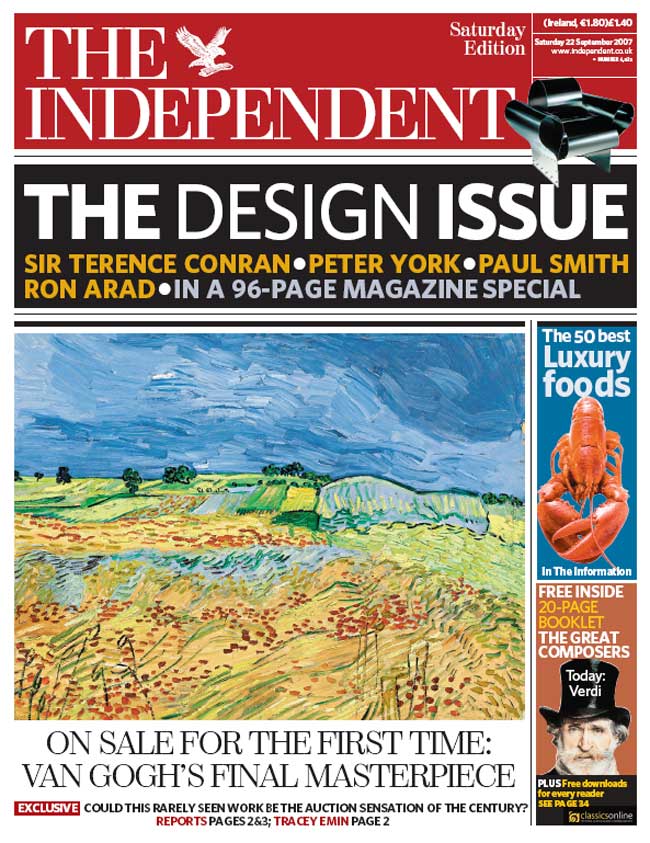
A Van Gogh masterpiece believed to be the artist's final piece of work is to be put on the public market for the first time, where it is expected to become one of the most highly-valued paintings ever auctioned.
The Fields (Wheat Fields) was completed on 10 July 1890, just 19 days before Vincent Van Gogh died. It hung in his room as he bled to death in his bed, where he had staggered after shooting himself in a field.
The work, only previously seen once in Britain, is one of just a few of Van Gogh's greatest works to remain in private hands and is celebrated for shedding significant light on the emotions felt by the artist in the days before his death.
The Fields will be unveiled at Sotheby's in London on 7 October and sold at auction in New York a month later with an estimated list price £17m.
But due to its extraordinary provenance and the booming art market, it is likely to provoke one of the heaviest bidding wars in the auction house's history and greatly exceed this price. When the painting was exhibited in Amsterdam in 2001, as a privately owned work, there was an immediate, if vain, rush by buyers to place offers.
"As a unique work of art from the final days of the artist's life, the price will most likely be driven by passion. This is perhaps the last opportunity for a collector to acquire a landscape of this quality by Vincent van Gogh," said a spokeswoman for Sotheby's. Van Gogh's brother, Theo, was so emotionally attached to the painting that he kept it in the family collection for 20 years before his widow, Johanna, finally sold it to a private collector, Paul Cassirer, in 1907.
Since then, it has remained in private collections, exchanging hands between collectors privately but never entering the public market.
David Norman, executive vice-president at Sotheby's, said that after Van Gogh's death, much of his work was sold to collectors but had not gone to public auction.
There has been much debate over the years as to which was the last piece Van Gogh worked on before committing suicide. A number of respected experts, including Walter Feilchenfeldt, the Swiss collector and Van Gogh scholar, believe that The Fields was the final creative project that the tormented artist undertook.
Many mistakenly believe Van Gogh's far more brooding painting, Wheat Field with Crows, which he also executed in the last year of his life, to be his final painting due to its gloomy overtones – which have led some to argue that it was Van Gogh's "suicide note". But although it conveys the melancholia that Van Gogh was feeling in his final weeks, there is evidence to suggest it was painted earlier. And in a letter written by Van Gogh to Theo on the 10 July, the artist described having just painted what experts believe to be The Fields, along with two other works.
He wrote: "They are vast fields of wheat under troubled skies, and I did not need to go out of my way to try to express sadness and extreme loneliness. I hope you see them soon – for I hope to bring them to see you in Paris as soon as possible, since I almost think that these canvases will tell you what I cannot say in words, the health and restorative forces that I see in the country," he said.
If it was the final work, The Fields illustrates how Van Gogh was able to separate his deep inner turmoil and stormy emotions from the hope and celebration of life that is instilled in this painting, said Mr Norman.
"Here is an artist literally on the verge of taking his life and filled with tremendous despondency, yet he is still painting with lemon yellows, azure blues and emerald greens.
"We know this is a man barely holding on to his will to live yet he is able to separate his energy and focus on what he sees before him," he added.
The Fields belongs to a celebrated series of canvases painted in early July 1890, in which the sprawling golden wheat field of Auvers-sur-Oise became the central subject that captured his imagination during his final weeks.
Living alone in the Ravoux Inn in Auvers, he would set up his easel and paint in solitude for hours. Loaned to various collections over the years; The Fields hung in the Van Gogh Museum in Amsterdam for six years alongside a series of moving landscapes painted in the final year of the artist's life. It was displayed in Britain for the first and only time in 1995 at a Royal Academy show.
Van Gogh had no formal artistic training and he did not embark on a career as a painter until 1880, spending his early life working for a firm of art dealers, and after a brief spell as a teacher, he became a missionary worker. Most of his best-known works were produced in the final two years of his life, during which time he cut off part of his left ear following a breakdown in his friendship with the artist, Paul Gauguin. After this he suffered recurrent bouts of mental illness, which led to his suicide.
On 8 May 1889 Van Gogh committed himself to the mental hospital in a former monastery in Saint Rémy de Provence, near Arles.
On 27 July, at the age of 37, he walked into the fields and shot himself in the chest with a revolver and staggered back to the inn at Auvers, not realising he had fatally wounded himself.
He died in his bed two days later, with Theo by his side, who is said to have reported his last words to be "La tristesse durera toujours" ("the sadness will last forever").
Join our commenting forum
Join thought-provoking conversations, follow other Independent readers and see their replies
Comments