Soaring fuel prices and green pressures herald comeback for Britain's waterways
Tesco and Eddie Stobart are among firms taking to the water to beat congestion and reduce costs. Hannah Godfrey reports
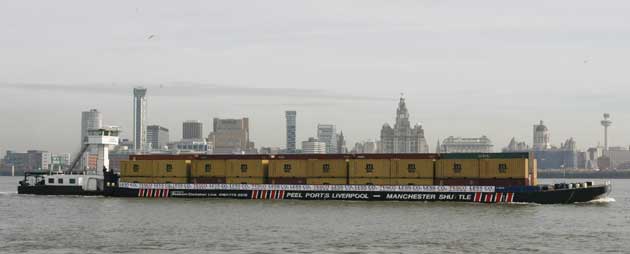
Britain's waterways are on the brink of an astonishing revival – and some of the UK's biggest trucking firms are leading the way. The UK's long-neglected latticework of canals and rivers, which once helped to jump-start the industrial revolution, are poised for a renaissance.
Growing traffic jams, rising fuel prices and environmental pressures are driving the boom, according to industry experts, to such an extent that many shipping and barge companies say they have received more inquiries about transporting goods by water in the past 18 months than they have had in 20 years. Some companies that have traditionally used roads are now appointing managers to mastermind their expansion on to water.
Eddie Stobart, one of the country's biggest road-haulage firms, has invested in a port on the Manchester Ship Canal and plans to expand its waterways routes. "It might seem odd that one of the goals of Britain's biggest branded truck company is to get trucks off the road, but that is exactly what we are trying to do," Julie Gaskell, a spokeswoman for the firm, said.
"It seems ironic that we are now looking to revive more traditional modes of transport, but new pressures such as congestion, rising fuel prices and the environment mean the old methods are becoming viable again," she added.
Several major companies, including Tesco and Sainsbury's, have already switched thousands of tons of freight on to ships and barges, while the international courier firm DHL is looking to move urgent mail from central London to Heathrow by speedboat to avoid congestion in the capital. Tesco transports new world wine by sea and water to its bottling plant at Irlam on the Manchester Ship Canal. The scheme, which involves three journeys a week and moves an estimated 600,000 litres of wine along a 40-mile stretch of the canal from Liverpool to Manchester, takes 50 lorries off the roads each week. Tesco says it plans to expand the scheme, saving an estimated 3,500 lorry movements by the year's end.
In London, Sainsbury's is considering shipping goods from a depot in south-east London to stores in west London via the Thames. On the Severn, Cemex, a manufacturer of cement and other building materials, is moving more than 270,000 tons of sand and gravel to its plant in Ryall in Worcestershire, saving around 34,000 lorry journeys a year.
Despite such moves to water, industry experts say the potential is being frustrated by a lack of planning and imagination by the Government, local authorities and British Waterways, the body which runs much of the UK's canal network.
A proposal to build a commercial wharf at Staines, near Heathrow, to enable cargo to be transferred down the Thames from Tilbury docks or the proposed Thames Gateway port, saving tens of thousands of lorry journeys around the M25 or through central London, was not pursued by the Environment Agency. The plan would have seen cargo switched to train or road at Staines to be transported to destinations in Wales and the west of England. If built in time, it could have also been used to move materials to and from Heathrow's Terminal 5.
British Waterways regards itself primarily as a "heritage and leisure organisation", and critics say it fails to give sufficient priority to freight. Vital wharves are being sold for waterfront development schemes, according to transport experts. In central Leeds, aggregates firm Lafarge's lease on a wharf on the Aire & Calder canal was not renewed as the land had been marked for development. The firm was forced to build a new wharf outside the city, transporting its sand and gravel into Leeds by lorry.
So many of London's wharves were sold off to developers that those that remain have protected status. In February 2007, the parliamentary transport select committee said that wharf protection should be extended to the rest of the country. The Government has yet to respond.
British Waterways denies the allegations and points to its development of the Prescott Lock in east London, which will enable boats to access the Bow Back river to reach the 2012 Olympics site. It estimates it will save as many as 1,000 lorry journeys on local roads each week. Critics claim planning was poor and all the major excavation work on the Olympics site was completed and rubble removed by road before it came into operation.
Ed Fox, head of communications at British Waterways, said: "Britain is covered with castles that were built in medieval times when people had to protect themselves from invaders, but there are no longer battles, and no one is suggesting that we restore them to their original function. Why should it be different for canals? We can't influence the prevailing economics. The amount of subsidies given to canal transport dwindles into insignificance alongside those given to roads, because canals are not judged to be a transport network."
John Dodwell, chairman of the Commercial Boat Operators Association, said the benefits of the waterways could be realised more quickly if the Government moved to end what he called "business inertia". "In cases where it would cost £11 per tonne to transport some cargo by road and £10 per tonne to transport it by water, companies often stick with road, because it is the tried-and-tested option." He said government incentives would help companies to make the shift to water.
Francis Power, chairman of consultants Sea and Water, says the Government supports transport of freight on water but has failed to take action. "Just saying you support freight doesn't change anything," he said.
To have your say on this or any other issue visit www.independent.co.uk/IoSblogs
Join our commenting forum
Join thought-provoking conversations, follow other Independent readers and see their replies
Comments
Bookmark popover
Removed from bookmarks