The Big Question: What would have happened if Henry VIII had obtained his divorce?
Why are we asking this now?
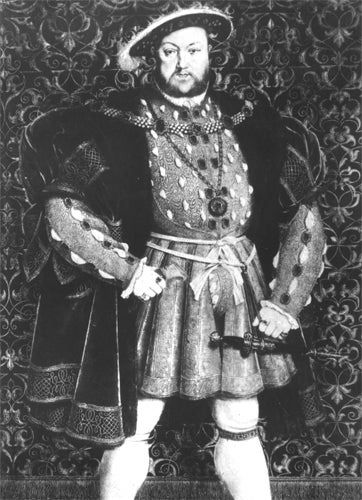
Because the Vatican has just announced that it will market 200 facsimile copies of the elaborately decorated parchment from 1530, which bore an appeal by English peers to Pope Clement VII asking for the annulment of the marriage of Henry VIII to Catherine of Aragon.
The document is key, historians said, to understanding the formation of the English national character. It marks, said Professor David Starkey in Rome yesterday, the most important event in English history. "This is the moment at which England ceases to be a normal European Catholic country and goes off on this strange path," he said, "that leads it to the Atlantic, to the New World, to Protestantism, to Euro-scepticism."
Why did Henry want a divorce in the first place?
It wasn't a divorce, it was an annulment. To cement an alliance with Europe's most powerful country, Spain, Henry's father, Henry VII, had arranged a marriage between Henry's elder brother Arthur and the daughter of the Spanish monarchs, Queen Isabella of Castile and King Ferdinand of Aragon. When Arthur died she was married off to Henry.
But by the end of the 1520s, Henry's wife, Catherine of Aragon, was in her forties and he was desperate for a son to secure the Tudor dynasty.
Henry applied to the Pope for an annulment of the marriage, on the grounds that it was not lawful in those days for someone to marry his brother's widow. Technically that was correct. And royal annulments had happened before: Louis XII of France had been granted one in 1499. But, by then, Catherine's nephew had become the Holy Roman Emperor, Charles V, and he did not want to see his aunt humiliated. So the Pope dilly-dallied.
What happened?
Henry fell in love with Anne Boleyn and by 1533 she was pregnant. He married her in secret. Meanwhile he had pushed through Parliament a series of Acts cutting back papal power and influence in England. Several months after the wedding he got the Archbishop of Canterbury, Thomas Cranmer to unilaterally declare his first marriage invalid. Anne Boleyn was crowned queen a week later. A year later the Pope declared that Henry's second marriage was invalid.
Henry declared that the Pope no longer had authority in England and in 1534, Parliament passed an act that stated that Henry VIII was now the Head of "The Church of England". The Pope responded by excommunicating Henry. The king passed the Act of Supremacy. Those who would not swear allegiance to him as head of the Church were executed for treason. Then followed the Dissolution of the Monasteries, under which all the lands and possessions of Britain's religious orders were purloined by the king and his apparatchiks.
Wouldn't the reformation have happened anyway?
That was the myth peddled by the English establishment for centuries. The propaganda was that a corrupt and decaying Catholicism was replaced by a more morally pure and progressive Protestantism. But historians now challenge that view. They are led by Cambridge University's Eamon Duffy whose scholarly masterpiece, The Stripping of the Altars, was a meticulous study of the accounts, wills, primers, memoirs, rood screens, stained glass, joke-books and graffiti of the period.
What did this book show?
It showed beyond doubt that medieval Catholicism was in fact flourishing and much loved by the ordinary English people for whom it offered social and spiritual sustenance. Luther's Protestant reformation had taken no root.
"Very few people were remotely interested in ideas from Germany," said David Starkey. But "because Protestantism won and because history is written by the winners, the Protestant account of the Reformation triumphed". The Reformation in England was imposed from the top.
How was the Reformation imposed?
By a fierce centralist onslaught by the King and a small group of brutal, greedy, self-serving henchmen out for loot. Protestantism was imposed – through coercion, spying and disenfranchisement – by a cadre of political opportunists during just three decades of Henry's and then his daughter Elizabeth's reign.
Public resistance to Elizabeth's dismantling of the Catholic parish system persisted until the 1570s. And some Catholic customs and loyalties lingered until the beginning of the 17th century. However, by then, as Professor Duffy put it, England's Catholic inheritance became for the English people "a distant world, impossible for them to look back on as their own".
Wouldn't Protestantism have flourished anyway?
Probably not. Henry had persecuted English Protestants until the row over the annulment. But once his estrangement from Rome was clear, Protestants flooded into England. There was a big influx from France after the St. Bartholomew's Day Massacre in 1572 when a large group of wealthy and prominent Huguenots were slaughtered in Catholic Paris. There was also a steady wave of Protestant from the Low Countries after Spain began to assert its rule there. So Protestantism was a foreign import.
How did the move towards Protestantism manifest itself?
In 1536 Henry gave permission for an English translation of the Bible to be published in England, which was a very non-Catholic act for Rome was still hiding behind its Latin. Henry continued to regard himself to be a Catholic but by doing this he began to move the Church in the direction of Protestantism. From that point onward, the Church of England claimed itself to be both Catholic and Reformed (as distinct from just Protestant) a character which many proclaim to be its continuing compromising genius to this day. It was to be 100 years before the Protestants really showed their strength – by cutting off the head of the king in the Civil War.
Were it not for the annulment, as John Stuart Mill put it in his essay On Liberty, this country would almost certainly have followed the example of the majority of the Continent. "In Spain, Italy, Flanders, the Austrian empire," Mill wrote, "Protestantism was rooted out; and mostly likely would have been so in England, had Queen Mary [Henry VIII's first daughter] lived, or Queen Elizabeth died."
How would things have been different if England had remained Catholic?
"My offices might be in Rome and I might be writing in Latin," quipped Paul Handley, the editor of the Church Times, the leading Anglican newspaper, yesterday. "And what would have happened to the bolshy individualistic Englishman on which we base all our historical mythology?"
It would have been a unique Catholicism though, not fervent like the Mediterranean kind, but not separatist like the Catholism of France which is the product of a guillotine-crazed Revolution and a secularising Enlightenment. We might just be irreligious Catholics instead of irreligious Protestants. But the world may have lost something rather special.
Join our commenting forum
Join thought-provoking conversations, follow other Independent readers and see their replies
Comments