Victoria's plunge: Queen's beach to open to public
Queen Victoria's private beach, where she fell in love with the great British outdoors, is to be opened to the public for the first time. Jack Watkins reports

For free real time breaking news alerts sent straight to your inbox sign up to our breaking news emails
Sign up to our free breaking news emails
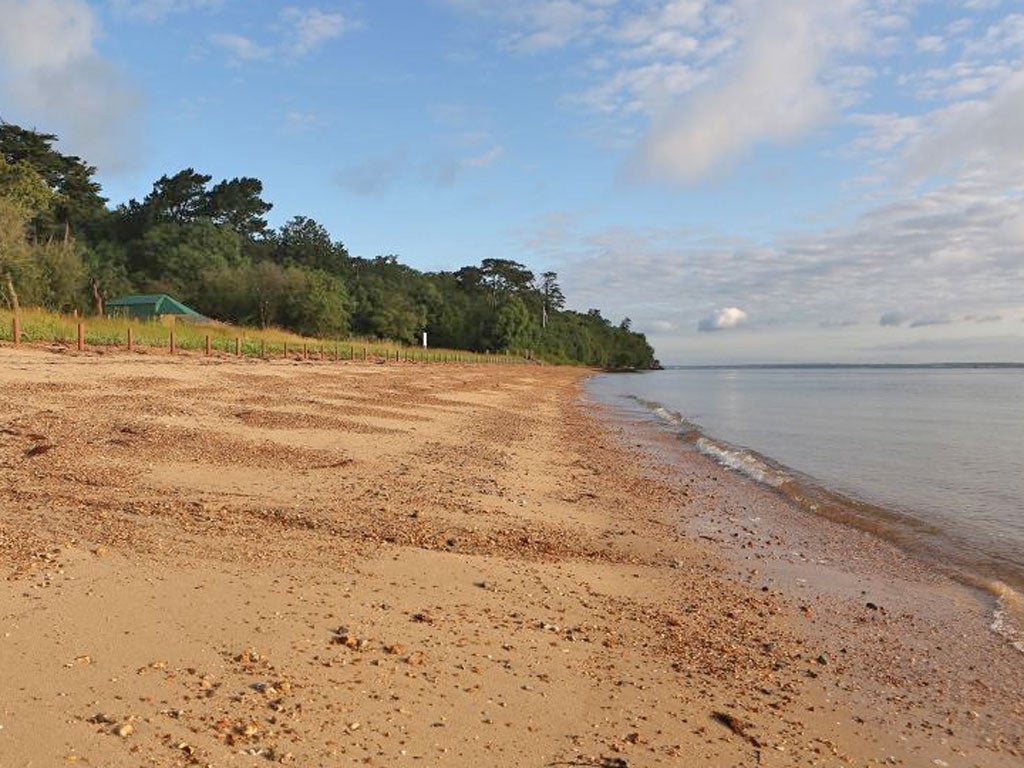
The image of Queen Victoria as a mordant, po-faced monarch is to undergo something of a sea change this month as the private beach at her seaside retreat of Osborne House, Isle of Wight, opens to the public for the first time.
The Queen's journals are full of happy references to time spent on or near the beach, where the children, including Bertie (later Edward VII), learned to swim and the monarch herself could spend time away from the burden of responsibility.
"They really loved it here," said English Heritage historian Dr Andrew Hann. "We know from her journals that the children were brought down from the house to play here every day, and the queen, who enjoyed walking or riding around the estate, would often join them for a stroll, or to gather seashells."
The idyllic spot, which reminded Prince Albert of the Bay of Naples, was a deciding factor in the royal couple's decision to build the house on the island in 1845. The beach remained in use when Osborne House became an officers' convalescent home in the early 20th century, but afterwards fell into neglect. English Heritage took on the management of the property in 1986, and the opening is part of its long-term scheme to restore and re-emphasise the estate's origins as a royal family home.
The original wooden bathing hut, from which the queen would emerge resplendent in a voluminous bathing costume, is being returned to the beach, newly restored. The alcove, within which, surrounded by colourful mosaics and seated on a bench supported by cast-iron dolphins, she sat sketching and painting, has also been restored. As well as admiring the views, which inspired the queen's illustrations, visitors will be able to watch or participate in a range of Victorian-style beach entertainments and games, such as Punch and Judy shows, quoits and skittles.
Announcing the plans, Simon Turley, chief executive of English Heritage, said that Victoria was: "Fixed in many people's minds as the 'Grandmother of Europe', who spent most of her reign in mourning for her husband. Opening her beach at Osborne lets us see another side to her – this was a queen who collected seashells with her children, who sketched the changing sea, and who swam sometimes twice a day. Osborne was her seaside retreat from the formalities of Buckingham Palace."
The queen's bathing machine was unusually ornate, with a front verandah and curtains which would conceal her until she had entered the water. The interior had a changing room and a plumbed-in WC. The royal offspring, meanwhile, were taught how to swim in a "floating bath", specially designed by Albert, and moored a few hundred metres off the beach. It consisted of two pontoons with a wooden grating suspended between, which could be lowered or raised according to the proficiency of the swimmer.
Evenings would feature fishing trips, using a little boat moored on the beach, from which they would be rowed out to be escorted by local fishermen. In one journal entry, Victoria triumphantly records: "We got 39 whiting perch, of which I caught 10."
The beach had a landing pier and was where many eminent guests, among them the French emperor Napoleon III, had their first sight of Osborne House, through groupings of trees and shrubs specially laid out to provide tantalising glimpses along the footpath. "Prince Albert was concerned with planting for special aesthetic effect in the views of the beach, sea and of the house. He would sit in the tower of the house and convey orders to the workers by semaphore," said Dr Hann, who said many of the trees planted by Albert survived.
The queen continued to visit the beach after Albert died and her children had grown up, he says. "She liked the solitude and serenity of the spot and continued with her watercolours, although her style became loser and darker in tone, probably reflecting her changed mood."
In subsequent years, the bathing machine was used as a hen coop, and much damage was done to the beach when it was used for army training during the Second World War. However, neglect of the bay meant it has also became something of a wildlife haven, including a colony of red squirrels. It contains a rare and fragile strip of vegetated shingle, while eel grass growing in the shallow waters provides an important habitat for seahorses. Natural England has carried out an audit of the flora and fauna and its protection and interpretation will part of the visitor experience.
Victoria's Secret: in her own words
21 June 1846 "We drove down to the sea in our char a bancs… by the beautiful new road laid out by Albert, which goes through the wood and winds down gradually to the sea. The view is quite beautiful."
30 June 1846 "Albert went back to the beach again later and bathed Bertie in the sea – a great event. He was extremely good and proud of his performance."
30 July 1847 "Afterwards drove down to the beach with my maids – went into the bathing machine where I undressed and bathed in the sea (for the 1st time in my life). A very nice bathing woman attended me. I thought it delightful till I put my head under water, when I thought I should be stifled."
16 August 1855 "Every day, every year, this dear sweet spot seems more lovely, & with its brilliant sunshine, deep blue sea & dazzling flowers, is a perfect paradise, & all my beloved one's creation, the result of his exquisite taste!"
Subscribe to Independent Premium to bookmark this article
Want to bookmark your favourite articles and stories to read or reference later? Start your Independent Premium subscription today.
Join our commenting forum
Join thought-provoking conversations, follow other Independent readers and see their replies