A chilling tour of the Kenyan church that became the scene of mass murder
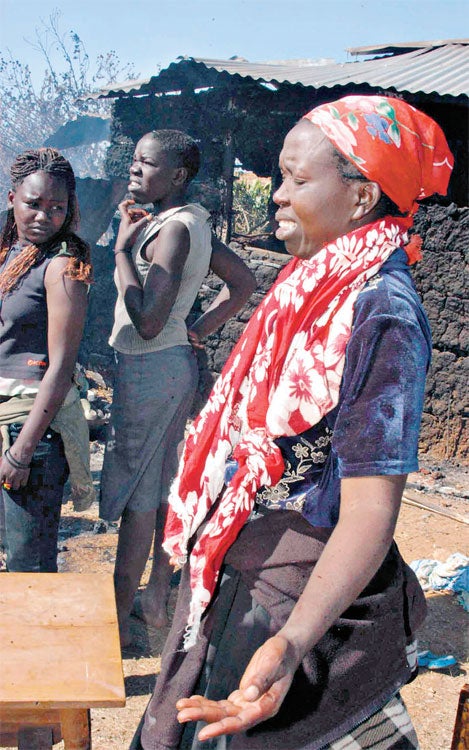
Tears streamed down the cheeks of 18-year-old Sheila Kai as she described the moment before the Kenya Assemblies of God Pentecostal church in Kiambaa was burnt to the ground.
"They told us to get inside the church or they would kill us," she whispered, describing a gang of more than 200 men. "Then they closed the door."
All possible escape routes were then locked shut with metal chains. Mattresses were placed around the outside of the building, then doused with paraffin and set alight. "People were praying, calling for God, screaming," Ms Kai said.
She was one of the lucky ones, dragged to safety through a window as the church collapsed. But dozens were killed; the youngest just three days old.
Monday's attack on more than 200 Kikuyus seeking sanctuary from rising tribal violence has shocked the country. Kenya has always prided itself on being an oasis of stability in an otherwise turbulent region, but that reputation seemed in tatters after violence that has engulfed the country following presidential elections widely seen as flawed.
As accusations flew yesterday in the capital Nairobi, with re-elected President Moi Kibaki, a Kikuyu, accusing his rival Raila Odinga, a Luo, of unleashing genocide, here in this small village in western Kenya the grim recovery of bodies was under way.
Two lay on the charred ground by the still-smouldering ruins of the church, grey and blue blankets thrown over them to give a veneer of modesty in death. The woman was badly burnt, the man appeared to have been hacked to death with a machete.
And in the smoking ashes, there were signs of the sheer panic that swept through the church as the flames rose. A small dainty red shoe lay in the ashes; beside it a child's white trainer, a blue plimsoll and a green Wellington boot.
A handbag, singed around the edges, lay in the nearby grass; others were hastily jettisoned by a wall, dropped by owners who had hoped to find refuge, but instead found themselves fleeing in fear of their lives.
"They wanted us to burn inside," said a middle-aged mother of five with severe burns across her forehead. "Men forced open the door and people started falling over each other, trying to escape," she said.
Survivors said the attackers were from the Kalenjin tribe, the dominant ethnic group in the Rift Valley area of Kenya. Until Tuesday, they had been living alongside them as neighbours. "They were calling us by our names," said Jospeh Mugweru, one of the Kikuyu men who had tried to fight the assailants. "I don't know why they would do this. We were friends."
"We knew them well," another woman said. "They were people who came to our houses to drink tea."
Red Cross volunteers, who had originally believed that up to 100 people may have died, had recovered 17 bodies, all charred beyond all recognition, by yesterday morning. The remains of several small children had still not been found, their bodies reduced to ash by the force of the flames. The final death toll was likely to be between 30 and 40, officials said.
Survivors of the Kiambaa massacre had walked the five long miles through the now barren sugar-cane fields to the nearest town, seeking refuge and treatment for their wounds.
Last night Eldoret was under siege. Marauding gangs of 50 or more men burnt and looted houses in Kikuyu areas, attacking men, women and children. "No Kikuyus!" they shouted, "Go home!" referring to Kenya's Central province, the Kikuyu heartland. But no one could leave. Roadblocks ringed the town, manned by young men armed with machetes, sticks and bows and arrows. They hauled people from their cars, barking at them to show their identity cards. Those with Kikuyu names were dragged away and killed, witnesses said.
A military truck carrying nine machine-gun toting soldiers and members of their families was stopped at a roadblock manned by Kalenjins and Luhyas. The young men, some of them drunk, demanded that all the Kikuyus on board get off before the truck could continue. The soldiers refused and turned back towards town. The youths fired arrows at the departing truck, striking three people in the back.
"We are now landlocked," said Susan Iraya, a mother of three seeking shelter in the hospital grounds after seeing her neighbour's house torched and four people killed. "We are surrounded. We cannot move. They were telling us it's an ODM [Orange Democratic Movement] zone," she said. "We are now refugees in our own country."
The ODM, the party of the opposition candidate Raila Odinga, has claimed it was robbed of victory in last week's presidential election. President Kibaki was hastily sworn in on Sunday, but international observers have said the election fell short of international standards.
Last night some 10,000 people were huddled in the grounds of Eldoret's Sacred Heart of Jesus Catholic cathedral. Its bishop has been threatened for sheltering Kikuyus.
Police are patrolling the streets at night but there are no guards stationed outside the cathedral's gates. "We are dealing with a very dangerous crowd outside," said Bishop Cornelius Korir. "They are all anti-Kikuyu, and their enmity is strong."
As the ethnic violence has continued to spread across Kenya, comparisons have been made to other African nations, including Rwanda, where vicious bouts of ethnic-cleansing spiralled into civil war. But Bishop Korir said the sheer number of tribes in Kenya there are 42 could prevent such a thing. "There are still good neutral people who can help us solve this, people from other tribes who can mediate."
Meanwhile, at the hospital in Eldoret, medical workers are struggling to cope with a death toll that has dramatically escalated in the past three days. Thirteen bodies were recovered on Monday, 34 on Tuesday, and at least 50 were waiting to be transported to the hospital's mortuary. Distraught nurses sat on corridor benches, quietly sobbing, before returning to their duties.
"Yesterday alone we treated more than 150 people injured in the fighting," said Dr Omar Ali, the hospital's deputy director. "We normally just deal with malaria and kidney failure, things like that," he said. "This is the worst situation we have ever had."
For those despairing about the abyss into which Kenya seems to be sliding, one scene at the hospital did offer at least a glimmer of hope. Outside the emergency room sat Job Baraza, a baker by trade, who had brought his friend and colleague William in to be treated after he was struck on the head by a machete when he tried to break through the roadblock.
The pair were from different tribes, but Job was clear about his priorities. "We are still friends," he said. "It does not matter what tribe he is."
A diverse country
* Kenya: 36 million people, 40 ethnic groups.
* Kikuyu: Around 22 per cent of Kenyans share the ethnic background of the founding President, Jomo Kenyatta, and the current President Mwai Kibaki. Political and economic power is controlled by Kikuyu, who come mainly from the agriculturally rich central highlands.
* Luhya: A Bantu group like Kikuyu, their homeland is around Kakamega in the west.
* Luo: Some 13 per cent share the Luo ethnicity of the opposition leader Raila Odinga. Many Luos are traders and artisans, and typically feel dominated by Kikuyus.
* Kalenjin: Most of Kenya's famous long-distance runners are Kalenjin who make about 12 per cent of population.
* Maasai: Kenya's best-known tribe make up 1 per cent of total. A nomadic, cattle-herding group, they migrated south from what is now Sudan.
Join our commenting forum
Join thought-provoking conversations, follow other Independent readers and see their replies
Comments