Butter that brought fat profits to the mud huts of Ghana
How did a women's co-operative manage to grab a share of the £2.4bn global cosmetics industry?
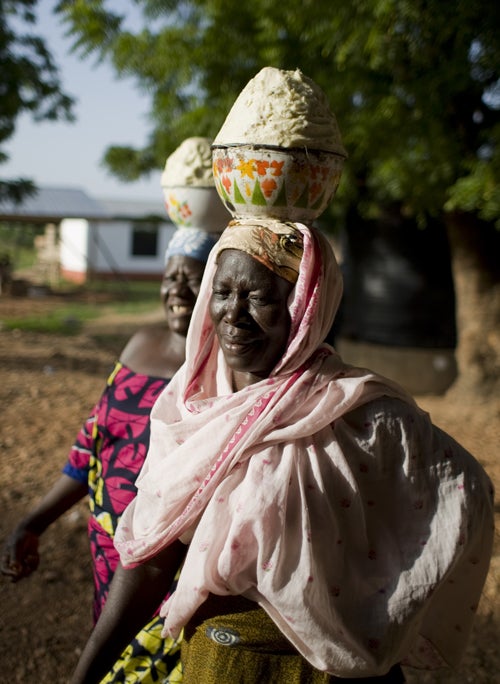
After two decades of being mocked as the "toothless one", Habiba Anhasan used her first earnings this week to buy a set of dentures.
Until a year ago, the £130 price of the false teeth would have been only a dream for a woman such as Mrs Anhasan, who scratched a living as a hawker selling cheap goods in the arid savannah of northern Ghana.
But a mixture of arduous labour under the blistering sun and insatiable demand in the developed world for plant-based beauty products, has transformed Mrs Anhasan and 30 other women into a band of steely entrepreneurs with a lucrative toehold in a £2bn global cosmetics industry.
Pounding golfball-sized shea nuts with her comrades in the "Pagsum" or Ideal Woman Shea Butter Producers and Pickers Association, Mrs Anhasan said: "Our butter goes from our village to London and Tokyo. It makes me so proud to think that what we make here goes to the greatest cities in the world."
From their production base in the mud-hut village of Sagnarigu and neighbouring communities in the heart of Ghana's sub-Saharan savannah, the women's co-operative churns out orders for their premium handmade shea butter to clients ranging from a US pharmaceuticals company to Britain's Body Shop.
Their success is largely due to a dramatic rise in demand in the developed world for what they call pikahali, the vitamin E-rich cream with the appearance of clotted cream and the smell of the savannah that is extracted during a back-breaking, 25-stage, three-day process.
For centuries, women across west Africa have picked the green fruit of the shea nut tree – a leafy giant of the bush similar to the walnut tree – and processed it into an unguent with a bewildering multiplicity of traditional uses, from healing the navel of a new-born child to cooking daily stews of yam. In the dark days of the region's civil wars, some guerrilla groups believed a thick application to the skin would deflect bullets.
But as cosmetics companies jostle for position in the lucrative market for natural beauty products and try to source ethically sound products for an ever more eco-aware consumer base, this labour-intensive product sold until recently for pennies in the street markets of countries from Senegal to Burkina Faso to Ghana to Nigeria has become big business.
Soaring cocoa prices, now about £1,500 per tonne, have also increased demand for shea butter, which can be used as a substitute for cocoa in chocolate and patisserie.
In 1994, all of west Africa made 50,000 tonnes of shea butter worth about £5m. This year, the export market will be worth £50m and Ghana alone will produce 250,000 tonnes, worth £200 per tonne. Big buyers include the French cosmetics giant L'Oreal and the upmarket high street chain L'Occitane.
In such a context it is perhaps unsurprising that some of the women working in the co-operative, which has united the women of Sagnarigu with 25 surrounding villages to form a powerful marketing group, now refer to the shiny nuts as "brown gold".
Barely two years after they formed their co-operative, the women have gone from making a few hundred kilograms of their premium hand-made butter every month to the present 1.25 tonnes a week. The price the group receives has risen from 30p per kilogram to the £2 per kilogram paid by international buyers. One order from a Japanese cosmetics company last year gave the Sagnarigu women a windfall of £2,500, which allowed Mrs Anhasan to get her teeth.
The industry has caused a sea change in the economic prospects and lifestyle of the co-operative members, many of them widows on the margins of northern Ghana's patriarchal society, who work together in a small communal area in the heart of the sun-baked village. Ironically, the emergence of the co-operative is due to the deterioration of the environment around Sagnarigu and its neighbouring communities, close to Tamale, the biggest city in Ghana's impoverished northern regions.
Rapid deforestation in the Sahel – the strip of bushy savannah that acts as a buffer between the sands of the Sahara and the rainforests of equatorial Africa – led to a UN-backed initiative in the early 1990s to replant scrubland rendered bare because the trees were chopped down for cooking fuel. Thousands of shea trees were planted around Tamale. The shea was chosen in part because local superstition dictated no tree could be planted by human hand which grew more quickly than the villagers' children.
Now the all-female work has been particularly vital to women such as Mrs Anhasan and Adamu Amidu, whose status as widows means they lost the right to live in their former husband's home – normally reclaimed by his male relatives – and faced a life of destitution.
When asked what they dream of spending their profits on, most widows give the same answer. Mrs Amidu, 51, said: "A house for me and my children. They can go to school. I can feed them. In return, I work for the business as hard as I can."
Pointing to a tub of fresh shea butter, another said: "For years, we have used it for everything. It cures our ills and fills our bellies. Now it is filling our pockets."
Join our commenting forum
Join thought-provoking conversations, follow other Independent readers and see their replies
Comments