Congolese 'warlords' deny slaughtering entire villages
Second trial at permanent court hears militia leaders raped and killed scores
The attack came at first light. The village of Bogoro was turned into a slaughterhouse where "some were shot dead in their sleep, some cut up by machetes to save bullets", the International Criminal Court (ICC) was told yesterday. "Others were burned alive after their houses were set on fire by the attackers," the prosecutor, Luis Moreno-Ocampo, recounted.
Scores of women were raped, children were killed and young girls marched away to become sex slaves. When it was all over, one of the two suspects, Germain Katanga, was allegedly heard to boast: "Nothing was spared. Absolutely nothing. Chickens, goats, everything... was wiped out."
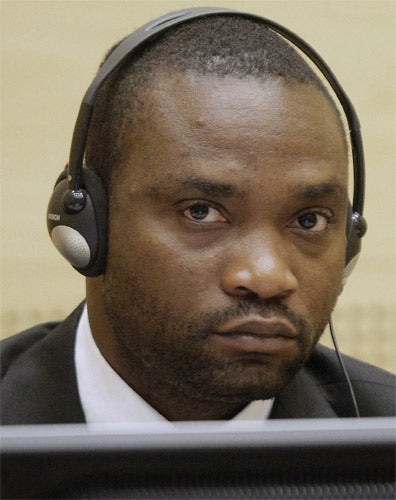
Mr Katanga and Mathieu Ngudjolo Chui were in the dock yesterday in The Hague – in only the second trial to get under way at the permanent ICC (as distinct from the temporary courts judging war crimes in the Balkans and Liberia) – as prosecutors described the horrors of civil war in the north-east of the Democratic Republic of Congo.
The two men, alleged to be warlords, were charged with seven counts of war crimes and three of crimes against humanity, including murder, sexual slavery, rape, using child soldiers and pillaging. They pleaded not guilty. Mr Katanga, 31, is accused of leading the Patriotic Resistance Force (FRPI), an ethnic Ngiti militia, while 39-year-old Mr Ngudjolo allegedly led the allied National Integrationist Front (FNI).
The two militias combined forces in February 2003 to attack a village hosting a camp belonging to a rival force, the Union of Congolese Patriots (UPC), mostly from the Hema people. The groups were engaged in a struggle for control of the region's gold, diamonds and oil.
Rather than a military operation, however, Mr Moreno-Ocampo described how two mobs of child soldiers and veteran fighters with automatic weapons set out "to wipe out Bogoro" – "to destroy not only the UPC camp but the whole village," he claimed.
The trial comes as the ICC is being accused by some in Congo of staging show trials of relatively small players in a broader conflict. The war in Ituri was part of Congo's Second War, referred to by many as "Africa's World War" which pulled in soldiers, money and arms from all over the region.
Traces of the fighting persist in Ituri where attempts to screen the hearings of the first ICC trial, against UPC leader Thomas Lubanga, had to be stopped for security reasons in February. The ICC also faces criticism for focusing almost entirely on African cases and it is accused by some of being a "neo-colonial project".
"There's a growing disconnection between how the ICC is seen in the West and how it's perceived in Africa," said Richard Gowan, an Africa expert at the European Council on Foreign Relations.
The Rome Treaty signed in 1998 – the same year that General Augusto Pinochet was arrested and held in the UK for several months – brought 122 countries together in a landmark moment for international justice. With rights campaigners touting the so-called "Pinochet effect", despots and war criminals were to be made unsafe everywhere.
More than a decade on, only 110 of the 122 nations have ratified the treaty that created the ICC, and crucially the absentees include Russia, China and the US. The building of the court's institutions has moved at a painfully slow pace, and it launched its first prosecution at its permanent base in The Hague as recently as January.
The court has argued that arresting and prosecuting those responsible for crimes against humanity in ongoing conflicts will act as a deterrent to those still fighting.
In the dock: Army commanders
Germain Katanga
Born in Mambasa, in the north-east of the DRC, he is known to his fighters as Simba, or Lion. He is accused of leading the Bogoro massacre, killing at least 200 and sexually enslaving women and girls, and an even worse attack in 2002 on a hospital in which 1,200 civilians died. In 2004 he was appointed general in the DRC army during the peace process but was arrested and extradited to The Hague in 2007.
Mathieu Ngudjolo Chui
Born in 1970 in Bunia, also in north-east DRC, this "poor farmer's son" became an army corporal but joined rebel groups in 1998 when civil war came to his region. He is accused of ordering his forces to "wipe out" Bogoro. He was made a colonel in the DRC army in 2006 but was arrested in 2008 and sent to the ICC.
Join our commenting forum
Join thought-provoking conversations, follow other Independent readers and see their replies
Comments