Critics fear all is not well in the darling of Africa on eve of election
Botswana President's disciplinarian tendencies 'are shading into autocracy'
Alongside a taxi rank at Tsogang, on the outskirts of Gaborone, the opposition Botswana Congress Party (BCP) attempts to draw a crowd. An activist in a green shirt calls for free secondary education.
The ward candidate, Gaborutwe Thekiso, has other worries: "People will not even stop and listen. You won't see a single civil servant at our rallies. They are too scared of being spotted by the authorities."
A darling of the West and the producer of the world's most valuable diamonds, Botswana is cited as a model for Africa. But as the sparsely populated country goes to the polls today, there are claims from lawyers, journalists and human rights campaigners that all is not well – that President Seretse Khama Ian Khama, educated at Sandhurst, has a disciplinarian tendency that is shading into autocracy.
Yet the policies of his Botswana Democratic Party (BDP) – which has been in power since 1966 – seem hard to fault. In partnership with the diamond company DeBeers, the government has brought Aids to heel. And when, in October 2008 during the financial crisis, DeBeers closed three mines for six months, the state launched public works and agricultural programmes.
The government spokesman Jeffress Ramsay said: "We were lucky to have had two years of good rains. We have managed economic growth of 6 per cent outside minerals for the last 12 months." He said that Mr Khama's mantra was "democracy, development, dignity and discipline" and before his arrival "the elite was resting on its laurels or helping themselves".
Southern Botswana and its capital, Gaborone, are recognisable from Alexander McCall Smith's series of novels, The No 1 Ladies Detective Agency. The city is well groomed, with slick shopping centres, and it even seems to have a higher-than-average number of little white vans.
But critics of the government point to a side of life that is harsher than even what Mma Ramotswe would investigate. The Botswana National Party (BNP) spokesman Moeti Mohwasa described deep rural poverty: "We want one tap for every household. Botswana can afford it. The BDP controls the traditional chiefs and thereby the rural vote; it neglects the people."
The San people – indigenous nomads of the Kalahari – are not an election issue, but they could be. International pressure groups such as Survival International claim the San are discriminated against by a government influenced by the combined lobbies of cattle farmers, tourism operators and DeBeers. The claim has long fallen on deaf ears. In Gaborone, though, urban professionals increasingly believe the San heritage – one of the most ancient in the world – deserves constitutional protection.
But the government seems more focused on restricting dissent. Last month, a senior civil servant, Moses Lekaukau, was sacked for allegedly making comments in favour of a dissident wing of the ruling BDP.
The BDP secretary general, Gomolemo Motswaledi, was suspended for making decisions without consulting Mr Khama. And journalists claim the pending Media Practitioners' Act will create a pro-government press council.
In May, the Law Society of South Africa (LSSA) said that human rights lawyers in Botswana were being prevented from seeing their clients. It raised concerns about the operations of the Directorate of Intelligence and Security – a military group close to the President. And it linked the Botswana Defence Force with up to 12 killings of criminal suspects. Mr Ramsay said only: "We have an independent judiciary," he said, but added: "These were hardened criminals."
The fragmented opposition expects defeat at the polls. "The BDP is divided," said the BCP spokesman Dumelang Saleshando, "but it has the advantage of already being in power." Out of 57 seats, the government won 44 in 2004, against 12 for the BNP and one for the BCP. "They may lose a couple of seats," is as far as Mr Saleshando will go.
By the taxi rank in Tsogang, the BCP ward candidate Mr Thekiso is equally despondent. "The opposition needs to ally if we are going to have any chance," he says. "Our pride as a country is to have never suffered a coup, a war or civil strife. If the BDP abuses its position, the people will react – eventually."
President Khama: Clarkson's Sandhurst buddy
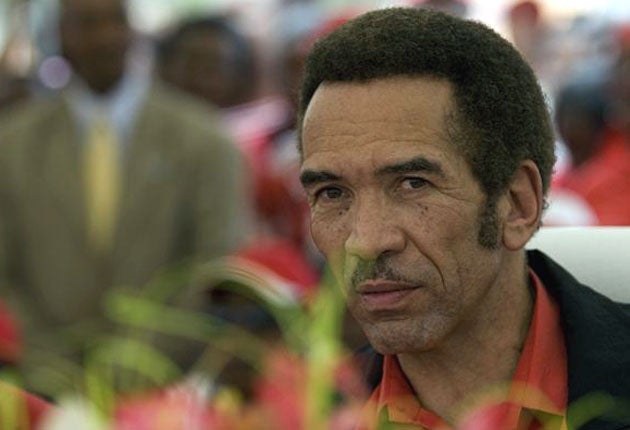
So confident was President Seretse Khama Ian Khama's Botswana Democratic Party that it would retain its majority in today's election that his portrait appeared on new bank notes six weeks ago. Lieutenant-General Khama, 56, was appointed President in April 2008 by the BDP, the party his father created.
Internationally, he is best known for breaking ranks in southern Africa by speaking out against neighbouring Zimbabwe's President, Robert Mugabe. A pilot and wildlife enthusiast, President Khama is known to British television viewers for having appeared in 2007 alongside Jeremy Clarkson ahead of a BBC Top Gear dash through the Kalahari.
The President, who is single, is deeply intolerant of racists. He was born in Surrey two years after his father was exiled to Britain in 1951 by the colonial authorities for having married a white Briton, Ruth Williams. The family returned in 1956.
Fact file: Botswana
1966 The year Botswana gained independence and the BDP came to power.
$13,900 The country's GDP (purchasing power parity) per capita. South Africa's is $10,100.
23.9% Share of those aged 15 to 49 with HIV/Aids, second only to Swaziland.
12.6 Infant mortality rate, for every 1,000 live births.
Join our commenting forum
Join thought-provoking conversations, follow other Independent readers and see their replies
Comments