Special Investigation
Dumped in Africa: Britain’s toxic waste
Children exposed to poisonous material in defiance of UK law
Greenpeace
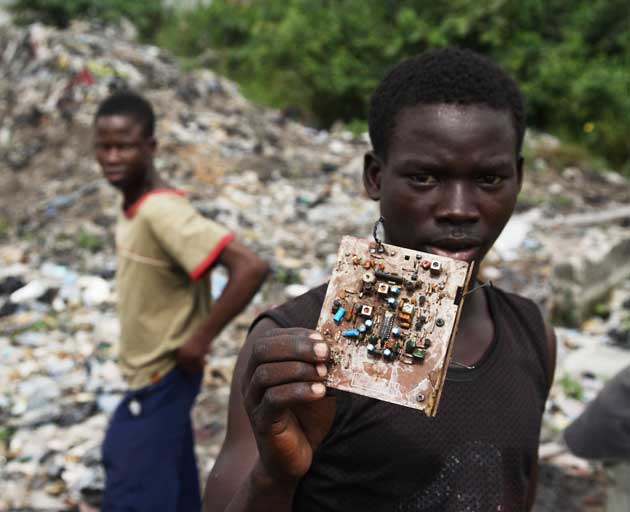
Scavengers at Alaba market in Lagos, Nigeria, try to make a living from the illegal exports
Tonnes of toxic waste collected from British municipal dumps is being sent illegally to Africa in flagrant breach of this country’s obligation to ensure its rapidly growing mountain of defunct televisions, computers and gadgets are disposed of safely.
Hundreds of thousands of discarded items, which under British law must be dismantled or recycled by specialist contractors, are being packaged into cargo containers and shipped to countries such as Nigeria and Ghana, where they are stripped of their raw metals by young men and children working on poisoned waste dumps.
In a joint investigation by The Independent, Sky News, and Greenpeace, a television that had been broken beyond repair was tracked to an electronics market in Lagos, Nigeria, after being left at a civic amenity site in Basingstoke run by Hampshire Country Council. Under environmental protection laws It was classified as hazardous waste and should never have left the UK.
The television, fitted with a satellite tracking device, was bought by a London-based dealer, one of dozens of operators buying up a significant proportion of the estimated 940,000 tonnes of domestic electronic waste, or e-waste, produced in the UK each year and sending it for export.
Investigators bought back the television after a 4,500-mile journey from Tilbury Docks in Essex to the giant Alaba electronics market in Lagos, where up to 15 shipping containers of discarded electronics from Europe and Asia arrive every day. At least a third of the contents of each container is broken beyond use and transferred to dumps where waste pickers scavenge amid a cocktail of burning heavy metals and dioxins. The television is just one example of a broader problem with the enforcement of the legislation, which permits the export of functioning equipment but prohibits broken electronic goods from being sent outside the EU to a country with a developing economy.
Such is the confused state of the recycling industry, with some local authorities collating figures on the amount of waste being exported and others simply handing the task to sub-contractors, that the e-waste body representing the electronics industry admits abuse is widespread.
Claire Snow, the director of the Industry Council for Equipment Recycling (ICER), told The Independent: “It is clear that the system for collecting equipment which UK householders have thrown away is not working as well as it should.
“On the pretext of re-use, equipment which is clearly not suitable for any type of re-use is effectively being dumped in developing countries.”
Government figures show that 450,000 tonnes of e-waste is currently being treated in accordance with Britain’s waste electronic and electrical equipment laws, which place a responsibility on manufacturers to meet the environmental cost. But with the average Briton throwing away four pieces of e-waste every year, approximately 500,000 tonnes is going unaccounted for. Industry research seen by The Independent estimates that at least 10,000 tonnes of waste televisions and 23,000 tonnes of computers classified as hazardous waste are being illegally exported as part of a wider e-waste market worth “tens of millions of pounds”.
Campaigners say dealers offering around £3 for a television and £1 for a computer monitor to waste sites are undercutting specialist recycling companies, creating a “grey market”.
Britain is responsible for around 15 per cent of the EU’s total e-waste, which is growing three times faster than any other muncipal waste stream.
Martin Hojsik, toxics campaigner for Greenpeace International, said: "Companies can stop this illegal toxic trade now by ensuring their goods are free from hazardous components. It is critical they and governments take full responsibility for the safe recycling of their products and put an end to the growing e-waste dumps that are poisoning people."
Bosses at Hampshire County Council last night launched an inquiry into its waste sites but insisted it and its household waste site contractor, Hopkins Recycling, only used dealers who exported functional equipment.
A spokesman for Consumers International, which is campaigning for tightened e-waste controls, said: “The sight of children scavenging toxic wastelands overflowing with the West’s unwanted computers and televisions makes a mockery of international bans to prevent the dumping of e-waste. Western governments, including the UK, have shown little desire to deal with the root cause of this problem.”
View all comments that have been posted about this article.
Offensive or abusive comments will be removed and your IP logged and may be used to prevent further submission. In submitting a comment to the site, you agree to be bound by the Independent Minds Terms of Service.
- Print Article
- Email Article
-
Click here for copyright permissions
Copyright 2009 Independent News and Media Limited


Comments
And Islam is becoming more and more widespread in this nation, whilst the UK and US throw power and money at the dwindling christian elite that run the country, the general people at large are more and more turning away from the western ideals and becoming entrenched into the faith of Islam.
People might be interested to know that the US muscled in on a few infrastructures in Nigeria, airport security is run by the US Military as an example and there is a growing presence of US "lily pads" in that country, which are Nigerian bases but "black op" sites for US military operations there, if the west don't do something for this country, if the people don't get rid of the massive corruption that goes hand in hand with US support then in a decade this nation will be at war with itself...
It infuriates me!! the lack of care for other human beings we seem to have nowdays.
Just wondering how scavenging it products helps hungry people (according to you, though Nigeria is a very rich country)
Another typical example of ignorance?
seems to me a bit of travel and exposure to some of these countries would enlarge your mind.
The statements you make are pretty thougtless,and careless, demonstrating a narrow - mindedness supported by what seems to me a grievous lack of travel and education.
It is easier to pull through with toxic waste than newsprints for books, magazine and publications needed to educate the people.
It is still about greed.
Like Fela Kuti stated Authority Stealing.
If there is hope for them, is there any hope for us?
Bravo Nigeria.
What,Who to blame, the Brtish?
No Africa itself. The poor are not protected. In many African countries there are standards bureaus and strict customs boards but there is nothing they can do to block these waste as they are valueless yet they know something hazardous is being imported. The only time these boards work effectively is if you dare export a rotten tomatoe to an African President. Let the Nigerians and Ghananians poor die faster than they thought ! perhaps thats what we want????
God save Africa!
Organizations like WR3A.org are trying to establish "Fair Trade Exports" rules. When the well-meaning westerners grind up good repairable electronics, Africa does not go without - they buy where they have to.
God save Africa!
The problems of toxics and overseas dumping are just two heads of the many-headed beast that's trashing the planet. This beast is not only allowed to roam free; it's actually encouraged to run faster in the name of economic growth and prosperity. Clever, huh?
The global financial crash is a tough lesson, but if we can get something from it, I'd like to see us learn more than whether it's a good idea to run our economies on unpayable debt. The bigger question is how to tame the ravenous beast that will otherwise soon have us looking fairly silly, up to our necks in chaos, conflict and climate mayhem. The usual thinking on this is impressively weak, attempting at most to grab hold of one or two of the heads, or just to cage the beast. With a bit more thought the beast could be put to work building genuine lasting growth and prosperity. Worth a try perhaps?
The beast is like Frankenstein, a monster of our own making. We didn't intend to make it but we also didn't do anything to stop it when our sloppy economic thinking caused it to strengthen and run out of control. We thought it made sense to keep economics and ecology separate. We thought that the world was so big and resources so vast that we could do what we liked and there would be no consequences. We thought it would be ok to omit the cost of getting things right out of product prices, and to handle any problems at the 'end of the pipe' with flimsy (often corrupt) regulation and deliberately vague plans. We were dead wrong.
The beast is an economic animal and can be tamed by taming economics. This is less difficult than we might imagine, in view of the decades wasted not doing it. Why not economics that takes care of resources in endless cycles, protects nature and shows compassion for all people? Economics that helps people by looking after the world instead of trashing it. Economics that gives hope and builds communities. Economics that thrives on a thriving planet and makes us all wonder why we didn't do it decades ago.
A few things would help in this task but the beast can be tamed with just one remarkably simple tool. We need to adjust prices by the risk of products not becoming new resources for people or nature. That's not too hard is it? Products with toxics are hard (almost impossible) to recycle so the risk would go up, such products would be uncompetitive and toxics would vanish from products almost overnight.
Products that are found dumped overseas have a greater risk of not becoming new resources so their price would go up and producers would instantly become intensely interested in setting up viable effective recycling systems. Clever producers would cash in by better designs; durable, upgradeable, repairable and recyclable. Planned non-obsolescence.
This would be an insurance-based tool. Its beauty is in using the premiums from wasteful products to reduce the risk of things becoming waste throughout society. That means sustainable development, a nice idea that has lain dormant on bureaucratic desks, actually happening. Premiums would subsidise sustainable community, business, infrastructure, conservation and overseas initiatives. Producers would invest even more in order to cut their risks and costs.
One final comment. Fuels are products too so fossil fuels, which basically all become waste, would pay high premiums. Renewables would pay little or none. Premiums would fund the ending of society's dependence on waste-based fuels. This includes the so-called clean fuel nuclear power, that actually becomes a different kind of toxic waste. And waste incinerators, which are the fiery breath of the untamed beast. We need not waste another minute with the decades-long haggling over emissions capping which, like most regulatory cages, is entirely redundant if the economic beast is tame.
James Greyson www.blindspot.org.uk
people burning plastics to get what's in the case
no one's going to watch those telis and actually learn
that the west's moved on to digital, that's why they're there to burn.
and even for the ones that are dumped still working well
which in Britain would be worthless but in this country, will sell
At 20 quid a pop, it's quite unlikely you'd acrue
something worth your monthly wages giving you a worldwide view
Of the fact that not all cities are such thriving rubbish dumps,
leaking neurotoxins all around, ongoing poison pumps.
Not to mention kids who scrabble through what we've consigned as dead,
to melt and sell the metals, irregardless of the threat
of plastic to the lungs and eyes, mercury to the brain
it could be said to earn like this is easier insane!
And all the while the west will say 'at least we're not all wrong!'
we're actually providing stuff that they can profit from
that bunch of copper wiring may earn them 60p,
Without that kind of money, they probably wouldn't eat!
They may be suffering nausea, head pounding day and night
they may be taking plastic home to keep the fire alight
but that's the cost of progress really, nothing comes for free
the best thing is it's something we can choose never to see!!
THANK GOODNESS FOR JOURNALISM!!
So whilst this trade is reprehensible, and councils etc should do more to prevent it. Our own individual responsibility in all these matters is always forgotten or overlooked; why are there so many TVs out there? Because, for example when flat screen LCD screens came out, half the country threw away or replaced perfectly good tvs and repairing a faulty TV nowadays is almost unheard of.
http://www.sdti.com.tw/front/bin/pt
visit http://www.storyofstuff.com/ and watch Annie Leonard's award winning short annimation
and learn more about the route of the problems and practical solutions