Egyptian Copts demand end to post-revolution sectarianism

For free real time breaking news alerts sent straight to your inbox sign up to our breaking news emails
Sign up to our free breaking news emails
"I shouldn't have told them I am a Copt," says Hani Armanius Agib, recalling how his admission, as he tried to join a Coptic demonstration, that he is a Christian to a crowd of Muslims led to him being beaten up and his wallet and mobile phone stolen. Taken to hospital, he was arrested as he lay in a hospital bed and was held for hours in a military detention centre without food or water.
Egypt's 10 million Copts, the largest Christian population in the Middle East, are demanding that they no longer be treated as second-class citizens in post-revolutionary Egypt. But they are fearful that they are in danger of anti-Christian violence after the fall of President Hosni Mubarak because the police are weak and anti-Christian Islamic preachers are free to whip up sectarian hate.
"I am feeling threatened as does my community. I don't feel safe as a Christian at home," says Michael, a 25-year-old pharmacist who is Hani's brother. "But I also want to know if, after the revolution, I have rights in this country and if we are still going to be targeted by the government and extremist organisations."
So far the weakening of the police state, which ruled Egypt for 60 years, has enhanced opportunities for Egypt's Copts but has also led to more attacks on them. Issad Ibrahim of the human rights group Egyptians for Personal Rights says, "there definitely has been a rise in hostility between the two communities and, for the first time, you are having churches burnt out. The army doesn't want to interfere and extremist Muslims and criminals feel free to break the law."
The last couple of months since the revolution have seen several explosions of anti-Coptic violence. In the grim, run-down, religiously mixed district of Imbaba in central Cairo, construction workers are busily rebuilding the Virgin Church on el-Wahda street, which was set alight by petrol bombs on 8 May in riots in which 15 people were killed and 242 injured.
The origin of the attack on the church was a rumour that a Muslim woman called Abeer Talat, who was a supposedly a Christian convert to Islam, was being held prisoner by Christians in another Imbaba church called St Mena. Angry crowds of Muslims gathered outside and rock throwing and shooting started. It is easy to stir up a sectarian riot in Imbaba which is a poor, tough district of narrow alleys, drug dealers, and a reputation for being an Islamic fundamentalist stronghold.
The story of the Christian girl converted to Islam is one incident in a long-running dispute between the two communities The Copts say that hundreds of Christian girls disappear every year and, when they are seen again, they have converted to Islam. They agree that some may have run away from arranged marriages, but that most have been coerced or raped and then forcibly converted. If they return to their families, Issad Ibrahim says "the government makes it impossible to convert back to Christianity."
Copts point to many forms of discrimination against them in getting jobs, particularly top jobs. When a Copt was appointed for the first time as a provincial governor several months ago there were mass demonstrations by Muslims who blocked railway lines in protest. Christians are also trying to open 53 churches, which have been built but the Interior Ministry has previously forbidden them to open. It was an attempt to open one of these churches in the working class Cairo district of Ain Shams that led to further violence.
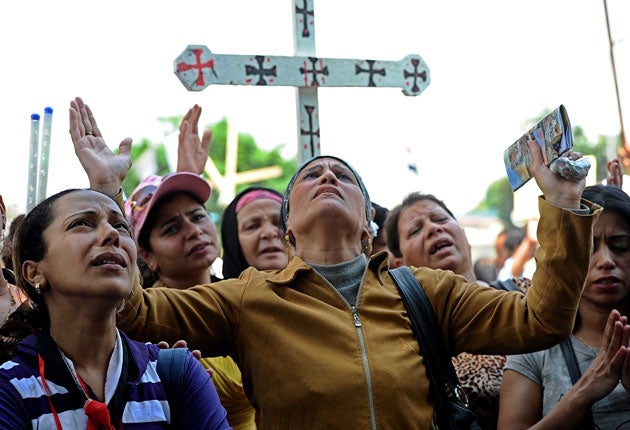
Copts have taken to the streets to demand their rights, including protection for their churches and the arrest of fundamentalist preachers who provoke riots by claiming that weapons are being hidden in churches or girls converted to Islam are being held captive. Father Filobater Gamiel, a middle-aged Coptic priest, organised a two week-long mass protest, which became a focus for the Coptic community outside the Media Ministry in central Cairo that has just ended.
"It isn't so hard to bring Copts out to demonstrate after the churches are burnt," says Father Gabriel, a mild-mannered man, who proved to be an effective organiser. He wants discrimination against Copts to be made illegal and the state to be neutral between religions so schools don't force Copts to learn parts of the Koran.
The protesters outside the Media Ministry came under constant attack, but got support from all parts of the Coptic community. Milad Morkos, 32, owner of a clothing factory, received a shrapnel wound in the left arm and bruises to his legs from anti-Christian demonstrators whom he says were "bearded men, thugs and young kids".
"We are asking for freedom and for our rights and not for luxury," says Mr Morkos. "Most of my friends are Muslims, I was born and raised with them but lately the violence started against us, burning churches and closing them down. I am not an optimist but it is important we do this for our freedom."
Subscribe to Independent Premium to bookmark this article
Want to bookmark your favourite articles and stories to read or reference later? Start your Independent Premium subscription today.
Join our commenting forum
Join thought-provoking conversations, follow other Independent readers and see their replies