Gaddafi's forces close in on rebels' capital
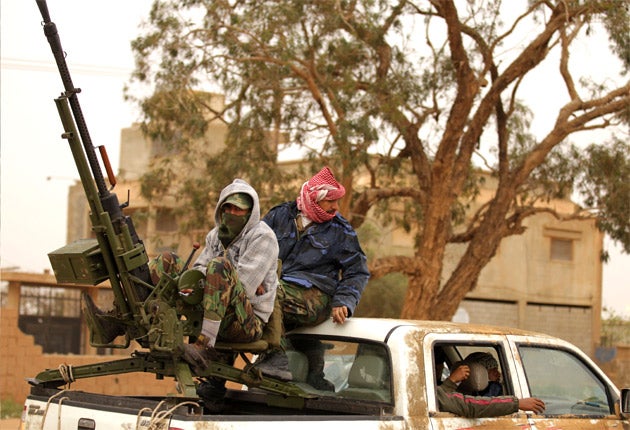
After a sustained barrage, Gaddafi loyalists took over the southern and western perimeters of the city of 130,000 people, leading to an exodus of terrified residents. A small number of reinforcements sent from Benghazi to bolster the resistance was passed by groups of revolutionary forces, the Shabaab, fleeing in the opposite direction. Houses were hit by missiles and ambulances and cars ferried the wounded, including children, from the area.
Benghazi lies just 90 minutes by road to the east and by late afternoon the regime's units could be seen along desert tracks attempting to cut off that route. With one contingent of the dwindling numbers of rebel fighters trapped in Ajdabiya, Gaddafi's armour could move on to Benghazi, possibly as early as today. Last night, the aid group Médecins Sans Frontières said it had been forced to withdraw from the rebel capital.
Opposition leaders in Benghazi had vowed to hold Ajdabiya and maintained that Gaddafi's troops, with their lines overstretched and suffering fuel shortages, would have no appetite for potential house-to-house fighting in the densely populated urban centre. They also insisted that revolutionary "special forces" had retaken Brega, an oil port which fell to the regime a few days ago.
Yesterday, amid the salvos of shelling, smoke and confusion, the claims appeared to be illusory. The main gate to the city, where the Shabaab had built berms, dug ditches and piled up sandbags – the first time they had taken such precautions – was hastily abandoned after two air strikes. Mohammed Jawad, a rebel fighter heading out of the city, shouted: "Where is the 'no-fly zone' they promised us? Will they do this when we are all dead?"
In Tripoli's central Green Square, hundreds of Gaddafi supporters celebrated the advance on Benghazi, blaring revolutionary songs, waving green flags and shooting into the air. As the regime forces advanced deep into rebel-held "free Libya", British-backed efforts to establish a no-fly zone over the country were dealt another setback. A meeting of foreign ministers from the Group of Eight industrialised nations broke up in Paris with no consensus on the prospect of intervention by the West.
Alain Juppe, the newly installed French Foreign Minister and chairman of the G8 talks, acknowledged in a radio interview that the window of opportunity for military action may have been closed. "If we had used military force last week to neutralise some airstrips and the several dozen planes that [the Gaddafi forces] have, perhaps the reversal taking place to the detriment of the opposition wouldn't have happened," he told Europe 1 radio. "But that's the past."
The G8 meeting concluded simply with a joint agreement warning Colonel Gaddafi of "dire consequences" if his campaign to crush the rebels continued, and requesting that the United Nations take up the task of punishing and pressuring Tripoli.
The UN Security Council will begin debating as early as today the possibility of new measures intended to help the rebels and impede Colonel Gaddafi with new sanctions and restrictions.
Last night, Britain, France and Lebanon tabled a draft UN resolution imposing a no-fly zone over Libya. David Cameron authorised the text, containing a "menu" of options for restraining the Gaddafi regime, despite division within the international community. Russia and China are thought to oppose the move, while the US and Germany have voiced doubts.
Alongside a no-fly zone, the draft resolution would impose stronger enforcement of the arms embargo, restrictions on Libyan commercial flights landing in other countries, and more travel bans and asset-freezing against those linked to the Gaddafi regime. "We recognise there is extremely difficult negotiation ahead," a No 10 source said. "We are going into this with our eyes open."
Regional round-up
Syria
Supporters of the Syrian government broke up a small pro-democracy demonstration in Damascus yesterday by punching and attacking the protesters.
The protest was not the first time Syrians have tried to stage demonstrations inspired by those sweeping the Arab world, but intimidation and other factors have quashed the momentum in a country that closely controls the media and jails critics of the regime.
The protesters were demanding an end to emergency laws that give authorities a free hand to jail activists. "As we marched, the government supporters started chanting, 'Our blood, our souls we sacrifice for you Bashar!'" said one protester. AP
Yemen
Anti-government tribesmen in northern Yemen stormed a security building and shot dead four soldiers in a revenge attack after government troops opened fire on opposition protesters calling for the president to go, witnesses said. The government's crackdown has also intensified with police firing on protesters and plainclothes government supporters attacking crowds with clubs and knives.
Egypt
Egypt's interior minister yesterday dissolved the country's hated state security agency, which was accused of torture and other human rights abuses in the suppression of dissent against ousted President Hosni Mubarak's 30-year rule.
The new interior minister, Major General Mansour el-Essawy, a former Cairo security chief, said that a new agency will be formed, in charge of keeping national security and combatting terrorism.
Join our commenting forum
Join thought-provoking conversations, follow other Independent readers and see their replies
Comments