Horror of Guinea stadium massacre that killed 157
World unites in condemnation after pro-democracy rally ends with soldiers 'killing and raping' hundreds
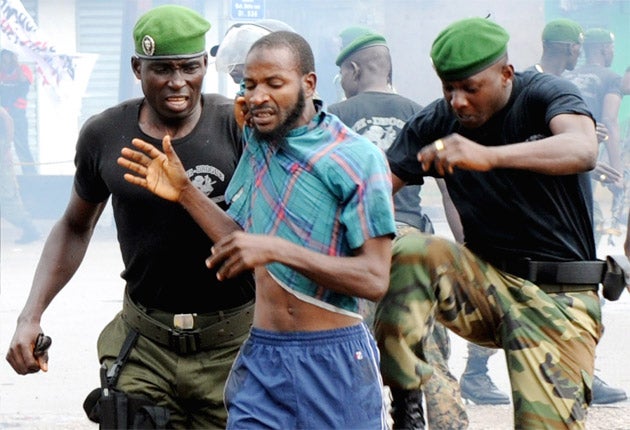
Thousands had marched to the football stadium in downtown Conakry on Monday to protest against Guinea's military junta. Nearly 160 people paid for that show of dissent with their lives, it emerged yesterday, some gunned down in a hail of bullets, other skewered by bayonets as they tried to flee or rescue the women being raped by soldiers in the stands.
As the full scale of the massacre became known, condemnation poured in from around the world. France, the country's former colonial ruler, suspended military aid and the African Union threatened sanctions. The French also called an emergency EU meeting for today to discuss punishing those individuals behind the "savage and bloody" repression.
An estimated 50,000 people had defied a ban on rallies and joined an opposition protest against the rule of Captain Moussa Dadis Camara, who seized power in a bloodless coup in December. The military ruler had promised not to stand in elections in January but rumours that he would contest them after all prompted the democracy rally.
Citing hospital sources, Thierno Maadjou Sow, president of the Guinean Human Rights Organisation, told Reuters that at least 157 people had been killed and 1,253 injured in the violence. But, amid reports that the security forces had swept corpses from the streets, Mr Sow said that his organisation's death toll only included those people whose bodies had been brought to the city's overwhelmed hospitals.
Witnesses recounted how security forces fired indiscriminately into the crowd just after noon on Monday. "Our [opposition] leaders didn't even have a chance to speak. I saw the armed men shooting directly into the crowds and shooting in the air – there was tear gas and gunshots and total panic; we ran for our lives," one witness told Human Rights Watch.
There were also reports of soldiers using knives and bayonets to finish off those protesters who had dodged the bullets, as well as female demonstrators being raped and sexually assaulted. "They were raping women in broad daylight," opposition activist Moctar Diallo told Radio France International. "Women were stripped naked. The soldiers were putting their rifles in the vaginas of these women ... I saw this myself."
Despite members of his red beret-wearing presidential guard being involved in Monday's bloodbath, Captain Camara shrugged off accusations of culpability, saying the security forces were beyond his control.
"I am very sorry," the junta leader told Radio France International. "This clash did not take place because of me... Those people who committed those atrocities were uncontrollable elements in the military. Even I, as head of state in this very tense situation, cannot claim to be able to control those elements in the military."
A later government statement noted that "according to preliminary investigations, most of the innocent victims died as a result of being crushed in the crowd."
Mr Diallo called on the military ruler to stand down. "The people of Guinea want him to leave," he said. "It's not about whether [he] runs or not in next year's election. He needs to go now."
Corinne Dufka, a West Africa expert at Human Rights Watch, said the slaughter was "shocking even by the abusive standards of Guinea's coup government". The military junta had pledged to break with Guinea's abusive past, she said; "but these deadly acts of repression and excessive use of force show how empty those promises were".
Captain Camara was unknown outside military circles until last December. Six hours after the death of the dictator Lansana Conté was announced, he broke into the state broadcaster, went on air and declared a coup d'etat.
After a quarter of a century of President Conté's rule, Guineans embraced the young captain and tuned in to the so-called Dadis show to see him name and shame drug barons, humiliate corrupt officials and interrogate the henchmen of the toppled authoritarian regime on television.
But the novelty value wore off, thanks to his unkept promises. First he delayed elections until 2010 and then appeared to renege on a pledge to stay out of the race.
Join our commenting forum
Join thought-provoking conversations, follow other Independent readers and see their replies
Comments