Hundreds of women raped by Gaddafi militia
Answers to a doctor's questionnaire reveal the attacks that have left their victims in fear of shame, Aids and abandonment
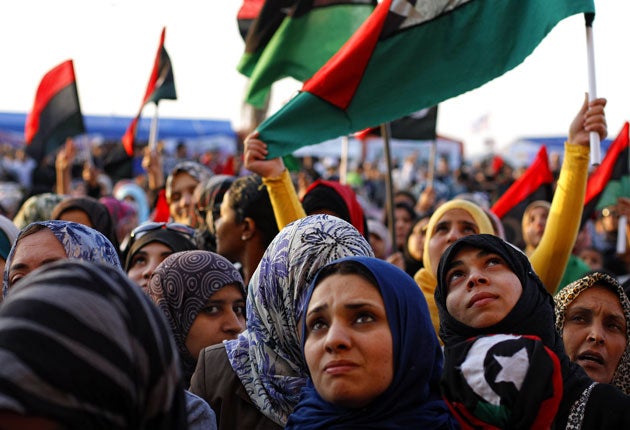
At first, the responses to the questionnaire about the trauma of the war in Libya were predictable, if tragic: 10,000 people suffering post-traumatic stress, 4,000 children with psychological problems. Then came the unexpected: 259 women said they had been raped by militiamen loyal to Muammar Gaddafi.
Dr Seham Sergewa had been working with children traumatised by the fighting in Libya, but soon found herself being approached by troubled mothers who felt they could trust her with their dark secret.
The first victim came forward two months ago, followed by two more. All were mothers of children whom the London-trained child psychologist was treating, and all described how they were raped by militiamen fighting to keep Col Gaddafi in power. Dr Sergewa decided to add a question about rape to the survey she was distributing to Libyans living in refugee camps after being driven from their homes. The main purpose was to try to determine how children were faring in the war; she suspected many were suffering from post-traumatic stress disorder (PTSD).
To her surprise, 259 women came forward with accounts of rape, which has been a common weapon of war throughout the ages, most recently in conflicts in the Balkans, Sri Lanka and in sub-Saharan Africa, where Congo has been described as the epicentre of sexual crimes.
Across the world, rape carries a stigma. But it can be a deadly one in conservative Muslim societies such as Libya, where rape is considered a stain on the honour of the entire family. Victims can be abandoned by their families and, in some cases, left in the desert to die. Speaking to a journalist is out of the question.
Dr Sergewa's questionnaire was distributed to 70,000 families and drew 59,000 responses. "We found 10,000 people with PTSD, 4,000 children suffering psychological problems and 259 raped women," she said, adding that she believes the number of rape victims is many times higher but that woman are afraid to report the attacks. The women said they had been raped by Col Gaddafi's militias in numerous cities and towns: Benghazi, Tobruk, Brega, Bayda, Ajdabiya (where the initial three mothers hail from) and Saloum in the east; and Misrata in the west.
Some just said they had been raped. Some did not sign their names; some just used their initials. But some felt compelled to share the horrific details of their ordeals on the back of the questionnaire. Reading from the scribbled Arabic on the back of one form, Dr Sergewa described an attack in Misrata in March, while it was still occupied by Col Gaddafi's forces. "First they tied my husband up," the woman wrote. "Then they raped me in front of my husband and my husband's brother. Then they killed my husband." Another woman in Misrata said she was raped in front of her four children after pro-Gaddafi fighters burned down her home.
Doctors at hospitals in Benghazi, the rebel stronghold, said they had heard of women being raped but had not treated any. However, a doctor in Ajdabiya, 100 miles south of Benghazi, said he had treated three women who said they were raped by fighters loyal to Col Gaddafi in March, when the town was invaded. "These women were terrified their families would find out – two were married, one was single," Dr Suleiman Refadi said. "They only came to me because they were terrified that they may have been infected with HIV." He added that the women had tested negative, but doubted they would return for follow-up tests.
Earlier this month, the prosecutor at the International Criminal Court in The Hague, Luis Moreno-Ocampo, said he had "strong evidence" of crimes against humanity committed by Col Gaddafi's regime, including allegations of "women arrested and gang-raped". One of Libya's leading psychiatrists, Dr Ali M Elroey, told the Associated Press that he has set up three mobile teams to treat trauma victims of the war in their homes or in temporary shelters: one for PTSD, one for other psychological problems and one for rape survivors.
Dr Sergewa said she has interviewed 140 of the rape survivors in various states of mental anguish, and has been unable to persuade a single victim to prosecute. None would speak to the AP about their ordeal, even with a promise to hide their identity. "Some I diagnosed with acute psychosis; they are hallucinating," Dr Sergewa said. "Some are very depressed; some want to commit suicide. Some want their parents to kill them because they don't want their families to bear the shame."
Some have already been abandoned by their husbands and fear that seeking treatment could get them ostracised or cast out of their communities. Others have kept their rape a secret for fear of retribution from spouses. "They fear their husbands will take them out to the desert and leave them there to die," Dr Sergewa said. She added that it is likely more rapes could occur as the conflict drags on.
"They are using rape not just to hurt women but to terrorise entire families and communities," Dr Sergewa said. "The women I spoke to say they believed they were raped because their husbands and brothers were fighting Gaddafi. "I think it is also to put shame on the tribes or the villages, to scare people into fleeing, and to say: 'We have raped your women'."
Dr Sergewa says women will continue to be targets of the militiamen, and this makes it all the more urgent to finish her study. "We must throw light on what is really happening in Libya and fight to bring justice for these women, to help heal them psychologically," she said.
AP
Join our commenting forum
Join thought-provoking conversations, follow other Independent readers and see their replies
Comments