'I was a doctor in Rwanda, not a mass killer'
Dr Vincent Brown, who won a battle last week to stop his extradition on genocide charges, speaks exclusively about his two-year ordeal
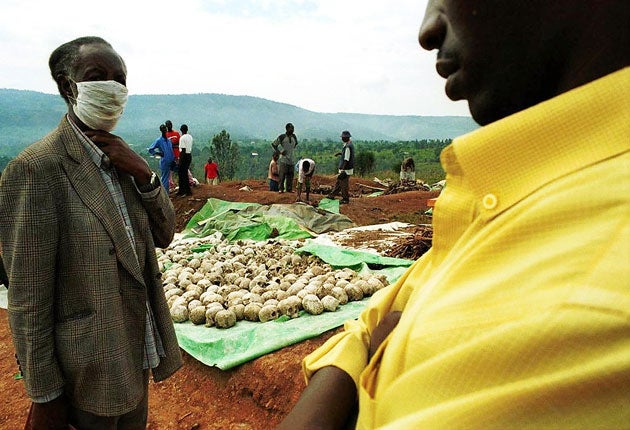
Vincent Bajinya had already left one nightmare behind. He had seen first hand the horrors of the civil war in Rwanda as a doctor in the capital, Kigali, and was forced to flee when the genocidal madness that overtook the country in 1994 looked like it would catch up with him.
Twelve years later, however, after rebuilding his life in Britain and changing his name to Vincent Brown, out of nowhere his second nightmare began. As he parked his car outside the refugee charity where he worked, Dr Brown was "ambushed" by a BBC camera team.
What, they asked, did he say to allegations that he helped organise some of the horrendous murders that took place when an estimated one million people were slaughtered in just 100 days?
"I was stunned," Dr Brown told The Independent on Sunday in his only newspaper interview. "I was aghast. I was accused on that BBC programme of being a killer. Even now I have not been able to get over it."
He was suspended from his job and then arrested, spending the next 27 months in Belmarsh prison while he fought the desperately slow extradition process. He was released only on Wednesday after the High Court ruled he would not face a fair trial in Rwanda and that there was "substantial doubt" over the allegations.
Although Dr Brown, a Hutu, was not a critic of the Rwandan government – now dominated by the minority Tutsis – he claims that simply successfully rebuilding his life was enough for the authorities to try to bring him back and lock him up – potentially for life.
The Rwandan government's allegations, made 12 years after the event, relied, for example, on witnesses who had never mentioned his involvement when the killings were originally investigated several years ago. He was accused of two killings in different parts of the country at the same time.
"It's a tendency for the Rwandan government to use genocide to destroy any perceived opponents outside Rwanda," he said. "If you're trying to get on with your life, you may get a good job – you flourish – [but] they find a way of destroying you and the best way is to use genocide."
Although Britain has no extradition agreement with Rwanda, the Home Office granted a special certificate to allow the extradition of Dr Brown and three other co-accused.
"When I was arrested in 2006 I was maybe thinking I go and come back the following day," Dr Brown continued. "I did not expect to be in there for 27 months.
"Because the charges against me are pure fabrication there was no prospect of a fair trial in Rwanda, so it was a double stress, not knowing if I can win the case, and knowing that if I go back, I'm facing ill treatment."
Dr Brown has consistently said he would be happy to face trial in this country, and so clear his name. The Crown Prosecution Service (CPS), however, says it has no jurisdiction to do this.
Dr Brown's QC, Alun Jones, disagrees. He argued in the extradition proceedings that more trials of suspected international criminals should take place here as opposed to protracted extradition cases which often fail, and that the provisions in the International Criminal Court Act allow for trials for genocide.
"I suspect that the reason for failing to try the Rwanda suspects in the United Kingdom is that the authorities accept there is not the faintest hope that a conviction could ever be obtained," he said.
"Of course we can try the men here. The problem is not a lack of jurisdiction. It is that neither UK nor international law provides any mechanism for deciding where a case should be tried which could be tried in more than one state, and we too readily opt for extradition not trial."
He pointed out that there are at least four other suspects in Belmarsh who have not been tried because the CPS is trying to extradite them. Abu Hamza has been locked up for four years, and another terror suspect, Khalid al-Fawwaz, has been waiting extradition to America for 10 years.
"I was not involved in any political movement," said Dr Brown. "I was just a medical doctor treating everybody who came to see me. During the civil war I continued to do my job.
"I fled after the assassination of the President [which sparked the genocide] because the Rwandan Patriotic Front was reportedly killing Hutus.
"I drove my car to Congo. I had my wife and one son. All I took was my certificates and my family. I left my parents behind. Even now for the past 14 years I was not able to see them. I've just talked to them over the phone.
"You don't know where you will end up. You don't choose. When I ended up in Britain I didn't think I could ever be accused of killing anybody. I just wanted to get on with my life."
Dr Brown arrived in this country in 2000. Unable to find work as a doctor because of the rules of the General Medical Council, he took a job working with a refugee charity.
"I'm married with two children," he added. "My son is now 17 and my daughter 12. I've missed two years of them growing up. I was always very anxious about what was happening with them. They could visit once a week. That was the only pleasure for the past 27 months."
Yet Dr Brown is surprisingly forgiving. "I'm angry against the people who falsely accused me," he said. "But I'm not trying to settle any scores. And I have no resentment against the British Government. They arrested somebody who was accused of terrible crimes and it was right to do so."
Join our commenting forum
Join thought-provoking conversations, follow other Independent readers and see their replies
Comments