Independent Appeal: Connecting the middle of nowhere
Thanks to the work of Computer Aid, the Zambian village of Macha has a gateway to the rest of the world

For free real time breaking news alerts sent straight to your inbox sign up to our breaking news emails
Sign up to our free breaking news emails
If nowhere really has a middle, then it can't be far from Macha. This southern Zambian village is about 50 miles from the nearest town and two hours' drive from the nearest paved road. Nonetheless, 130,000 people live within a 20-mile radius.
Macha is rural Africa, the place where some two-thirds of the billion people on the continent actually live. Africa's rural reality rarely includes access to electricity, transport, roads or healthcare – and much the same could be said of Macha until recently.
So it's a surprising place to find shipping containers. And an even more surprising place to find the largest wireless internet network in rural Africa.
The two things are connected. The shipping containers were dispatched to Macha by the the UK charity Computer Aid, which collects and refurbishes used IT equipment and redistributes it in the developing world. It is one of three charities for which we are raising funds in this year's Independent Christmas Appeal, which closes at the end of this week.
Wireless routers similar to those in many UK homes work just as well in the Zambian bush. "The community first gained an internet connection from the hospital satellite dish," says Tony Roberts, CEO and founder of Computer Aid. "They have since learned how to used plain wireless routers to bounce the signal around the village to create the largest wireless network in rural Africa."
The key to success in Macha has been the charity's local partner, LinkNet, which has put community members in charge of developing their own ideas and approaches. As a result of this co-operation, around 200 PCs and 400 wireless routers now form a "mesh network" connecting the hospital, malaria research centre, nurse training centre, schools, community centre and homes. All of which leaves one question: Does rural Zambia need the internet, and if so, why?
If anyone can answer that it's Fred Mweetwa, a farmer who has become a spokesman for the community – as well as one of its leading entrepreneurs and host of his own radio programme. He works closely with LinkNet to encourage people to make use of the new technology.
This was an area where farmers had previously not grown much more than maize to feed their families, he explains. But the internet taught them that the soil and climate is suitable for sunflowers. It has moved them from being merely subsistence farmers to producers of a cash crop.
"Many people have been motivated to plant sunflowers in areas where they never were planted," Mr Mweetwa adds. Sunflowers, thanks to the internet, have leapt in popularity to become the area's second biggest cash crop, helping to pay school fees for hundreds of children.
Despite poor rains, Mr Mweetwa's harvest from 25 kilos of seeds, for example, was 1,750 kilos in 2007, providing jobs for 10 local people and leaving him enough seed to barter for maize and four sheep and still have animal feed left over. Mr Mweetwa also works as a preacher, talking up the entrepreneurial spirit at local churches. "As a farmer, the internet has changed my way of life because people can do wonders, miracles through the internet," he says. "Our economy as a rural area has greatly improved."
Young people are even moving into the area to chase opportunities, with at least 1,000 new jobs created. Nurses are using IT to train and access medical resources, and most adults have re-engaged with education through online eLearning courses.
The area has also played a long-term role in malaria research, in a partnership with Johns Hopkins University in the US. In fact, LinkNet was born out of that research, which brought a Dutch tropical medicine researcher, Dr Janneke van Dijk, to the area in 2001. She and her husband, Gertjan van Stam, saw an opportunity after the arrival of mobile phones six years ago to bring the internet to the community, with a satellite dish at the hospital in 2004.
Mr van Stam, encouraged by early enthusiasm from the community, helped set up LinkNet. People like Mr Mweetwa, he says, "are the local heroes. People here have ideas, and when they search on the internet they can get the training and start to do the entrepreneurial stuff."
Dr van Dijk says the three-step approach of getting wired, finding local talent to take the lead, and building local initiatives is increasingly seen as a model for development. Macha gets 1,000 visitors a year, including community representatives from all over the country and researchers from Zimbabwe and South Africa. The Zambian government now plans to replicate the "Macha miracle" at 100 other sites nationwide. Chief Chikanta, the traditional leader of an adjoining area which is about to receive a shipment of PCs from Computer Aid, believes the Macha model is a good one. "LinkNet lets the outside world know what life is like in Macha, and brings that world to people here," he says.
As for the malaria that brought the outside world to Macha, that is almost completely defeated, with infections down 90 per cent and no children suffering from the disease in hospital over the holidays this year.
"She has worked herself out of a job," Mr van Stam jokes of his wife. "Now that there's no malaria, almost, there's nothing to clinically study, but they are looking at HIV and TB."
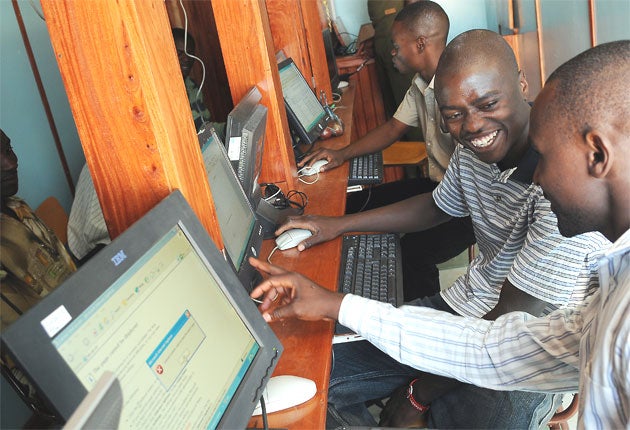
As for the shipping containers, they have been refitted with computer booths and inviting wooden doors to create some of Africa's first rural internet cafes.
Subscribe to Independent Premium to bookmark this article
Want to bookmark your favourite articles and stories to read or reference later? Start your Independent Premium subscription today.
Join our commenting forum
Join thought-provoking conversations, follow other Independent readers and see their replies