International Criminal Court staff freed from Libyan prison after painstaking international negotiations
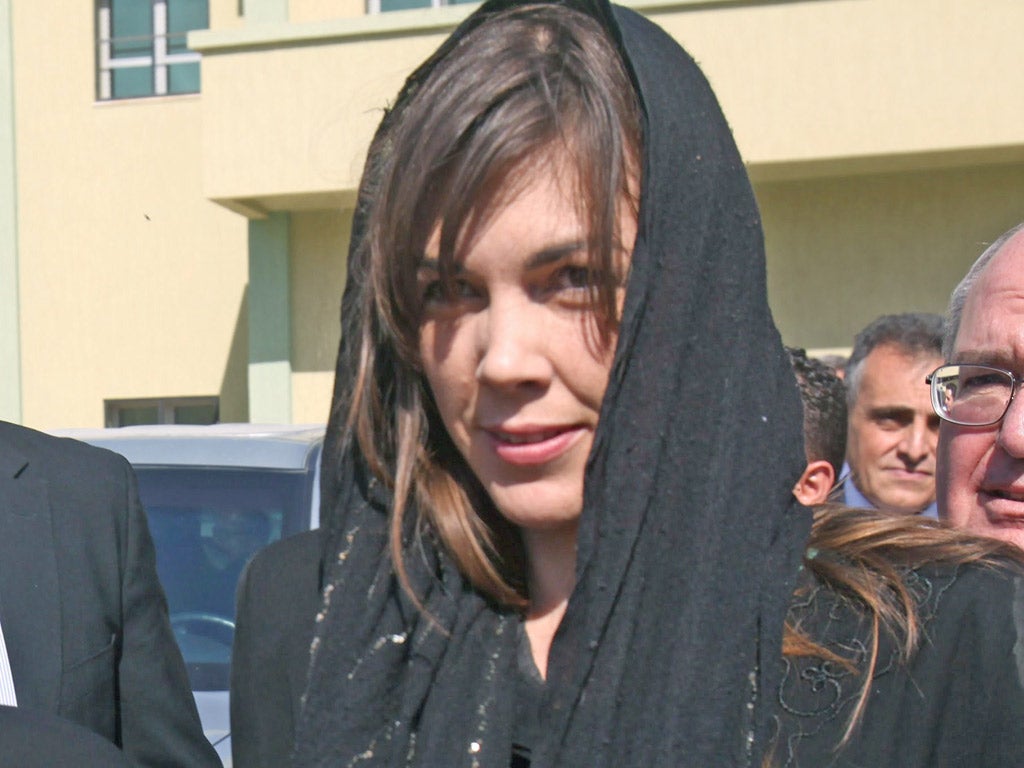
Four staff members of the International Criminal Court (ICC), who had come on an official visit to meet Saif al-Islam Gaddafi, Libya’s most famous prisoner, and had ended up in jail themselves, were finally freed today after painstaking international negotiations.
Days ahead of the country’s first elections for half-century, the release took place after senior government ministers, foreign ambassadors and the ICC president had driven down to Zintan in a convoy to pay homage to this medium sized town for its “leading role in the revolution”, the “upholding of democratic values” and “matchless sacrifice”.
It was after the ICC president Sang-Hyun Song had apologized profusely for any misdemeanours by his staff, making seven references to the achievements of Zintan, which he found “overwhelming”, that Australian lawyer Melinda Taylor and her three colleagues were freed.
Reiterating their generosity, the men who run Zintan laid on a celebration lunch for the freed prisoners and VIP delegation, to which, to show their openness, some members of the foreign media were invited.
Ms Taylor said she was “very happy” to be able to return to her family. The proceedings on a hot and dusty afternoon also reinforced, however, the image of power the Republic of Zintan has projected since the overthrow of Muammar Gaddafi.
Ms Taylor had been guilty of trying to smuggle incriminating documents and a camera to Saif al-Islam, according to Alejmi Al-Atari, the militia chief who captured him. Commander Al-Atari also stressed later that the fallen dictator’s son will not be transferred to the government in Tripoli, let alone the ICC in The Hague. “He will be tried here, in Zintan for crimes, for all his oppression. Zintan can take care of justice for the Libyan people.”
Until recently, the Zintan battalions, which have more than 15,000 men under arms, “took care” of the capital’s airport, which is steadily opening up to foreign and domestic flights and becoming the main transport hub of the country. It is nominally now under the control of the Tripoli administration, but the Zintani presence is still very much there to see.
The Zintanis had become “protectors” of the capital after proclaiming themselves to be the liberators of city. This was a claim hotly disputed by fighters from Misrata, Benghazi, as well as the Sons of Tripoli brigade. It had also led to a series of blood clashes on the streets leaving dozens dead and sowing deep animosity between the various groups of former revolutionary fighters.
Tripoli itself is relatively peaceful now with Zintan distracted by another conflict, this time with Al-Mashashiyah, a neighbouring community, in which around 120 have been killed and more than 500 injured so far.
Anti-aircraft artillery has used as a ground weapon, rocket propelled grenades and heavy machine guns have been in action in the fighting. The Libyan Human Rights Observatory has accused the Zintanis of using mustard gas, although there is little evidence to support this.
Omar Buseifi, a doctor who heads the emergency unit of the hospital at Gheryan, a town at the scene of the clashes stated that he had personally dealt with documenting around 80 deaths, most of them from the Mashashia community. He said: “There were lots of wounded people as well many of them serious, mainly men, but also some women and children as well. The fighting has calmed down a bit, but we don’t know when it will start again.”
The lull is partly due to the arrival of a force sent down from Tripoli with the head of the National Transitional Council (NTC), Abderrahim al-Keib, demanding both parties stop “the killing of innocent people and making families homeless.”
But it took more than a week for the administration to send the troops. NTC spokesman Nasser al-Manaa said: “It was difficult for the army to intervene directly at the beginning out of fear of provoking further casualties.”
There is a general perception that the NTC does not “want to mess” with the Zintani fighters who are well equipped after helping themselves to heavy weaponry from the regime’s abandoned arms caches.
That certainly is the view of Abdelmohammed Ibadullah, a Mashashia elder. “The people in Tripoli are scared of Zintan… it is only two hours drive away from Tripoli and they don’t want to make them angry. In the meantime, it is we who are suffering.”
With five days to go before the first polls of ‘Free Libya’, the NTC is at pains to avoid confrontations in an already tense situation with repeated outbreaks of violence in the south, west and east of the country.
In one of the most serious eruptions, on Sunday evening, hundreds of protestors, many of them armed, sacked the offices of the election commission in Benghazi and Tobruk. Activists in the two eastern cities, where the Libyan uprising had started last year, are angry at what they see as unfair distribution of seats for the election.
The demonstrators carried banners condemning NTC leaders from the east of being traitors to the region. Computers, ballot boxes and electoral rolls were burnt in the streets with footage disseminated through the Internet.
Benghazi has also seen the appearance of gunmen in cars flying the black flag of al-Qa’ida, the bombing of the city’s US consulate and an ambush of a convoy transporting the British ambassador Dominic Asquith, in which protection officers were injured.
One man sees trouble ahead unless stronger figures take charge. “The government needs to work on building security first before working on elections. I will be boycotting what they call this election and so will many others,” said Mokhtar Lakhdar, who was, until two months ago, busy working on security at the airport, for the Zintan Brigade.
Join our commenting forum
Join thought-provoking conversations, follow other Independent readers and see their replies
Comments