Johannesburg at risk from acid lakes
Rising toxic water levels from abandoned gold mines threaten the city and have blinded wild hippos
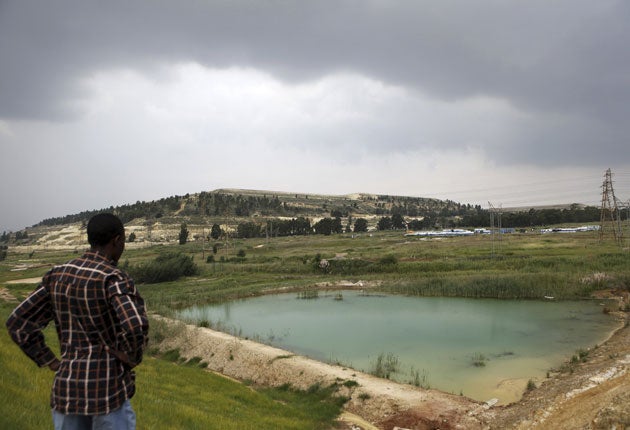
South Africa's city of gold, Johannesburg, may soon start being eaten away by acidic water flowing from the mines that created its astronomical fortunes. Mines dug more than a century ago stretching about 25 miles along one of the world's largest gold deposits have reached their water-storage limit and will start leaking a toxic cocktail of chemicals in the coming months, independent experts and government officials have said.
If left unchecked, acidic mine water is expected to foul up works near the country's Apartheid Museum, flood basements in central Johannesburg and seep into the streets of the city of about four million people. "The threat of acid water decanting from old mine workings is a real and present danger. It poses a threat to our economy, environment, health and history," Terence McCarthy, a professor of geosciences at the University of the Witwatersrand, wrote in a report.
Already, in some parts, the leaching is happening. In the western Johannesburg suburbs, acid mine water began leaking in 2002; in towns such as Krugersdorp, acidic lakes dot the landscape near large open piles of chemicals extracted from mines. Signs warning of radiation are posted outside a sludge-filled pool; hippos at a nearby nature reserve are going blind because of what is thought to be acid water run-off, and fish are dying in polluted water near the Cradle of Humankind World Heritage Site.
Acid mine drainage has plagued derelict mines globally for decades but most of the damage has been in remote areas. The problem for Johannesburg is that it was built over its gold mines and that land now is home to some of the country's biggest firms and greatest population densities.
About three years ago, the last major pump removing water from the mines stopped, signalling an end to a gold rush that brought wealth to a few while hundreds of thousands of black Africans went underground to dig.
Then the water began to accumulate in the massive underground cavities, reacting with rocks formed about 2.8 billion years ago and triggering chemical reactions that produced sulphuric acid, heavy metals, toxins and radiation. The water, once about 1,000ft underground, has been rising at an average rate of 50ft per month, with the void expected to fill up completely in less than three years.
The leakage problems will be small at first and grow costlier the longer action is delayed, experts said. Professor McCarthy said the spillage can be avoided by immediately setting up two pump and treatment stations along the main gold reef to keep the water to at least 1,000ft below the surface. "The solutions are expensive, though not technically daunting – and must be implemented in a matter of months," his report said.
The government agrees that urgent action is needed but has given little indication it will do anything before the acid water reaches underground facilities in Johannesburg. A report from government-appointed experts planned for release last month has yet to see the light of day.
Along with finding a way to solve the problem, the government has yet to figure out how to pay for it. It cannot pass the bill on to firms as ownership of mines has changed hands so often and many firms have vanished. There is not enough gold left to make it commercially viable for a new firm to go in and pay for a clean-up. The environment ministry several years ago warned of the escalating costs of inaction, saying in a report: "If the threat from acid mine drainage is not solved in the short to medium term, it is likely to persist for centuries to come." But environmental protection ranks low in the state's budget.
Sandile Nogxina, director-general of the Department of Mineral Resources, told parliament last year: "We will not allow the situation to get out of hand; it will not reach crisis proportions."
But others are not reassured. "The fact that the government has not acted is astonishing," said Mariette Liefferink, chief executive of the Federation for a Sustainable Environment. "Over 120 years, there were more than 120 mining companies that passed on or externalised their costs. There are no short-term, medium-term or long-term plans in place. It is just crisis management."
Join our commenting forum
Join thought-provoking conversations, follow other Independent readers and see their replies
Comments