Libyan rebel leader says MI6 knew he was tortured
Abdelhakim Belhaj was delivered into Gaddafi's hands by MI6, then brutally attacked. Kim Sengupta meets him
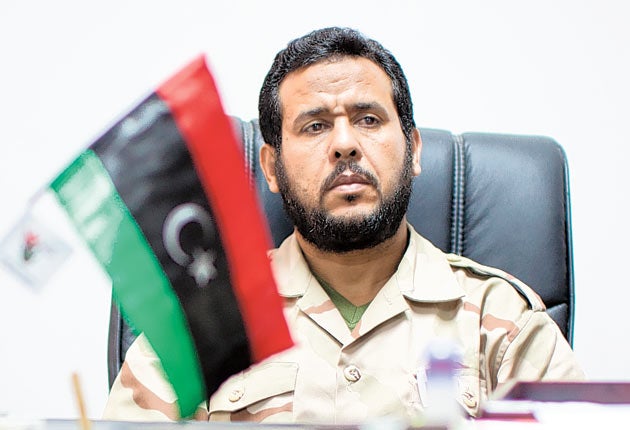
"They knew I was being tortured, I have no doubt of that," Abdelhakim Belhaj, a former prisoner who is now the rebel security chief of the Libyan capital, said about the British intelligence agents who came to interrogate him while he was in the hands of Muammar Gaddafi's secret police.
"I hoped they would do something about it. I was too terrified during the meeting to say out loud what was being done to me because I thought the Libyans [secret police] were taping what was going on. When the Libyan guards left I made sign movements with my hands.
"The British people nodded, showed they understood. They showed this understanding several times. But nothing changed, the torture continued for a long time afterwards."
The appalling treatment inflicted on Mr Belhaj, a former head of the Libyan Islamist Fighting Group (LIFG), is now in the centre of an international diplomatic storm. The Independent revealed, after discovering secret files in Tripoli, how Britain played a key role in the rendition of Mr Belhaj, which delivered him into hands of the Gaddafi regime for seven years of incarceration, six of them in solitary confinement.
Mr Belhaj's vehement claims that British officials were fully aware of the maltreatment he was undergoing and lays the UK intelligence services open to charges of direct complicity. There is nothing to suggest in a tranche of MI6 papers that the UK raised concerns about his ordeal with the regime.
Instead there are repeated requests to the Libyan secret police for information about Mr Belhaj, including one believed to be from Sir Mark Allen, who was then MI6's head of counter-terrorism and now works for BP, when arranging Tony Blair's visit to meet Colonel Gaddafi. "I was grateful to you for helping the officer we sent out last week. Abu Abd Allah's [a nom-de-guerre for Mr Belhaj] information on the situation in this country is of urgent importance to us."
Speaking to The Independent in a Tripoli hotel now being used by the Transitional National Council (TNC), Mr Belhaj described being interviewed by three British agents, one woman and two men, at the security headquarters of Moussa Koussa, who was then Libya's spymaster. The two questioning sessions each lasted about two hours. The name of the female officer is known to The Independent but it is not being published for security reasons. Documents show that she was one of the most frequent visitors to Tripoli under the Gaddafi regime.
"The British people they sent were real experts, they knew the names of LIFG members in England, even their codenames. I have been told [by regime officials] that if I named them as being involved with al-Qa'ida they would be returned to Libya and my own conditions would improve. I was given names of other opposition people who were not even members of LIFG, who I did not even know," Mr Belhaj, 45, said.
"I told the British, as I told everyone else, that LIFG had no link with al-Qa'ida. I knew making a link would stop what was happening to me, but I was not going to do it. I showed the British about what was happening to me."
Mr Belhaj's sense of being betrayed extends beyond the unheeded plea for help to the UK agents during his interrogation. After being arrested in Malaysia as a suspect during the US-led "war on terror", he had applied for asylum to the UK, which was supposedly granted. Instead, British intelligence used the system to start a chain of events that led to his rendition to Libya. As Mr Belhaj and his wife, who was four months pregnant, travelled from Kuala Lumpur to the Thai capital, Bangkok, on the way to London in March 2004 they were arrested by CIA officers and the Thai police.
Mr Belhaj said he was subjected to physical abuse in Thailand before being moved to Abu Salim prison, a place of fear for Libyans where torture became a daily occurrence and often involved being suspended from the ceiling by his wrists.
Mr Belhaj, who was released from prison under an amnesty by the regime earlier this year, said yesterday: "My wife is still badly affected by what happened, even after all these years. It was very frightening for her. I am angry that the asylum application was used in this way. I thought Britain was a place where human rights were respected. I thought it was a place I could go to be safe. Instead, they used this to trap me.
"Britain, America, they demand that other countries follow laws on human rights. But I want to know, are there intelligence people above the law? Can they do whatever they like with people's lives? I am waiting for legal advice on whether I can sue the British Government. But these are the questions I would like to have answers to."
As a public inquiry is ordered in London into the complicity of the British intelligence service into the mistreatment of Libyan prisoners, Geoffrey Robertson QC, the human-rights barrister, is studying the evidence in preparation for possible legal action by Mr Belhaj against the UK Government.
Peter Bouckaert, the emergencies director for Human Rights Watch, who sent documents to Mr Robertson, said in Tripoli yesterday: "[the] CIA and MI6 appeared to have broken their own rules on information gained through torture. There may well be a civil case brought by Mr Belhaj. On a broader point it is essential that Islamists know that they have a part in the political process. This is essential for democracy."
At the time of Mr Belhaj's arrest, Sir Mark Allen wrote to Moussa Koussa in self-congratulatory tone. "This was the least we could do for you and for Libya to demonstrate the remarkable relationship we have built over recent years. I am so glad... amusingly, we got a request from the Americans to channel requests for information from Abu Abd Allah through the Americans. I have no intention of doing any such thing. The intelligence on Abu Abd Allah was British. I know I did not pay for the air cargo [Mr Belhaj]. But I feel I have the right to deal with your direct on this and am very grateful to you for the help you are giving us."
The issue raises deep and disturbing questions about the morality and ethics of the West. Nato bombed Libya for six months supposedly to free its people from the tyranny of Colonel Gaddafi. But the documents found strewn in the abandoned ministries of the regime are grim testimony to how the same countries were eager to get information extracted under extreme brutality by the dictator's henchmen.
"There was a queue of people here to see me," Mr Belhaj said. "The Americans were first then the British, they knew what was going on. France, Germany, Italy, Spain. They all came with questions. They all dealt with Gaddafi."
Join our commenting forum
Join thought-provoking conversations, follow other Independent readers and see their replies
Comments