Mercenaries join Mugabe's ruthless terror campaign
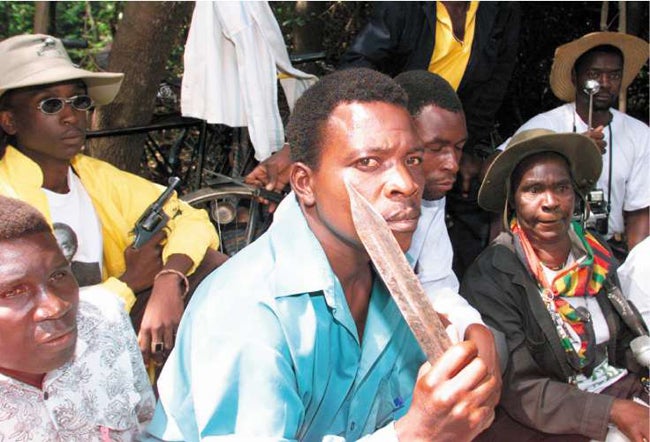
Foreign mercenaries have joined so-called "war veterans" and militiamen attacking opposition supporters in rural parts of Zimbabwe, human rights workers have confirmed.
Eyewitnesses say the men are more vicious than their Zimbabwean counterparts, with the marauding gangs attacking suspected members of the Movement for Democratic Change (MDC), forcing them to renounce the party.
They dress in army fatigues, carry Russian-made guns and are accompanied by interpreters when out with the militias.
Patrick Chitaka, the MDC chairman in Manicaland province in the east of the country, said the foreigners had been identified in the past two to three weeks supporting government-backed men.
Mr Chitaka said: "We have observed that some of the people leading the violence are foreigners because they speak a different language and they do not understand our local languages.
"Also the tactics they are using are not peculiar with Zimbabweans because they are cutting out the tongue, removing eyes and genital parts. We are not sure where they come from."
It is the first time reports of foreigners fighting alongside Zanu-PF have surfaced. Since losing the presidential vote on 29 March, Robert Mugabe and an inner circle of military and intelligence chiefs have launched a military campaign of violence against opposition areas which voted against him and his party.
More than 100 people have been killed, thousands injured and more than 200,000 displaced as gangs target one-time MDC strongholds.
The claims were supported by human rights workers in Manicaland last night. A spokesman for one group who did not want to be named said observers on the ground had witnessed "tens, if not hundreds" of foreigners accompanying government-backed militias. He said the soldiers were not from neighbouring countries but were more likely from farther north in Africa, possibly Rwanda, Kenya or Uganda.
Local people claim the irregular forces are Hutus from Rwanda, but the human rights representative said he could not be definitive. There are an estimated 4,000 Hutu refugees living in Zimbabwe, some of whom took part in the genocide of Tutsis and moderate Hutus in 1994.
Many fled the country, seeking asylum after the killings, which destabilised neighbouring countries especially the Democratic Republic of Congo.
The human rights official said: "These men do not speak any local languages and are extremely violent. They are attacking people in their homes and as they get off buses, giving them terrible beatings. We do not know what these people are doing in Zimbabwe. There is a problem identifying these people. You cannot go to the police because they say it is political – they are not interested."
The spokesman said observers in two constituencies – Makoni South and Makoni West – west of Zimbabwe's third city of Mutare, had calculated there were up to 200 foreigners spread across both areas.
"There are between six and 10 foreigners in each base, and there are 20 Zanu bases in the two constituencies. They wear military uniform, carry guns especially shotguns which we think are Russian. They are cruel and brutal. Each unit has an interpreter who tells them what to do. People here live close to several borders and they know Portuguese from Mozambique and languages from Malawi and Zambia. They don't speak any of those or English.
"The tongues are from much farther up north – Kenya, Uganda or Rwanda."
Mr Chitaka added: "People are very scared of them because they know no bounds. They go house-to-house in MDC areas and beat people and force them to shout for Zanu-PF. The men then get their victims to beat their neighbours in the same way.
"They have gang-raped women and abducted them. People are missing but families are too afraid to look for them."
Rwandan refugees fear they may be sent home if an MDC-led government came to power. Despite internationally backed efforts to rehabilitate Hutu refugees, fears remain among exiles that those returning will face persecution from the government of President Paul Kagame.
Among those Hutus staying in Zimbabwe is said to be Protais Mpiranya, the former head of the Rwandan presidential guard during the 1994 genocide. He is on the wanted list of the International Criminal Tribunal for Rwanda, but is suspected to have strong business links with senior Zimbabwe army officers.
The United Nations High Commissioner for Refugees' representative in Zimbabwe, Marcellin Hepie, said a change of government would not necessarily see repatriation of refugees.
Oppression by numbers
*115 Movement for Democratic Change supporters killed in attacks by police, army, war veterans and ruling party militia
*More than 200,000 displaced by the violence since the elections on 29 March
*Three million at risk of starvation after ejection of aid agencies by government
*1,450 documented cases of state-sponsored beatings, torture or assault of opposition supporters
*Inflation now running at two million per cent. There are 350bn Zimbabwe dollars to the pound
Join our commenting forum
Join thought-provoking conversations, follow other Independent readers and see their replies
Comments
Bookmark popover
Removed from bookmarks