Migrants flee South Africa as wave of violence spreads to Cape Town
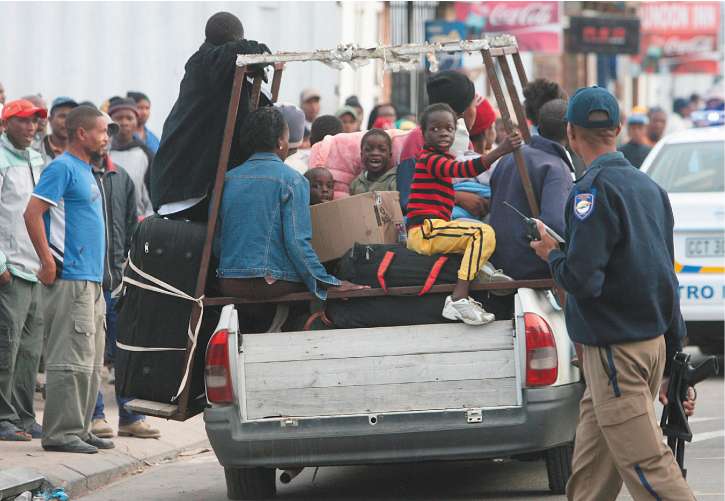
The wave of xenophobic violence that has convulsed South Africa reached Cape Town yesterday with mobs looting shops and immigrants forced to flee a squatter camp which came under attack on the outskirts of the city.
At the same time neighbouring Mozambique declared a state of emergency to help its citizens fleeing the attacks, warning the "exodus will worsen" as thousands are still housed in makeshift camps awaiting transport back home.
At least 42 people have been killed and more than 25,000 foreigners displaced since attacks began in Johannesburg earlier this month by South Africans who blame them for crime and unemployment. The violence which has included shootings, lynchings and people doused with petrol and burnt alive has badly tarnished the rainbow nation image the country has treasured since the end of apartheid.
With violence now reaching the city central to South Africa's valuable tourism industry the government sought to deflect mounting criticism of its handling of the crisis by blaming right-wingers linked to the former apartheid government for fanning xenophobic violence.
Manala Manzini, head of the National Intelligence Agency, said people linked to former apartheid security forces were stoking the violence.
"Definitely there is a third hand involved. There is a deliberate effort, orchestrated, well-planned," he told Reuters. "We have information to the effect that elements who were involved in the pre-1994 election violence are in fact the same elements that have re-started contacts with people they used in the past."
The violence in Cape Town was not on the scale of the rampages in Johannesburg with gangs accused of using the crisis as cover for opportunistic looting. Billy Jones, Cape Town police spokesman, said about 400 people had sought shelter on a racetrack after 12 people were injured in overnight attacks on an informal settlement in Cape Town.
"The area is quiet now but we are maintaining a visible presence," he said, adding that many of the displaced had been moved to various community centres and town halls.
Somali-owned shops were also looted in Knysna, a resort town on the south coast.
Predicting an "exodus", Mozambique's Foreign Minister, Oldemiro Baloi, said the state of emergency had been declared on Thursday as thousands of Mozambicans flooded across the border.
Mr Baloi said about 10,000 people had returned on their own while 620 people arrived on Thursday in buses arranged by the consulate in Johannesburg.
With the emergency declaration, the Mozambican government can release money and aid to help those returning. They are being transported from the capital to their home towns and given clothes, food, blankets and basic domestic implements so they can start again.
South Africa's President, Thabo Mbeki, has mobilised the South African National Defence Force for the first time since the end of apartheid in 1994. Soldiers were used in a dawn swoop on three central Johannesburg worker hostels whose residents allegedly were involved in inciting violence. A total of 28 people were arrested.
The crisis has confronted many of South Africa's estimated five million immigrants with some appalling dilemmas. About three million Zimbabweans, fleeing the collapse of their own country's economy, are generally better educated than many poor South Africans, who accuse migrants from neighbouring countries of stealing scarce jobs. Few of the Zimbabweans could expect to find any work were they to return to their own country – currently beset by a violent political campaign by its own government. And millions of Zimbabweans who have remained north of the Limpopo river rely on their relatives in South Africa to send them the money needed to survive.
Voices of the victims
Justin
"When I go out I have to be very cautious, not stay anywhere a long time. I pay attention to what is happening around me. I don't talk to anyone and not look at them in case they know I am Zimbabwean and want to attack me.
"We have talked about leaving because of the killings. It is very worrying but for the moment we are staying. You have to understand what is happening back home. Things are bad there. We have no option but to stay. I resigned from my job in Zimbabwe to come here to start a new life. We have parents back home to take care of. If I went back, I could not get a job with the government for two years and I would be unemployed and destitute. I don't want to be unemployed – but if the worst comes to the worst here, our lives are more important and we would go. We won't be killed in Zimbabwe."
Thabiso
"I was awoken by the sound of screaming on Monday. A shack belonging to a Mozambican immigrant had been set alight. He tried to escape the fire. But the residents were armed with all sorts of weapons and AK-47 rifles. They shouted, 'Umbambe engabaleki', which means 'Don't let him run away' in Zulu. The mob caught up with him, doused him with petrol and threw him back into the burning shack. I have never seen such barbarism. I cannot stand this kind of life.
"Some other Zimbabweans and I ran to take shelter in a shack owned by a South African woman. Other residents, who had seen us taking refuge followed, shouting, 'Where are the foreigners?' They were armed with sticks and knives. The owner told the attackers we were South Africans. What saved us was that we could speak Zulu."
Nyiko
Nyiko Ngobeni of Chikwalakwala, Mozambique, told the CAJ news agency how he witnessed the killing of three of his best friends
"I am experiencing nightmares every day now. Each time I close my eyes, I see my three friends being butchered in cold blood. The four of us were asleep when some thugs started attacking us. I survived through faking death. I smeared my friend's blood on my chest, mouth and nose, to fool them. They only left after being convinced we were all dead. I'm not going to risk my life again. South Africa was good for us, but I will never set my foot in Johannesburg again. I now hate South Africans."
Join our commenting forum
Join thought-provoking conversations, follow other Independent readers and see their replies
Comments