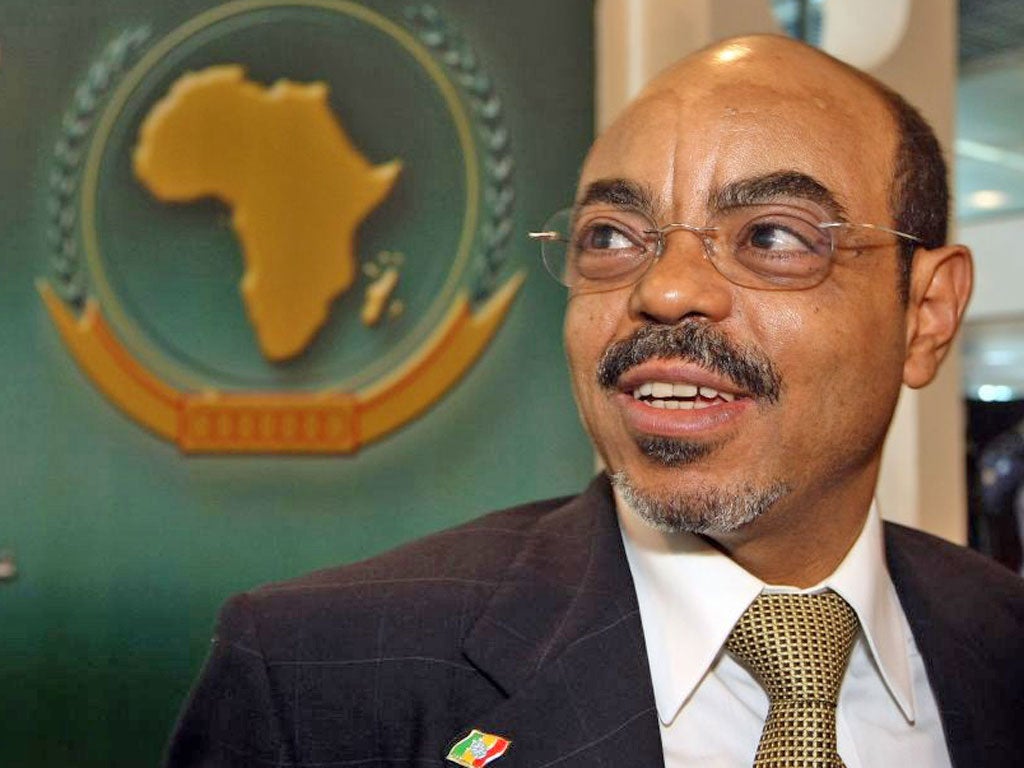
Ethiopia's missing prime minister has been taking part in diplomatic efforts to resolve the Sudan crisis from his sick bed, according to African Union officials.
Meles Zenawi, Ethiopia's normally highly visible premier, has not been seen in public since June, and his government has refused to release any details of his condition.
His disappearance saw opposition groups claim that the 57-year-old had died, while there are unconfirmed reports that he has been treated for a brain tumour.
His absence became more apparent as Ethiopia hosted an important African Union summit in the capital, Addis Ababa, where Mr Meles would have expected to lead efforts to defuse the crisis in DR Congo and the simmering dispute between Sudan and newly independent South Sudan.
Despite his failure to appear at the summit – where his wife played host to African leaders – the AU say he has been in regular contact with the their chief mediator in the Sudans' dispute, the former South African president Thabo Mbeki.
Mr Meles was understood last month to be being treated in a hospital in the Belgian capital, Brussels, but Ethiopian officials insist he has since returned to Addis Ababa. The influential information minister, Simon Berekat, a close ally of Mr Meles said he expected him to return to work “soon” and that he had taken “sick leave”.
A former guerrilla leader with one of the groups that overthrew dictator Haile Mengustu Mariam in 1991, Mr Meles has since been the dominant force in Ethiopia. Known as a shrewd and intellectual leader, he has been a regular at global forums such as the G20 and a star turn at the World Economic Forum.
Under his stewardship Ethiopia has been credited with significant economic progress, posting eight consecutive years of more than 10 per cent growth. That progress has turned the country into a favourite of Western donors, who are pumping up to $4bn (£2.6bn) annually in the Horn of Africa nation. Despite the scale of humanitarian aid and Addis' role as a close ally of the US, Mr Meles has developed strong ties to China.
Ethiopia currently has troops serving as peacekeepers in Sudan and Somalia – where they are battling Islamic militants al-Shabaab.
The prime minister's absence has raised concern across the region with his Kenyan counterpart Raila Odinga admitting in interviews this weekend that he is in the dark over the state of his health.
Critics have accused Mr Meles of creating a one-party state that is dangerously reliant on him.
Ethiopia is nominally governed by a coalition, the EPRF, which represents all of the country's major regions and ethnic groups and has some four million members. However, the ruling party is dominated by an inner circle, including the powerful army chief of staff, from Mr Meles home area of Tigray.
The foreign minister, and vice leader, Hailemariam Desalegn, has taken charge during the sick leave but serious questions over the succession remain.
The government in Ethiopia has been criticised by human rights groups for a litany of abuses, while press freedoms and opposition political parties have been rolled back heavily in the last seven years.
Comparatively free elections in 2005 saw the opposition make huge gains against the EPRDF and there were protests after results were allegedly rigged in the ruling party's favour. More than 200 people died during a crackdown on demonstrators and as many as 30,000 were arrested. Since then dissenters have routinely been jailed, the government has been accused of tying food aid to political support and may dissident have moved into exile. Elections in 2010 saw the EPRDF take 99.6 per cent of the vote.
Join our commenting forum
Join thought-provoking conversations, follow other Independent readers and see their replies
Comments