Nato air strike 'kills Gaddafi's son'
If details verified, serious questions will be raised about who authorised missile attack that goes beyond UN Resolution 1973
An apparent attempt to kill Colonel Muammar Gaddafi failed late last night when the Libyan leader escaped unharmed from a reported direct hit by a Nato air strike on his youngest son's house. However, his son Saif and three of his grandchildren were killed, according to a government spokesman.
Col Gaddafi and his wife were in the Tripoli home of his 29-year-old son, Saif al-Arab Gaddafi, when it was hit by at least one missile fired by a Nato warplane, said Libyan spokesman Moussa Ibrahim. "The leader himself is in good health," Mr Ibrahim said. "He was not harmed. The wife is also in good health. The attack resulted in the martyrdom of brother Saif al-Arab Gaddafi... and three of the leader's grandchildren."
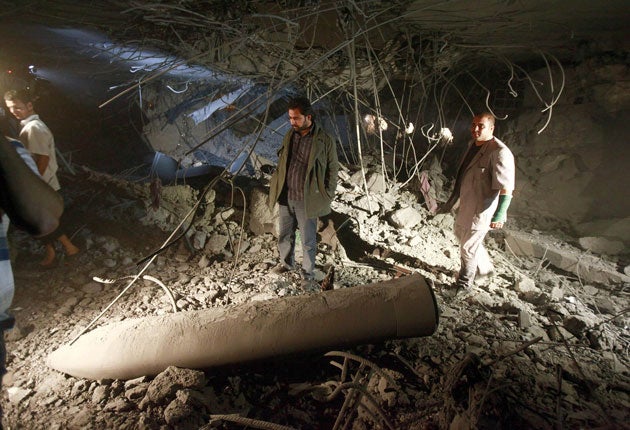
The one-story house in a Tripoli residential neighbourhood was heavily damaged. Libyan officials took journalists to the house, which had been hit by at least three missiles. The roof had caved in, leaving strings of reinforcing steel hanging down among chunks of concrete. Saif al-Arab Gaddafi was the sixth son of the Libyan leader. He had spent much of his time in Germany in recent years.
The information could not be independently verified, but, if accurate, would be a considerable step on from the terms of the United Nations Resolution 1973, which authorised action to "to protect civilians and civilian populated areas".
Leaders of member states participating in the coalition have frequently dodged the issue of whether Col Gaddafi would be or should be directly targeted. Neither the Foreign Office nor the Ministry of Defence were last night available for any questions on the strike. There are bound to be serious questions raised about who authorised the strike which would have been, effectively, an assassination attempt, and which reportedly killed children.
The attack was not the first on Tripoli yesterday.
Strikes in the morning damaged a building which houses the Libyan Down's Syndrome Society, and the government commission for children, according to evidence shown to journalists by officials. The force of the blast blew in windows and doors in the parent-funded school for children, and officials said it damaged an orphanage on the floor above. "I felt sad really. I kept thinking, what are we going to do with these children?" said Ismail Seddigh, who set up the school 17 years ago after his own daughter was born with Down's Syndrome.
Earlier reports said the attack was on a compound which includes the state television station, and came as Col Gaddafi made a rambling pre-dawn address to the nation. His officials were swift to condemn the attack as an attempt to kill their leader, which came, they pointed out, just as he was offering not only yet another "ceasefire" but also talks with Nato. Both coalition, and rebels, took little time to reject the offer.
Colonel Gaddafi's performance had its statutory defiance, but was strangely low-keyed, subdued almost, as if he had been roused from his bed and led immediately to a microphone and told to fill in for an absentee broadcaster. His address lasted more than an hour, and he paused frequently to flip through his notes. "The door to peace is open," he said, sitting behind a desk. "You are the aggressors. We will negotiate with you. Come, France, Italy, UK, America, come, we will negotiate with you. Why are you attacking us? Why are you destroying our infrastructure?" He also promised that if the rebels fighting his regime gave up their guns, he would give them cars and money, stating that they were children "tricked" by Nato.
Behind his rhetoric, and the continued fighting on land and at sea, over Misrata, there are two stories that may yet determine any outcome. The first is the fuel shortage in Tripoli, where queues for rationed petrol can stretch for 2km. There are tales of families sitting in shifts in vehicles over several days as their cars edge towards the pumps. Tempers are fraying and weapons brandished to secure supplies.
Second is the shortage of cash for the rebels in the east. Libya's interim national council estimates it has only about 40 per cent of the funds it needs to cover its budget for April and May. Italy's envoy to rebel-held eastern Libya said last Friday that the international community must unfreeze Libyan assets abroad – and pass the money to the rebels – as a matter of urgency. The money is needed to fund military operations, and to pay workers keeping power stations, water supplies, transport, policing and hospitals going.
Ali Tarhouni, a rebel official in charge of economic and financial matters, said insurgents were facing serious challenges in supplying food, fuel and medicines in areas under their control. "The problem is that the private sector cannot import because our assets are frozen," he told al-Jazeera television. The issue will be among those discussed at a meeting of Western and Middle Eastern states in Rome tomorrow, which is also expected to seek ways of allowing oil from Libya's east to be sold on world markets.
In Misrata, there is no sign of the regime's willingness to hold fire. This western city, from whose centre Gaddafi forces were driven a week ago, is still being shelled by government troops, who on Friday were found planting mines in the port, the only lifeline for weapons, imports and humanitarian aid for the city's 300,000 population. Three aid ships were unable to dock while coalition warships cleared the mines.
Meanwhile, in a reminder of why leaders in this region cling so tenaciously to power, Egypt's new justice minister said yesterday that the former president, Hosni Mubarak, would face the death penalty if convicted of ordering the shooting of protesters.
Join our commenting forum
Join thought-provoking conversations, follow other Independent readers and see their replies
Comments
Bookmark popover
Removed from bookmarks