New face of power in Zimbabwe
Aid suspended as Western diplomat says Mugabe has ceded control to head of army
Zimbabwe's crisis deepened significantly last night as the country's leaders ordered the indefinite suspension of aid distribution, while a group of US and British diplomats were detained at gunpoint by thugs of the Mugabe regime.
A senior Western diplomat told journalists in London that Zimbabwe was now being run by a military junta, locked in an embrace with President Robert Mugabe. Asked if we have already seen a coup in Zimbabwe ahead of the run-off presidential election in three weeks' time, the diplomat said: "Yes we have. This is a junta," referring to the shadowy Joint Operations Command. "These are the people who have actually kept Mugabe in power."
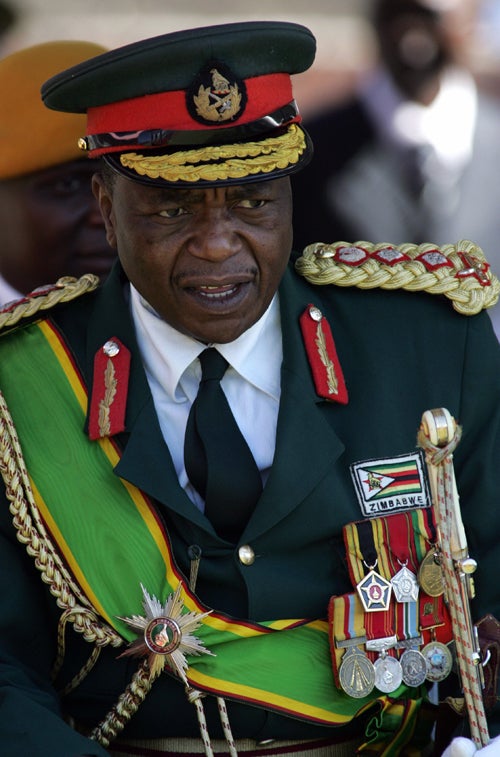
The JOC is under the nominal control of a veteran politician, Emmerson Mnangagwa, but is, in fact, run by General Constantine Chiwenga, head of the Zimbabwe Defence Forces.
The Zimbabwe government announced the suspension of all field work by private aid and development groups, and non-government organisations, on the ground that they were breaching their terms of registration. The blanket ban came after Care International and Save the Children were accused of campaigning for the Zimbabwean opposition, charges that they deny.
There has been a dramatic escalation of voter intimidation before the run-off between President Mugabe and Morgan Tsvangirai, of the Movement for Democratic Change.
A group of US and British diplomats were stopped at a roadblock in Bindura, 50 miles north of the capital, Harare, and held for six hours. James McGee, the US ambassador to Zimbabwe, said the campaign to intimidate diplomats was "coming directly from the top".
Mr Tsvangirai, who was himself detained for eight hours on Wednesday after being stopped at a roadblock, has also accused the military of staging a de-facto coup by taking control of large swaths of the country and declaring them no-go areas for the opposition.
Speaking to Voice of America radio, Mr Tsvangirai said the army was calling Zimbabweans to political meetings at which they were instructed to vote for Mr Mugabe. He said this opened up the military to being involved in politics. "I think it's tantamount to a military coup," he said, adding that it was "the most dangerous development that's happening in the country".
The Foreign Secretary, David Miliband, summoned the Zimbabwean high commissioner to the Foreign Office to explain why the diplomats had been detained. "This is a window into the lives of ordinary Zimbabweans," Mr Miliband said afterwards. "We have to be concerned obviously about British staff, but we also have to be concerned that intimidation does not become the order of the day."
Mr McGee, who was not in the convoy, told CNN: "Police put up a roadblock, stopped the vehicles, slashed the tyres, reached in and grabbed telephones from my personnel. The war veterans threatened to burn the vehicles with my people inside unless they got out and accompanied police to a station nearby."
A State Department spokesman Sean McCormack said. "It is absolutely outrageous, and it is a case of the kind of repression and violence that this government is willing to use against its own people."
Bright Matonga, a spokesman for the Zimbabwean government, accused the diplomats of handing out campaign literature for the opposition party, and said they had refused to leave their vehicles. "The police simply wanted to get to the bottom of the issue. No force or violence was used," he said.
Following the release on 2 May of the presidential election result, in which the challenger came ahead of the President and forced him into a humiliating run-off, Mr Mugabe's supporters have unleashed a kind of electoral cleansing, systematically targeting MDC voters to prevent them from casting their ballots on 27 June.
The Western diplomat said the military running the enforcement campaign appeared to be prepared to take any risks to stay in power. At least 50,000 people are reported to have been driven out by the displacement of opposition supporters.
Another worrying development, the diplomat said, was the "effective decapitating" of the opposition, by the abduction and murder of five prominent MDC activists, including Tonderai Ndira. Mr Tsvangirai left the country for five weeks and returned at the end of May despite assassination fears.
The diplomat said Mr Mugabe, who almost stepped down after the first round but was persuaded to fight in a run-off, was now "beholden" to the military to stay in power. "They are faceless securocrats. These are not people who can run the country without a figurehead like Mugabe." This was why the leader was confident he did not risk being overthrown when he went to Rome this week for a UN food summit.
Mugabe's military strongman
In the run-up to the first round of Zimbabwe's presidential election in March, General Constantine Chiwenga nailed his colours to the mast. "We will not support anyone other than President Mugabe, who has sacrificed a lot for this country."
Coming from the commander of the Zimbabwe Defence Forces for the past four and a half years, the message rang out loud and clear. After it became apparent that Robert Mugabe had lost the popular vote, Mr Chiwenga was instrumental in persuading him to come out fighting.
He has been a faithful Mugabe ally ever since he joined the then-guerrilla leader in Mozambique and fought alongside him in the battle to end white Rhodesian rule. After independence, Mr Chiwenga joined the army, where his ruthless ambition saw him rise swiftly through the ranks.
When Mr Mugabe's land reform got into full swing, Mr Chiwenga was one of the first to grab a white farm. In 2002, he and his wife Jocelyn seized control of a major producer of flowers and vegetables near Harare, a move that saw their wealth swell by some $20m. According to court testimony, Jocelyn told the owner, Roger Staunton, that "she had not tasted white blood since 1980... and that she needed just the slightest excuse to kill someone."
Both Mr and Mrs Chiwenga are among those barred from travelling to Europe and the United States.
Join our commenting forum
Join thought-provoking conversations, follow other Independent readers and see their replies
Comments