Rebels claim the victory – but did the Brits win it?
Cahal Milmo and Kim Sengupta on the army of spies and special forces at work in Libya
The Berber rebels in the Nafusa Mountains to the west of Tripoli have played a key role in the endgame of Muammar Gaddafi's regime. What has received less publicity is the small but vital part played in that offensive by British intelligence officials, who from their seat in the Libyan highlands have been advising the rebel leadership on the strategy behind their final assault.
Since 19 March – when the Royal Navy launched cruise missiles on Libyan air-defence targets, followed the next day by attacks by Royal Air Force Tornado jets – Britain has placed itself in the front ranks of Western powers enforcing the United Nations resolution protecting civilians from Colonel Gaddafi's forces and simultaneously pursuing the Brother Leader's removal from power.
While the Ministry of Defence has been diligent in providing daily updates on the progress of "Operation Ellamy", the British codename for its £250m part in the Nato campaign in Libya, a quieter London-sponsored offensive has been taking place on the ground for six months, involving an army of diplomats, spooks, military advisers and former members of the special forces.
One British intelligence operative in the Nafusa Mountains had previously been deployed elsewhere in Libya, including the besieged city of Misrata, part of attempts by London to influence events in Libya beyond the activities of warplanes and naval vessels.
It is a clandestine operation that got off to a spectacularly inauspicious start in March when seven SAS soldiers and an MI6 officer were detained by militia members outside the rebel stronghold of Benghazi, during a botched mission to make contact with anti-Gaddafi leaders. Since then, the British auxiliary efforts have been conducted more clandestinely.
A British diplomatic source said: "From quite an early stage there has been a view that Gaddafi's stranglehold would only be broken if there were practical measures on the ground as well as the air campaign. We are not talking legions of SAS crawling through the undergrowth. What we are talking about is offering expertise, diplomatic support and allowing others to be helpful."
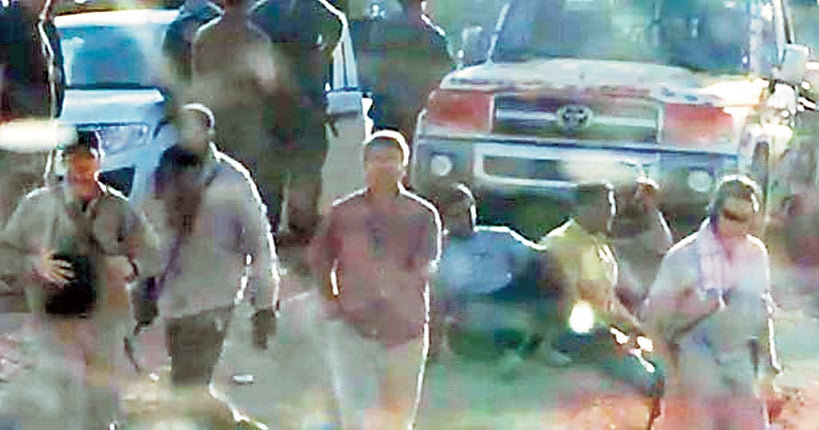
The "others" in question are the small groups of former special forces operatives, many with British accents, working for private security firms who have been seen regularly by reporters in the vanguard of the rebels' haphazard journey from Benghazi towards Tripoli.
These small detachments of Caucasian males, equipped with sunglasses, 4x4 vehicles and locally acquired weaponry, do not welcome prying eyes, not least because their presence threatened to give credence to the Gaddafi regime's claims that the rebel assault was being directed by Western fifth-columnists.
Amid frustration and even disdain in British and Allied circles about the ragtag nature of much of the Libyan rebel army – whose reputation as fair-weather fighters proved to be literal in April when two days of rainfall halted their offensive – London has been content for the Benghazi-based National Transitional Council to use funds to buy in ex-SAS men and others with a British military background to help train and advise anti-Gaddafi forces.
The Independent understands that the contracts for the security companies, often signed in Qatar and the United Arab Emirates, have involved funds provided by Western countries to the NTC, although much of the money has come from previously frozen regime bank accounts and assets.
The coalition, including Britain, France and Italy, has also funded high-tech equipment used by rebel fighters to communicate their position to Nato commanders as they plot the air strikes that have helped to tilt the balance against Colonel Gaddafi's demoralised military forces. Since March, British forces have destroyed 890 targets in Libya, including 180 tanks or armoured vehicles and 395 buildings.
But it is arguably in the arena of post-conflict planning that the British have been most active. In the wake of last month's decision by London to recognise the NTC as the de facto government of Libya, expelling pro-Gaddafi diplomats in London, the UK mission to Benghazi is now the second largest in North Africa. Diplomats have been engaged in drawing up a blueprint for a post-Gaddafi Libya, including humanitarian aid, help with policing, governance and reform of the military. The prize of being seen as a "friend" in a stable, oil-rich Libya is considerable.
Call for Megrahi's return
Pressure was mounting last night on the British Government to seek the return of the Lockerbie bomber Abdelbaset al-Megrahi, who has been a vigorous supporter of the Gaddafi regime since being returned to Tripoli from a Scottish jail two years ago. The Tory MP Robert Halfon said rebel leaders should be urged to extradite the former intelligence officer. The Foreign Office said: "He was convicted in a Scottish court under Scottish law. He could be returned under the terms of his release but that is a matter for the relevant authorities."
JONATHAN BROWN
Join our commenting forum
Join thought-provoking conversations, follow other Independent readers and see their replies
Comments