Rebels die as victims of their own disarray
Fifteen killed when coalition planes interpreted gunshot celebrations as anti-aircraft fire
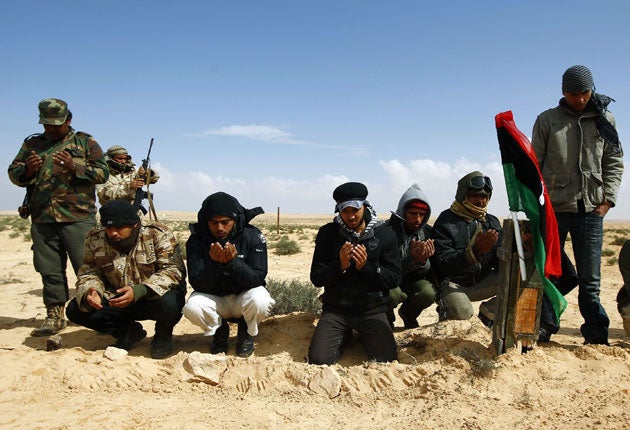
The rebel fighters were celebrating "victory" in their usual wasteful way, loosing off round after round into the air, using up ammunition in short supply. But this time it was a suicidal mistake: seconds later their vehicles, and an ambulance parked near by, were destroyed in an attack arriving with shattering explosions.
Air strikes had been carried out by a pilot from the international coalition who then thought an anti-aircraft barrage was being directed at him. Fifteen people, including three members of medical staff, were killed instantly when the warplane, believed to be an A-10 Tankbuster, responded with its devastating firepower.
These were the second set of "collateral casualties" in two days: eight others died in another bombing aimed at a regime convoy passing through the village of Argobe, near Ajdabiya. It ignited ammunition, spraying shrapnel into nearby houses. Four of those killed were female, including three girls aged 12 to 16 from the same family; two others were teenage boys.
The still chaotic conduct of the rebel military campaign contributed to the fatalities on Friday evening on the road to Brega, the city that the opposition is trying to wrest from Muammar Gaddafi's forces. Belatedly, the volunteer rebel fighters, known as the Shabaab, who had fired at least four times as much ordnance commemorating often imaginary "triumphs", as they fired in anger, had been told to desist and conserve ammunition. They had also been warned about precisely what happened with the international coalition flying the only planes in the sky.
The Gaddafi regime yesterday sought to use the "friendly fire" to their advantage. The state-controlled television channel announced that a large number of civilians had been killed by the West.
In Tripoli, Mussa Ibrahim, a regime spokesman, decrying the "illegal attack", said: "Some mad and criminal ministers and presidents of Europe are leading a crusade against an Arab Muslim nation. Sounds familiar? It's a crime against humanity."
On the ground, Gaddafi troops tried to use the position where the attack had taken place to their tactical advantage. As a crowd of rebel fighters and journalists gathered, a salvo of mortar rounds and rocket-propelled grenades landed.
The protest movement's provisional government described the deaths on the Brega road as an "unfortunate mistake". Spokesman Mustafa Gheriani said: "You have to look at the big picture. Mistakes will happen. We are trying to get rid of Gaddafi and there will be casualties, although, of course, it does not make us happy. We are pleased to see the Nato forces doing what they are assigned to do – protecting civilians, enforcing a ceasefire and creating a situation to allow peaceful protests."
But in the characteristically fanciful version of events provided by the Shabaab, a spokesman claimed it was all part of a cunning regime plot. According to Mustafa Ali Omar: "Some of Gaddafi's forces sneaked in among the rebels and fired anti-aircraft guns in the air. After that, Nato came and bombed them."
Captain Rahim Mohammed Fatousi, an army officer who defected to the revolution, shrugged "It is very difficult with the Shabaab: they were told many times to leave because we knew the coalition was going to carry out air attacks. But these people have support from some of the political factions in Benghazi who want to use their influence through them. We shall continue to try and have some discipline into this operation."
There were discernible signs of more efficiency at the front line, where former military personnel took over command from the Shabaab. General Bashir Abu-Gadr, who has gained a reputation as one of the few able commanders in the rebel ranks, left his hospital bed, where he was receiving treatment for battlefield injuries, to take charge of the operation to capture two oil ports, Brega and Ras Lanuf.
And, for the first time since the conflict began, the two most senior officers in the revolutionary forces, General Abdel-Fatah Youni and General Khalifa Haftar, visited the front line.
On Friday evening, after coalition air strikes, rebel forces entered a university complex on the outskirts of Brega where they were ambushed by regime troops and withdrew after losing a number of men. There was a second probe towards the city, during which rebel officers could be seen using communications equipment and receiving instructions.
General Abu-Gadr yesterday refused to discuss the extent of his liaison with foreign military advisers. "I was told that they were going to provide us with better weapons. But that has not happened," he said. "We are using weapons captured from the government and also equipment from arms storage places we know about. I would rather have weapons, but I will take advice if it is free."
The rebel manoeuvres on the front line on Friday had showed an element of organisation hitherto missing. Former soldiers carried out efficient flanking moves, and, when the regime forces opened fire, they did not break and run as the Shabaab fighters have done repeatedly.
By yesterday, however, this had frayed. The Shabaab, as well as unarmed civilians, were allowed access to the front line and the result was seen in the retreat from the scene of the "friendly fire" when the Shabaab began to shoot in panic at their own side – rebel military moving along the desert – and even others fleeing behind them. Later, another retreat followed when a "volunteer", a 17-year-old who had decided to observe the fighting while his school remains shut, mistook some local farmers for undercover Gaddafi troops.
While there had been no pause in the fighting despite reports of a possible ceasefire, regime troops have made no advance towards Ajdabiya, the next city after Brega, in the past few days. One view is that the regime may settle for holding the line there and at the town of Ras Lanuf, which lies beyond both oil ports, rather than risk having its supply lines hit from the air by moving further eastwards.
The rebels, on the other hand, would like to retake Brega and Ras Lanuf before any ceasefire comes into effect without trying to move any further westwards. During a number of skirmishes, in the towns of Bin Jawad and Nawfiliya, local men had fought against the rebels. In the complex dynamics of Libyan politics, with its tribal influence, the regime is not without its supporters.
Join our commenting forum
Join thought-provoking conversations, follow other Independent readers and see their replies
Comments