Seizure of disputed province brings newly divided Sudan to brink of civil war
UN intervenes as North takes control of contested region
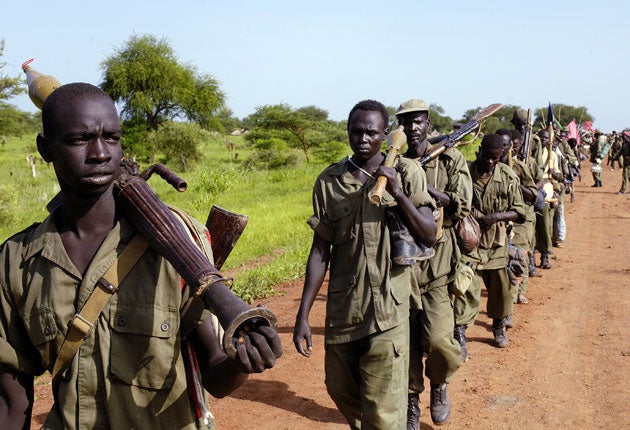
Sudan was back on the brink of civil war last night after an escalation in fighting over a province disputed between the north and south of Africa's largest country. Northern forces occupied the town of Abyei, which is claimed by both the Arab-led government in Khartoum and the government of southern Sudan, which voted this year to secede.
Map of Sudan: click here to download graphic (33k)
Authorities in the south accused the north of "an act of war" after three days of heavy fighting saw their forces pushed out of Abyei. "We didn't declare war," said the southern army spokesman Colonel Philip Aguer. "The National Congress Party and the Sudan armed forces declared war on us."
The government in Khartoum confirmed that it had occupied the area, but denied that it was provoking a war. "The Sudanese armed forces control Abyei and are cleansing it of illegal forces," said Amin Hassan Omar, a minister of state for presidential affairs.
The crisis comes only two months before Sudan was due to split in two, and threatens to plunge the country back into a damaging conflict.
Both the southern Dinka Ngok and the northern Arab Mussiriya tribes have fought for territorial control over the province, which has significant deposits of oil. Hundreds of people have fled Abyei in the last three days as the northern army responded to fighting in the area by sending in heavy armour and attacking the town.
The US condemned the operation over the weekend, criticising the southern forces for their actions but deploring the north's response as "disproportionate and irresponsible". "The actions being taken by the government of Sudan [the north] are blatant violations of the comprehensive peace agreement and threaten to undermine the mutual commitment of the CPA parties to avoid a return to war," the White House said in a statement.
As the south appealed to the international community to help dislodge northern soldiers – an appeal likely to fall on deaf ears – the UN last night condemned both sides in the conflict, calling on the north to withdraw from the region and criticising the south for an attack on a UN convoy on Thursday.
Abyei has been the chief sticking point preventing a peaceful divorce between the north and the south. Sudan was ravaged by a 20-year civil war between the Muslim-dominated north and the predominantly Christian south. The war claimed up to 2 million lives and emptied much of the south of the country. It ended with a peace deal in 2005 which established a power-sharing government and gave the south the right, after five years, to vote on separation from the north. That referendum went ahead without serious incident in January, and resulted in a near-total vote for secession.
Internationally brokered talks are underway over the division of Sudan's oil, most of which would lie to the south of a new border. The conflict in Abyei, which is primarily about rights of grazing and control of territory, has been harder to solve than even the future of the oil.
The people of Abyei were meant to have been given a vote in January on whether to join a new south Sudan or to remain with the north, but Khartoum blocked this poll.
The move was seen at the time as a tactic by the government of Omar al-Bashir to destabilise the south. Any resumption of full-scale fighting between the civil war foes could quickly spread westwards to Darfur, where Khartoum has been accused of war crimes and genocide over its response to a rebellion.
President Bashir has been indicted by the international criminal court for his role in orchestrating the violence in Darfur, but remains in office and won re-election despite international criticism and the imminent loss of the south.
Abyei was supposed to have been demilitarised under an international agreement but both sides have been building up forces in anticipation of a possible conflict. Tens of thousands of civilians have been living in temporary camps in Abyei, after leaving the north ahead of January's vote.
Sudan's bumpy road to separation
1956 – Independence from Britain is declared. Attacks by southern guerrilla groups against government forces become a regular occurrence.
1962 – The first civil war between southern rebels and the northern government begins. Hundreds of thousands are killed or displaced.
1972 – The war ends with the signing of the Addis Adaba peace treaty. The south formally becomes an autonomous region of Sudan.
1978 – In Bentiu, in southern Sudan, major oil reserves are uncovered.
1983 – The second Sudanese civil war breaks out. This time separatists are led by the Sudan People's Liberation Movement (SPLM), led by John Garang.
2005 January – The second civil war ends with promises of a referendum on independence for the south. John Garang becomes Sudan's vice president.
2005 October – A new autonomous southern government is formed, as dictated under a new constitution.
2011 January – Referendum on southern independence is held. The result is a vote in favour of independence.
2011 February – Fighting breaks out in the southern Jonglei state and near the disputed area of Abyei.
2011 March – South Sudan says it is abandoning discussions with the north in protest at the violence. LEO HORNAK
Join our commenting forum
Join thought-provoking conversations, follow other Independent readers and see their replies
Comments