South Sudan takes first steps to independence
Historic election is marked by new fears of Khartoum-inspired violence. Daniel Howden reports from Bor
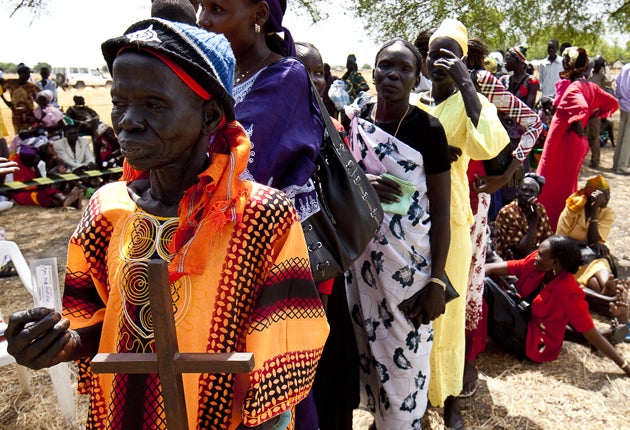
Under a fierce morning sun, clutching a wooden cross to her chest, Martha Ayom Duk became the first person in her village and one of the first women in South Sudan to ever cast a vote.
As three days of voting got underway yesterday in one of the most complex elections staged in Africa, her message was simple: "I wanted to vote for freedom, to be free."
Like the hundreds in line behind her, she faced a bewildering array of papers, party symbols and ballot boxes with a dozen different votes to cast.
Her eyes pale with cataracts and unsure of her exact age, the mother of six had clear reasons for her choices that were echoed across the south of Africa's biggest nation. People said they were casting their ballots against former civil war foes in the north and voting to create the continent's newest country.
"We suffered for 21 years with the Arabs. I wanted to vote for separation from the North so our small children will not die again and they will be educated," said Ayom Duk, who lost two of her sons in the civil war.
Voting began several hours late in Kapat-Koch, a scattered village of tear drop straw houses in South Sudan's largest state, Jonglei. These delays were repeated from the banks of the Nile in Juba, to the mountains of Darfur and on the superheated streets of the capital, Khartoum. The Independent witnessed young children being allowed to vote in one Jonglei polling station and monitors reported other complaints on what was otherwise a peaceful opening day.
The first national elections in 24 years – and the first real vote of any kind in the impoverished and war-haunted south – will stretch out over several days with few results expected before the week's end. With almost 16 million people voting for more than 14,000 candidates from the president to local councils, first time voters – many of them illiterate – faced a gauntlet of four separate ballot boxes and between nine and 12 races.
For Sudan's president, Omar al-Bashir, the first head of state to be indicted by the International Criminal Court, the election is about establishing legitimacy, an effort complicated by opposition boycotts that assure him of victory but not credibility. For the Darfur region, the vote has been overshadowed by an upsurge in fighting that forced EU monitors and many NGOs to leave and where turnout was reportedly low. The greatest excitement has come in the south where the vote has been portrayed as the final staging post ahead of a referendum expected early next year on secession.
The election effort in the south has revealed a fledgling country largely emptied during the war years and among the poorest on earth. Its makeshift towns are connected by rutted dust roads that will be impassable when the rains arrive later this month. The World Food Programme feeds up to four million people. There are only a handful of hospitals and the few schools which do exist are often classes held under the shade of a tree. Child mortality rates are as high as any in the world. Illiteracy rates are above 80 percent which has complicated the internationally funded effort to stage an election that was central to the comprehensive peace agreement that ended the civil war in 2005.
The governor of Jonglei, Kuol Manyang Juuk, was at the election offices in the capital, Bor, at first light, one of many agitated candidates. He expected serious delays especially in more remote areas and said that Khartoum would be pleased if fewer southerners were able to cast their votes. Many people, he feared, would know little about who or what they were voting for.
"Most of our people are illiterate," he said. "Some of them have never held a pen before."
They would need assistance to vote, he added, which would leave them at the mercy of voting officials.
"He or she won't even know what the assistant has done," the governor fretted. Inside the office one of those officials said that only 15 percent of those voting could read a polling card.
The build up to the landmark ballot in the south has been marked by an upsurge in militia killings and tribal violence. Cattle raids and local clashes that in the past claimed one or two victims last year left more than 2,000 people dead.
Jonglei has been at the centre of this violence and the village of Kapat-Koch has not escaped. The mud and straw Dinka homes and thatched cattle corrals are interspersed with black and burnt homes.
Stephen Mami, a towering 38 year old former soldier, said that peace still hasn't arrived. A former fighter with the rebel Sudan Peoples' Liberation Army, he lived in the bush for a decade during the civil war. For him, the north-south fight was unavoidable. "When someone comes to your house and they steal your things to go and make their own house, you must fight," he said.
The burnt houses are testament to a new fear haunting the village – the neighbouring Muerle tribe, who he believes are being armed and paid by the Arab-led government in Khartoum. Fifteen villagers were killed and half a dozen children were kidnapped here late last year in a single massacre.
These incidents have hardened support for a breakaway state that would cut the unstable oil-producing nation in half. Few of the hundreds of voters who braved soaring temperatures to queue for hours to vote saw a distinction between the current general election and next year's referendum on secession.
"Today we vote to choose good leaders because we need a referendum," said Abu Deng a 45 year old mother of nine.
Join our commenting forum
Join thought-provoking conversations, follow other Independent readers and see their replies
Comments