Sudanese woman guilty of daring to wear trousers
Journalist who defied restrictive law fined for 'indecency' but could face prison if she refuses to pay
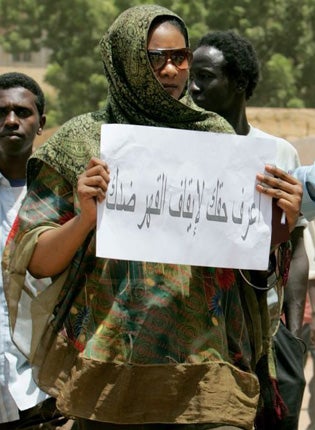
A Sudanese woman whose arrest on the charge of wearing trousers drew worldwide attention, escaped a public lashing yesterday but now faces up to a month in prison. Lubna Hussein was convicted of indecency but did not receive the typical sentence of 40 lashes as the judge opted to fine her.
Ms Hussein, who has used her trial to campaign against Sudan's restrictive decency code, said she would not pay the $200 (£120) penalty and could therefore face a prison sentence.
"I will not pay a penny," she told reporters at the court in the Sudanese capital, Khartoum. "I won't pay, as a matter of principle. I would spend a month in jail. It is a chance to explore the conditions in jail."
The combative former journalist who quit her job with the United Nations to strip herself of immunity and fight the charge, attended the hearing wearing the same trousers she had worn when arrested. The pair of loose green slacks have now been seen around the world as Ms Hussein has attracted global headlines in her battle.
The 43-year-old widow has emerged as a powerful campaigner against Sudan's strict laws that limit how a woman can dress, and vowed to appeal against the conviction to the country's highest court if necessary. She has said she would tolerate "40,000 lashes" if that's what it takes to change the law.
Public support for her has surprised authorities in Sudan and before yesterday's hearing dozens of women wearing trousers and protesting outside the court were arrested.
"Lubna has given us a chance. She is very brave. Thousands of girls have been beaten since the 1990s, but Lubna is the first one not to keep silent," one of the protesters, Sawsan Hassan el-Showaya, told Reuters.
The presence of the Hussein supporters drew a rival demonstration by Islamists who chanted religious slogans and denounced the accused and the other women as prostitutes. Scuffles broke out and around 40 women were arrested.
Ms Hussein's lawyer Galal al-Sayed, said afterwards she had been advised to pay the fine before appealing but she had refused. Sudan faced international condemnation over the case and the judge's decision appeared calculated to defuse the situation. She was tried in a normal court and allowed a lawyer, whereas other women are often tried for the same offence in special courts with no defence.
Inside the courtroom a number of foreign diplomats and human-rights activists gathered to show their support and underline the fact that the trial has become a test case for women's rights in Sudan. The journalist was arrested in July at a party in Khartoum along with 12 other women and had faced the possibility of 40 lashes for wearing trousers deemed indecent. Ten of the other women arrested at the same time have since pleaded guilty and suffered a public flogging.
Sudan operates under a sharia system in the mainly Muslim north and the strict interpretation of Islamic law has generated tension with the majority Christian south. In an article published before the trial, Ms Hussein said the restrictive laws were in part to blame for the tensions that have regularly provoked civil conflicts in Africa's largest country. "When I think of my trial, I pray that my daughters will never live in fear of these police ... We will only be secure once the police protect us and these laws are repealed," she wrote.
Campaigners in Sudan complain that the decency code gives too much latitude to individual policemen, leading to often arbitrary arrests. Article 152 of Sudan's penal code states that "indecent" dress among women is punishable by a fine and public flogging.
Amnesty International called on Sudan to review the law. "The penalty called for by the law, up to 40 lashes [is] abhorrent," said Tawanda Hondora, Amnesty's deputy Africa director. "Women are routinely arrested, detained, tried and then, on conviction, flogged simply because a police officer disapproves of their clothing."
Sudan: A study in strife
*Sudan is Africa's largest country, with an area of 2.5 million sq km and a population of 41 million.
*The country gained independence in 1956, but a north–south civil war lasting two decades claimed 1.5 million lives before a 2005 peace deal.
*A British teacher, Gillian Gibbons, was jailed after letting pupils name a teddy Muhammad. She escaped 40 lashes but served 8 days of a 15-day jail sentence and was deported.
Join our commenting forum
Join thought-provoking conversations, follow other Independent readers and see their replies
Comments