World

Rain (AM and PM) 10° London Hi 11°C / Lo 7°C

The Big Question: Has power-sharing done anything to end the crisis in Zimbabwe?
By Daniel Howden

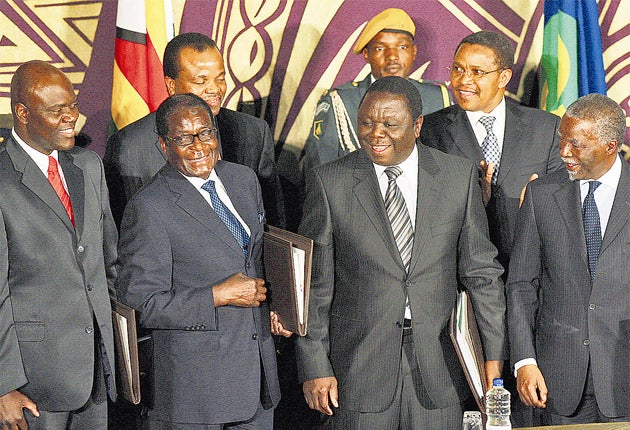
President Robert Mugabe and Prime Minister Morgan Tsvangirai alongside former South African President Thabo Mbeki and other African leaders after signing their power-sharing accord last year

AFP/GETTY IMAGES

President Robert Mugabe and Prime Minister Morgan Tsvangirai alongside former South African President Thabo Mbeki and other African leaders after signing their power-sharing accord last year

Why are we asking this now?

Morgan Tsvangirai arrives in London today on the UK leg of a tour of Europe and the US in an effort to convince Western leaders that Zimbabwe has turned the corner. The former opposition leader and now prime minister has insisted that he's not trawling the rich world with a "begging bowl" but the reality is scarcely different. The once prosperous Southern African nation is bankrupt and without development aid to go with the humanitarian assistance already being supplied there can be no recovery. As the acceptable face of Harare's power-sharing, Mr Mugabe's worst political enemy is now his most effective emissary.

What were the terms of the agreement that brought about power-sharing?

The unlikely photo opportunity in Harare, in February, which launched the new administration, was the result of months of often farcical negotiations, led by South Africa. Under the terms drawn up by former president Thabo Mbeki the opposition were to be offered half of the cabinet posts including a say in the security services, with ministers answerable to an executive prime minister, Mr Tsvangirai. Political prisoners were to be released while regional governorships were to be split again between the opposition MDC and Mr Mugabe's Zanu-PF party. The key finance ministry was to be turned over to the MDC with the expectation that the governorship of the central bank would follow.

Why did Tsvangirai and the Movement for Democratic Change sign up?

A number of factors drove the clearly exhausted opposition leader into a pact with his main enemy. The impossibility of holding free and fair elections had been amply demonstrated. The security forces had come close to smashing the grass roots network of his party. South Africa had failed to act as a fair broker and was putting intense pressure on Mr Tsvangirai to sign.

The MDC breakaway led by Arthur Mutambara allowed itself to be used as a wedge to split the opposition. Western governments offered warm words and cautious support but were in no position to deliver regime change. Added to this were the mundane ambitions of his own lieutenants, almost all of whom have taken quickly to a new life of chauffeur-driven Mercedes provided by the state. Several leading MDC figures were worried that their own chance to be in government was fading.

Have the original terms been fulfilled?

No. Most but far from all political prisoners have been released, and the impotence of the MDC faction in government has been revealed as police and courts have ignored the prime minister. Several high-profile prisoners, including Mr Tsvangirai's own head of security Chris Dhlamini, are still facing charges despite providing evidence that they were tortured by state officers.

The regional governors have taken more than six months to be installed. But worst of all Gideon Gono, the central bank governor and architect of Zimbabwe's hyperinflation which eventually killed the currency, is still in his job. The fate of the man who used state coffers and international deposits to bankroll Mr Mugabe's cronies and pay for state-led putsches is the most accurate weather vane of progress. So far he is untouched.

Who or what is blocking reforms?

Controversy continues to rage over who is the stumbling block to meaningful progress. Recently a number of leading MDC figures, including the respected finance minister, Tendai Biti, have had warm words for the schoolteacher turned autocrat. Others have suggested that at 85, Mr Mugabe was being used as a figurehead by the military men behind the Joint Operations Command, the cartel of generals and Zanu grandees that have long been the country's real powerbrokers. However, the tactic of co-opting, discrediting and demoralising political rivals was patented by Mr Mugabe as far back as the 1980s when he swallowed up and spat out Joshua Nkomo. As he sat in Victoria Falls this week taking the leadership of Africa's largest trading bloc, COMESA, preaching self-reliance and welcoming President of Sudan Omar al-Bashir who is wanted by the ICC, it was hard to believe much had changed.

What does the rest of Zimbabwe think of the two main parties?

While some people regard the unity government as the last chance for progress others see it as a betrayal of the people. Women's rights activist Jenni Williams, who has been arrested repeatedly, calls it a "government for politicians, not people". Respected lawyer and human rights campaigner Lovemore Madhuku has criticised the failure to progress on a new constitution which was supposed to be the main task of the MDC once in a unity government. Meanwhile thousands of ordinary Zimbabweans have continued register their objections by walking out on the country, in many cases literally, by crossing into South Africa and other neighbouring countries. Zimbabwe's large and well-educated diaspora has given its verdict by staying away in droves.

But are there any signs of progress in Zimbabwe?

Zimbabwe's schools are reopening as teachers have received basic salaries. The cholera crisis that highlighted the collapse of healthcare has been brought under some kind of control with international donor help. And hyperinflation has ended with the switch to the US dollar.

There is a darker side to each of these green shoots though. In schools there are no pens, paper or textbooks to teach with. Controlling cholera – more normally associated with disaster areas or war zones – cannot conceal the flight of most of the country's doctors and nurses. And while dollarisation has made life easier for those with hard currency, in parts of Harare it has pushed anyone without remittance money into poverty. Agriculture, once the mainstay of the economy, is still in a dire state, with farm invasions intensifying under the unity government. The MDC has denounced the takeover of commercial farms but been ignored.

Why is Tsvangirai raising funds for such a dysfunctional government?

From the moment that the opposition leader agreed to share power he had no choice but to try and make it succeed. By contrast Mr Mugabe is under little or no pressure to change course. The octogenarian's faction has retained control of the instruments of hard power and coercion and in the shape of Mr Gono the means to pay for their upkeep.

They have handed Mr Tsvangirai the thankless task of bailing out the devastated economy and atrophied public services knowing that should he fail it will be seen as his failure. The MDC has admitted that they must show Zimbabweans that they can "make a difference" while their government colleagues either stand idly by or actively sabotage their efforts. Mr Tsvangirai needs to his Western supporters to stomach their distaste for Mr Mugabe and invest in his potential leadership and he can provide them with scant evidence that it would be a winning bet.

So is the new alliance working?

Yes...

* The former opposition has declared that the country is on an upward trajectory

* Strikes have ended and teachers have gone back to work with schools reopening

* The crippling hyperinflation is over and Zimbabwe is now stable with the US dollarisation

No...

* Unemployment is nearly total, with only fractionally more than five per cent of people in paid work

* The United Nations is feeding more than half of the population through the WFP

* Robert Mugabe and his inner circle have retained the hard power in Zimbabwe

Post a Comment

View all comments that have been posted about this article.

Offensive or abusive comments will be removed and your IP logged and may be used to prevent further submission. In submitting a comment to the site, you agree to be bound by the Independent Minds Terms of Service.

Comments

Zimbabwe Power-Sharing
[info]alexweir1949 wrote:
Wednesday, 10 June 2009 at 07:10 am (UTC)
Zimbabwe Power-Sharing

MDC and Morgan Tsvangirai have been forced into a no-win situation by the selfishness and stupidity of Western Governments.

The Unity Government is presently obsessed with sourcing monies to pay salaries of ordinary public sector workers. Meanwhile the private sector is going exactly nowhere - noone of any colour or nationality will put their money into Zimbabwe while the International Thief Robert Mugabe is playing Elephant in the Cupboard.

Thus Zimbabwe is condemned to a slow and strangulating stagnation, so long as Mugabe is on the stage. And his life expectancy is another 10 years or so, barring accidents.

The upcoming Election will of course offer opportunities. Mugabe greatly fears any kind of accurate election, but at the same time he has refined his capability to rig and subvert elections to a high level. Thus one would imagine that the West would welcome with open arms any technology which would eliminate any and all attempts by anyone - internal or external - to rig any election in any country.

No - the West is dreadfully afraid of such fraud-proof voting technology being implemented - countries with pro-western dictatorships like Egypt, Gabon, Guinea, Angola, Nigeria, Uganda and a million others would topple like flies - the net balance of benefit to the West would be greatly negative with the introduction of such pro-people technology.

Therefore they resort to all kinds of obscufation and even to assassination to avoid embracing the Global Democracy which they so enthusiastically espouse. Hypocrisy is too gentle a word for this un-Christian and un-Islamic behaviour.

Mr Alex Weir, Harare, Zimbabwe
The headline should read : "the big question is"
[info]cronyblatcher wrote:
Wednesday, 10 June 2009 at 10:47 pm (UTC)
Has president Mugabe stopped falling down laffing every time he hears/reads the foreign news.
Funny money printing presses have doubled the 'Murkan / British money supply in a few months
http://www.gold-eagle.com/gold_digest_08/hamilton060509.html
Chaos and corruption
[info]jaded63 wrote:
Wednesday, 10 June 2009 at 08:52 am (UTC)
Zimbabwe is a prime example of the manner in which native African elites seem incapable of exercising any type of coherent government, preferring merely to enrich themselves and oppress their fellow Africans. The result is ever-increasing chaos, corruption, and conflict.

The only exception to this syndrome is South Africa, where the relative coherence of government and organisation of society is due mainly to the involvement of millions of whites. However, the signs are not good for that country, as increased Zimbabwe-style attacks on farmers, and a horrendous rate of violent crime generally, point the way to an ultimate Zimbabwe-style outcome.

It is fair to ask why native Africans seem to be incapable of organising their own societies in any kind of just and coherent manner.
Re: Chaos and corruption
[info]commentr wrote:
Wednesday, 10 June 2009 at 10:43 pm (UTC)
I think you'll find that ancient Zimbabwe (like many other parts of the continent) operated fine before the European arrived. Modern day African leaders are merely copying their colonial masters, the descendants of whom are continuing the art of corruption (sorry, sleaze, or "expenses within the rules") to this day in the ancestral home of Westminster.

As the writer Walter Smith recently stated, Africa is merely in the midst of returning to pre-colonial times.

The fact that only South Africa is considered an exception is further evidence of your ignorance of British history regarding African colonies. Do your research.
Re: Chaos and corruption
[info]jaded63 wrote:
Thursday, 11 June 2009 at 02:42 pm (UTC)
The last line is a lazy way of saying you can't think of any examples of an African state which, without the involvement of whites in its organisation, is not in effect a failed state.

'Ancient Zimbabwe' (whatever that is) 'operated fine'? What, in a state of ignorance and savagery?

If Walter Smith is right, it doesn't say much for the ability of Africans to raise themselves, does it. The fact is that Western societies are paragons of organised virtue and benevolent rule compared to African ones, despite our own innate problems with corruption. That's why so many Africans are desperate to flee here. It's no use endlessly blaming colonialism decades, half a century or more after they were given their freedom. At the time Western liberals were saying that things would improve greatly for Africans when they got their 'freedom'. They didn't improve, they got infinitely worse, as everyone with any sense knew they would.

The vast majority of Zimbabweans would have been far better off if they'd stayed Rhodesians.
Re: Chaos and corruption
[info]commentr wrote:
Thursday, 11 June 2009 at 08:58 pm (UTC)
Just one example for your perusal; the rest is for your own motivation. After you've finished reading, use the same resource to remind yourself of ancient Zimbabwe and finally take a visit to the British Library for further corroboration by your own fellow native researchers. It will pain you to accept such information so save face and decline to reply.
Re: Chaos and corruption
[info]jaded63 wrote:
Friday, 12 June 2009 at 08:15 am (UTC)
That made me laugh. Having lived through the era in which the appalling Nkrumah squandered the riches left to Ghana by the British, and then seen the violence of the coup which overthrew him, and 'the series of subsequent coups' (as your Wikipedia article states) which followed, I really can't see any real basis for describing Ghana as 'a stable democracy' (which Wikipedia also calls it), despite the lack of coups lately.

Here's a witness who has spent 12 years there (Holligurl, taken from her blog on www.aidworkers.com, note her words 'the overbearing corruption and chaos' to describe the general situation in Ghana):

'That time of year is upon us again in Ghana ? the time where every international flight that arrives, pours out scores of the bright and bushytailed, the hopeful and positive, the naïve and trusting? they are?

THE VOLUNTEERS.

Inevitably they will spend some days close to a toilet, worshipping from both ends, having been ?cool? enough to try the street food, with LOTS of pepper. Some will brave the ?mystery meat? in the stews?

They will be robbed, if not directly, then by coworkers who see a chance and inflate prices. By the taxi drivers and the market sellers seeing opportunity stare them in the face? By landlords and ?friends? and the system in general.

It?s a cycle. They fit the role within it.

I know these girls. I am these girls. I lived it, breathed it, sat in the 40 degree tro tro, stuffed like a sardine with 40 others (in a 12 person capacity van built in 1970) hundreds of times. I held babies and smiled a lot and pretended the density of human flesh, with it?s pungent overpowering smell was fine. Pretended that my knees against me, pinned in on both sides by the volumous arms of the market women, with the radio blaring at it?s loudest through fried speakers, bouncing without shock absorbers through the potholed roads of Accra was fine. In a way it was. What doesn?t kill you?.

12 years on, I have the clarity of hindsight. I see the well of experience that lay ahead of me back then and I watch them all fall straight down it now, year after year, time after time.

More and more volunteers come each year. What with Angelina Jolie, Chris Martin and Bono engaging the Hollywood crowd in the plight of Africa and the value of ?giving back?, it has become glamourous, trendy.

There are new organizations popping up both locally and internationally, cashing in on the guilt trip dolled out to the impressionable in the west. Help Africa! Give back. Donate your money and your time.
No one has looked much at the statistics regarding the success of all of the donations and exchange programs and volunteer time?

I ache to ask the new recruits ? and mostly because I don?t know what I would have answered back in my volunteer days ? ?What is it you feel you need to give back? Why is it that you will put up with fraud, discomforts, delays, disorganization, filth, and so many other obstacles that you would never put up with back home??. ?What is it that you took that you feel the need to give back??.

Every one of them who actually does a job here will be frustrated and will feel despair at some point. Every one will marvel at the chaos and the poverty and the resignation they see around them.

But they will go back remembering the bright eyes of the children, the friendly banter with the market sellers, the journeys where they saw goats tied to the tops of tro tros and Jesus stickers on the back windows. It will be the memories of the ?kitch? and the kindness not the overbearing corruption and chaos they will take away.

This in turn breeds more of their kind.

But then they meet me ? the one who stayed too long. The one who hears the annoying patronizing nasal tone the children use when they chant ?Obruni, obruni, give me a pen. Give me money, be my friend? and run off laughing. Instead of their innocence I see the way they are being programmed from a tender age to take advantage, to hold their hands out, to accept the mess around them and not strive for better.

My perspective is dangerous. I?ve lost my pink glasses.

Perhaps I should stay indoors this time each year.

---------------------------------------
Second section of your reply will be answered next.
Re: Chaos and corruption
[info]commentr wrote:
Friday, 12 June 2009 at 08:42 am (UTC)
I would equate the coups and mismanagement post-Nkrumah with the English Civil War, the British endured periods of instability before democracy was established; can't see why other countries aren't also allowed similar historical events. I was amused it took you so long to find a web page to support your weak hypothesis; I would equate your example of aid dependency with council benefit dependency by native English council estate residents (who have also squandered the wealth of the British state). :)

Since it pains you to describe Ghana as (stable) democracy, will you have the honour at least to withdraw your classification as a "failed state"?
Re: Chaos and corruption
[info]jaded63 wrote:
Friday, 12 June 2009 at 09:21 am (UTC)
'Amused it took me so long'? I only saw the guy's answer this morning, and I've got other things to do. After this I won't be looking at any replies for many hours.

The fact is it doesn't take long, it takes but a few seconds to find dozens of pieces on the chaos and corruption in modern Ghana. To hold it up as some kind of shining example is the real 'weak hypothesis', in fact an utterly ludicrous hypothesis. Ghana is en effet a failed state, which would collapse entirely if it were not for Western aid, like so many African states.


You would do better to take note of the article (by an African) in yesterday's Indie, citing the staggering total of $150 billion which is misappropriated by Africa's corrupt elites.
Re: Chaos and corruption
[info]commentr wrote:
Friday, 12 June 2009 at 10:51 am (UTC)
I would prefer you to read Ms Moyo's book 'Dead Aid' and then lobby your MP to insist that all aid (apart from a one-off natural disaster such as a tsunami) will be discontinued after 3 years from enactment in law.

First you said Europeans were needed within government organisation, now a failed state is one dependent upon aid. I see the goalposts moving...

If you insist on equating Ghana and the like with Somalia, Afghanistan, Pakistan and Iceland (yes the latest to be dependent upon western aid to prevent financial if not political implosion), that is your prerogative, but wrong.
Re: Chaos and corruption
[info]jaded63 wrote:
Friday, 12 June 2009 at 09:09 am (UTC)
'Great Zimbabwe' was a large stone fortress probaby (the matter is still the subject of some controversy) built between the 12th and 15th centuries by a nonliterate African society, who then abandoned it. Portuguese traders who discovered the ruins in 1500 also found that local Africans had no idea who built the place. The fortress also represents the only evidence that Africans were ever capable of matching the achievements of Western civilisation in any way, however temporarily.
Re: Chaos and corruption
[info]commentr wrote:
Friday, 12 June 2009 at 11:05 am (UTC)
I guess the Egyptian and Malian empires have been conveniently overlooked, not to mention the Ethiopian Christians (yes those very same literate Africans who have practiced Christianity during the time of Jesus whilst Britons at that time a mixture of illiterate pagans).

I assume the natives that discovered Stonehenge during the 16th century did know who built it.
Re: Chaos and corruption
[info]jaded63 wrote:
Friday, 12 June 2009 at 12:06 pm (UTC)
The ancient Egyptians were not African negroes. The Egyptian civilisation is regarded as Mediterranean. Mali didn't have an empire, it was a centre of influence. Ethiopian Christianity was indeed a civilised phenomenon for its time. Modern Ethiopia isn't much to shout about.

Stonehenge wasn't 'discovered' in the 16th century. It was always known about, and one of the earliest written references to it is that of Geoffrey of Monmouth in the 12th century. As Stonehenge was built about 2,300 years before 'Great Zimbabwe', it's not surprising that its origins are lost in the mists of time.

All your rather pathetic attempts at diversion try to dodge the point I originally made, and which I expand here: Why is it that modern Africans seem incapable of organising just, coherent, civilised societies, and are instead able only to produce chaos, corruption, endemic violence (mostly tribal) and states which are nothing other than failures unless propped up with Western aid? Blaming the West simply doesn't cut the mustard. No white society, not even a backward, mafia-ridden place like Albania, produces such dismal results.
Re: Chaos and corruption
[info]commentr wrote:
Friday, 12 June 2009 at 03:35 pm (UTC)
That ancient Egyptians were not Africans is as ludicrous as stating Europeans discovered the Americas. By the same argument, the Greeks are not European, but "meditteranean".

Fast forward to modernity and aid: stop giving and corruption will stop. Western aid has not supported democracy, only ensuring cheap access to resources. Nigeria is a classic example. Also since the Berlin conference to partition Africa, hardly any natural borders have evolved. This is another cause of instability.
Re: Chaos and corruption
[info]jaded63 wrote:
Friday, 12 June 2009 at 08:20 pm (UTC)
I didn't say the ancient Egyptians weren't Africans, I said they weren't African negroes. There are several European countries which abut the Med, and Greece is one of them, so Greeks are both European and Meditteranean.

Anyway, I thought you were Left wing, but you evidently are not, since you want all aid to Africa stopped. Seems a rather extreme position to take. However, I don't see the point in giving aid to African nations when that aid is, to a very large extent, embezzled by the African elites in charge. My solution would be to insist on 100% direct Western disbursement of the aid - not via the U.N., whose various aid agencies are as corrupt as any African elite, but directly from each donor Western nation to projects run by them individually or jointly. Since those projects would directly employ many Africans, a degree of proper and efficient administration, totally lacking at present, would then be introduced. This would also introduce a strong element of stability into African societies, and curb unrest. To ensure the security of these various aid projects, military units from each Western nation involved should also be present.

It should be made quite clear to African governments that if they did not accept aid on this basis, then they wouldn't get any aid at all.
Re: Chaos and corruption
[info]commentr wrote:
Saturday, 13 June 2009 at 07:16 am (UTC)
The way I see it, 'western' aid has already been previously disbursed immediately after decolonisation and it wasn't successful. The fact is aid has failed so I can't see why taxpayers' money should be further wasted. I'll say it again: no aid, no corruption.
Re: Chaos and corruption
[info]jaded63 wrote:
Saturday, 13 June 2009 at 07:20 am (UTC)
That is naive and ridiculous. Of course there'd be corruption. The African elites would simply embezzle whatever they could get their hands on locally.
Re: Chaos and corruption
[info]commentr wrote:
Saturday, 13 June 2009 at 09:00 pm (UTC)
You mean the elite would actually have to facilitate the creation of private wealth in order to tax and extract bribes from it? Sounds like progress from the current inadequate indigenous wealth!

Africa should be left to the free market and the odd bit of African philantropy. If poor leaders such as Bongo continue, the rest of the world needn't care.
Re: Chaos and corruption
[info]jaded63 wrote:
Sunday, 14 June 2009 at 01:45 pm (UTC)
Good grief - you are completely and utterly clueless. Even the poorest peoples can be forced to yield enough through taxation to keep a small elite in considerable style, or the elite can flog off whatever their country produces for their own benefit, and so on. They can also start wars and pillage- raid a neighbouring country for its mineral wealth, for example, as several African countries including Zimbabwe have done in fighting over the Congo.

Still, you're just a bloody fool. I shan't bother replying to any further of your inane replies.
Democratic Realignment
[info]swellington wrote:
Wednesday, 10 June 2009 at 11:09 am (UTC)
Whether they like it or not, the 'old guard' is slowly losing power. The wheels of democratic realignment have already been set in motion.

Though quantitavely insignificant , the progress made by the government of Morgan Tsvangirai is significant enough for Zimbabweans to realise that there indeed is life , and a better one for that matter, after ZANU PF.

Unfortunately ours and ever one else's government is one of humans and not of angels and so mistakes and temptations should be expected but not necessarily condoned.
Unity government has failled
[info]mhofela wrote:
Wednesday, 10 June 2009 at 11:50 am (UTC)
The unity government has done very little for the common people of Zimbabwe. It has opened the door for endless looting of farms with the police doing nothing. Mdc and Tsvangirai can not do anything yet they expect the people to trust the government. With the new unity government there should have been a liberal police commissioner to help the long suffering masses. There is need for review of the agricultural system to end the food shortages. In a normal society you dont see the army invading farms, they are soldiers not farmers yet there people who believe in the unity government.
Masimba
What do you expect from a monkey in a suit?
[info]fumanchuria wrote:
Wednesday, 10 June 2009 at 05:12 pm (UTC)
Africa will never be stable, let alone viable, until despots like mugabe are strung up. There are plenty more like him. A Nigerian in Benin once told me that Africa was f**ked as long as blacks stayed in power; he said he was a Negro, a Nigerian and African but he was greedy and that was what sank nearly every black African country, pure personal greed.
Re: What do you expect from a monkey in a suit?
[info]commentr wrote:
Wednesday, 10 June 2009 at 10:49 pm (UTC)
What do you expect from the pigs in Whitehall who decided who should fit those suits. I would have thought stringing up the pigs in Westminster were of more importance; their greed is worse.
Re: What do you expect from a monkey in a suit?
[info]fumanchuria wrote:
Thursday, 11 June 2009 at 12:44 pm (UTC)
Yes, I agree. Hubris, greed and selfish arrogance will be the end of us all. You're also right that this starts with our so called 'leaders' and 'betters???????'
What we need is a real World Revolution.
NO MORE CASH FROM ANY??????¥?£?£????÷§$@
[info]famulla wrote:
Monday, 15 June 2009 at 01:16 pm (UTC)
*Mugabe "not best of angels" but government strong
*Donors so far not stepping up with big pledges
*Zimbabwe still cannot afford to pay IMF arrears
By Simon Denyer and Andrew Quinn
WASHINGTON, June 10 (Reuters) - Zimbabwe's fragile unity government must work harder to convince donor countries that it can rescue the country from economic and political chaos, Prime Minister Morgan Tsvangirai said on Wednesday.
Tsvangirai, on a tour of Europe and the United States, conceded that his governing partner, President Robert Mugabe, may not be "the best of angels" and that tensions buffet the unity government the two formed in February.
But he said the political underpinnings of the deal remain strong and urged more help from the international community, which thus far has shown little readiness to provide more cash to fund Harare's reconstruction efforts.
"Zimbabwe must understand that we need to earn the confidence of the international community," Tsvangirai said in an interview two days before he was due to meet U.S. President Barack Obama. "The world is not going to come forward unless there is demonstrable improvement."
I thank you
Firozali A. Mulla


Article Archive

Day In a Page

Sun | Mon | Tue | Wed | Thu | Fri | Sat

Select date