World

11° London Hi 12°C / Lo 6°C

The great drought: Disaster looms in East Africa

Rotting carcasses testify to the scale of the disaster looming in East Africa.
Daniel Howden reports from Marsabit, Kenya

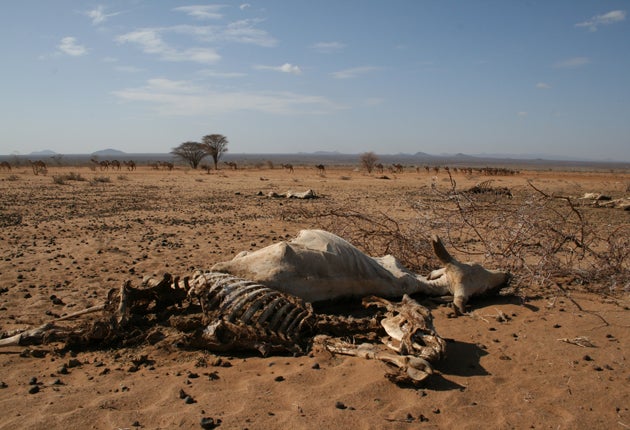
No rainfall for three years has left the Kenyan landscape strewn with animal carcasses

DANIEL HOWDEN

No rainfall for three years has left the Kenyan landscape strewn with animal carcasses

On the plains of Marsabit the heat is so intense the bush seems to shiver. The leafless scrub, bleached white by the sun, looks like a forest of fake Christmas trees. Carcasses of cattle and camels are strewn about the burnt red dirt in every direction. Siridwa Baseli walks out of the haze along a path of the dead and dying. He passes a skeletal cow that has given up and collapsed under a thorn tree. A nomad from the Rendille people, he is driving his herd in search of water.

He marks time in seasons but knows that it has not rained for three years: "Since it is not raining there is no pasture," he says. Only 40 of his herd of sheep and goats that once numbered 200 have survived. Those that remain are dying at a rate of 10 every day.

Already a herder before Kenya's independence he has never seen a drought like this.

"If I was young I would go to look for cash work. I am old. I may just die with my animals."

Across East Africa an extraordinary drought is drying up rivers, and grasslands, scorching crops and threatening millions of people with starvation. In Kenya, the biggest and most robust economy in the region, the rivers that feed its great game reserves have run dry and since the country relies on hydropower, electricity is now rationed in the cities.

And yet, it is in the semi-desert on the southern fringe of the Sahel zone where the most dramatic changes are being felt. Droughts are nothing new here and the nomadic way of life where herders follow patchy rains across the seasons developed centuries ago as a response to precarious natural resources. The herds of cattle, sheep, goats and camels – which are venerated by the nomads – were built up in the good years to pad the margins of life when the rains failed. But this way of life is being overwhelmed, even the camels are dying of thirst.

Naibari Arara lives in a typical Rendille village, a broad circle of domed shelters ringed by a barricade of thorny branches or bomas. Inside there are corrals for the animals on whom life depends and huts fashioned from hides, rags and sticks, designed to be collapsed, packed and rebuilt in a single day.

But the village doesn't move anymore. The animals are gone and so are the men. They left 12 months ago with the herds in search of pasture, she explains. In the meantime the women and children wait.

"We can't leave from here. We can't move without milk." The Rendille have survived for generations on a diet of milk, blood and occasionally meat. Now they are living on food stamps and milk powder. "When I was a young girl we would move every two or three months but now there are no rains. I cannot explain this."

An hour's walk away in the town of Korre, Rendille elders have been discussing the crisis. Monte Wambile, reed thin with a weather-beaten face says that what's unfolding is not a drought. According to folklore, a climatic disaster struck the same region about 120 years ago and is remembered in the local language as the "arbah", or catastrophe. Starving families were forced to sell their children in return for cattle to survive.

Now, he says it has returned.

"Since I was a young man the droughts would come but these were just changes we could cope with. Now there are carcasses all over and most of the people have lost their animals. Soon the people will start dying." Sariticho Lenelo is already dead. A 10-year-old Rendille boy in Loglogo, he was killed along with two young men when armed raiders attacked herders at the town's water pump and stole nearly 300 livestock.

Across the north of Kenya competition for water, grazing land and surviving cattle has sparked ethnic conflict. Cattle raids were always a feature of nomadic cultures but as the battle for survival intensifies the death toll climbs. Sixty-five people have been killed in the Turkana region alone since January. Despite being a disaster three years in the making, the drought is in danger of catching Kenya and the UN unprepared. Failed harvests mean high food prices, the national government is crippled by infighting and corruption, and international aid groups have seen funding squeezed by the credit crunch. The food vouchers sustaining hundreds of Rendille families will run out in less than a fortnight as the Irish aid agency paying for them, Concern, has run out of money for the project. In the last week, other big organisations such as Oxfam and Cafod have launched emergency appeals. The UN has received less than half the £350m it has called for.

In reality no one can deliver the rain that is really needed. Leina Mpoke has been working to unravel the cycles of drought, local deforestation and global influences for the Kenya Climate Working Group. "The drastic changes we're experiencing cannot be explained by local activities," he says. "Across the southern Sahel we're seeing a huge trend."

In the 1970s there was a major drought once in the decade. In the 1980s this quickened to once every seven years, in the 1990s, once every five years. At the beginning of this decade the rains failed every other season and what we now see is "perennial drought".

"What's being seen," says Mr Mpoke, who works with Concern, are "the consequences of global climate change".

Marsabit mountain rises up from the semi-desert of northern Kenya to touch the clouds at nearly 2,000 metres. Its highland slopes have always offered respite from the heat and dust of the savannah.

The mountain was known as "Saku" or mist, and its elevated forest sheltered elephants, kudus, lions and high altitude lakes. It is now home to climate refugees who have swollen the population to more than 40,000. Ibrahim Adan grew up in Marsabit and is sad to see how it's changed: "It used to be all green, now it's horrible and dusty."

"I remember as a child we had food we didn't know what do with."

He now runs a local organisation called Cifa that is working with struggling nomadic communities and distributes food stamps. He describes what's happening as a "national crisis".

"The climate has forced people to the mountain. The number of poor people is increasing every day. They are cutting down the forest for firewood, the environment is totally degraded."

Everything in town is coated in a choking layer of red dust, the two mountain lakes have dried to a green-black crust and rangers at the Marsabit National Park say that eight elephants have starved to death in recent months. "If it wasn't for climate change we wouldn't have this concentration of people, it's a vicious circle," says Mr Adan.

Many of the climate refugees come to Petro Namweni Lojich when they arrive. He is the local chief of the Turkana, proud and warlike nomads whose homeland is more than 200km west of Marsabit.

Every time a vehicle arrives in town, he says, it brings another five or six Turkana.

"Drought and conflict are forcing them to come," he explains.

These outlanders are shunned by many of the jostling communities in Marsabit and live on the margins. Their fate is a bleak harbinger for other nomads. Stripped of their livestock and "prestige" there is no way back for them.

The chief insists he is "still a Turkana" but admits that without a herd he would be treated as inferior even if he could go home. Without rain, he believes, the rest of the Turkana will be forced to do what he has done: "What is the alternative?" he shrugs.

Remembering the first time he stayed inside a building, he says: "I felt like my eyes had been closed. I couldn't see the night sky."

Looking older than his 44 years, he admits to not liking urban life. "When we lived outside we could see who was our enemy and see him coming. Here it is more complicated."

Post a Comment

View all comments that have been posted about this article.

Offensive or abusive comments will be removed and your IP logged and may be used to prevent further submission. In submitting a comment to the site, you agree to be bound by the Independent Minds Terms of Service.

Comments

Drought The Weather and a Tipping Point
[info]alykhansatchu wrote:
Saturday, 3 October 2009 at 04:37 am (UTC)
About 4 weeks, I was invited to the lunch on the fringes of the Nairobi National Park and the journey around the perimeter of the Park was an appalling scence. Cow carcasses on the side of the road and Herds of Cows so emaciated they were just hours from their extinction and you could the very living breath on their lips, ready to disappear into the ether. It was just stupefying, like coming through a slaughter.

Wherever you care to turn your Face, You will note the Weather is seriously stressed. The Cause and Effect is as plain as day. We have toasted the Planet beyond its comfort zone. I sense we have tipped it.

Markets are often the message. Sugar is in a sweet spot, Cocoa and Tea are boiling over and are at levels not seen since the 1980s. The Soft Commodity markets are an accurate and scientific measure of the consequences of our actions, our breakneck Cannibalisation of Agri Land, our headlong rush towards to Industrialisation, the environmental degradation is now a perfect storm. The Interconnectedness of our Human Ecosystem is shown by the fact that the Feedback lop is having an outsize blowback in areas such as Northern Kenya, Indonesia, Australia.

Aly-Khan Satchu
www.rich.co.ke
Twitter alykhansatchu
Re: Drought The Weather and a Tipping Point
[info]georgesign wrote:
Saturday, 3 October 2009 at 10:34 am (UTC)
We're all doomed! We're all doomed! Er ... but by my book first.
Re: Drought The Weather and a Tipping Point
[info]georgesign wrote:
Saturday, 3 October 2009 at 11:04 am (UTC)
Apologies. I should have written "buy". I've obviously been reading the Guardian too much. Still there's another plug.
The Great Waves of Change are upon are planet, How will you know what to do? GreatWavesOfChange.org
[info]knowledge_man wrote:
Sunday, 11 October 2009 at 08:44 am (UTC)
Climate change and its consequences are but one of the Great Waves of change now impacting the entire human family. These have been foreseen and prophesied for hundreds and thousands of years, in many spiritualities and faith traditions. In a new and ultimately visionary current affairs book The Great Waves of Change: Navigating the Difficult Times Ahead award-winning author and spiritual teacher Marshall Vian Summers explains the steps that you can take to navigate increasingly turbulent and uncertain times. Read 4 free chapters of the new book, online, now at GreatWavesofChange.org hosted by the nonprofit-publisher of Summer's work.

In addition to Climate change and catastrophic weather the Great Waves of change encompass: Growing Economic Hardship and Political Instability, Declining Energy and Natural Resources, Loss of Arable Land and Fresh Water, Pandemic Disease, Escalating Worldwide Conflict.

In the face of such uncertainty, Summer presents a revolutionary new way of knowing--a unique process that can be applied by people everywhere. By understanding the Great Waves of change and connecting to a deeper authority within, you can find the strength, courage, and inner certainty to adapt and to become a contributor, not a victim, to a rapidly changing world. At GreatWavesofChange.org at the author's request you can download 4 free chapters of this new book to experience and be with, at your own pace, now. If you are moved by the book's empowering and uplifting message of human cooperation in the face of a planet in decline, the book can be purchased online at many retailers, including amazon.com, powells.com. In the difficult times ahead, How will you know what to do? I urge you and all those uncomfortable with the planet's accelerating trends recently to experience this book and its New Message now, and if so moved, to share the book with others. its our time to begin now, namaste.
Where is the god
[info]aliceinwondera wrote:
Saturday, 3 October 2009 at 08:03 am (UTC)
I feel so sad this is happening. Poor people and animals over there have to suffer so much.
Re: Where is the god
[info]georgesign wrote:
Saturday, 3 October 2009 at 10:38 am (UTC)
Good question. If I was sailing on the high seas and I came across a sinking ship and ignored them and let them drown. I would rightly be guilty of crime against humanity. That's what the God of the religious weak-minded does every day. If there is a God he's a nasty bit of work.
Re: Where is the god
[info]corporeal_v002 wrote:
Saturday, 3 October 2009 at 09:20 pm (UTC)

Blasphemy! Are volunteering yourself to be a critic of God?
God creates situations (fortunate and unfortunate) to test individuals and mankind in general, this short life on earth is not heaven - but most people think it is/wish it was...
Re: Where is the god
[info]someofusknow wrote:
Saturday, 3 October 2009 at 09:29 pm (UTC)
There is the possibility that 'God' is the collection of physical and chemical factors that make life on this planet possible, in combination with tens of thousands of years of collective experience of humans who discovered over aeons the right way to live. Converting sequestered carbon (coal, oil, gas) and turningb them into trash and pollution has its ultimate price. If the Biblical representation of God is in fact correct, no government (Christian or otherwise) has implemented or is implementing policies that are in any way remotely connected to the teachings of Jesus; practically all government policy around the wolrd is directed towards looting and polluting. And since most people are deceived, stupid, or greedy, they contoinue to support political parties that promote greed. In that case, 'God' is telling humans: 'You have broken all my rules and ingored my instructions (be good custodians of the Earth); you have relentlessly assaulted your land base (and atmopshere and oceans) in the name of industrialism based on laziness, stupidity and greed; now you must pay the price.'

Eastern Africa just happens to be one of the more vulnerable places on Earth, so is being hit early in the 'punishment', but all natons will eventually be clobbered, one way or another.
Re: Where is the god
[info]someofusknow wrote:
Saturday, 3 October 2009 at 09:51 pm (UTC)
At least those animals did live naturally, got to breathe fresh air and saw the Sun before they died, unlike the animals that are kept in factory farms throughout the industrialised world, which are kept in 'comcentration camp' conditions for all of their short lives.
'the clouds are changing'
[info]janepracaction wrote:
Saturday, 3 October 2009 at 09:47 am (UTC)
The situation in Kenya is devastating. Just three years ago the UNFCCC took place in Nairobi and Maasai communities - many travelling for three days - took to the streets of Nairobi asking for world leaders to take action. One Maasai woman who addressed the COP delegation called politicans 'climate tourists' and told them to 'go home' as she was fed up of hearing 'later, we will take action later'.

I spoke to a a Maasai elder about the situation, both in Nairobi and also in his home in the Rift Valley. Just three hours outside Nairobi the landscape quickly changes from green to a sparse, dusty backdrop. He told me 'how the clouds were changing and didnt come', only a year earlier Kenya saw no proper rain for three years, killing huge percentages of livestock. The pattern is repeating itself with more regularity. Also maize production will be done almost 30 per cent this year, compounding the problem further.

For a number of years I have worked with the charity Practical Action which works with Maasai communities, both in the Rift Valley and Turkana. One woman who had 500 goats and 490 cattle when she married now only has 49 goats and 5 cows, and relies on selling the Maasai red shukas. We are working with communties, trying to create a nucleus herd of the healthiest animals, which will help pastoralists recoup after the drought, reconditioning and putting in more boreholes and working with people on alternative livelihoods.

Yet without urgent action in Copenhagen, agreement for adaptation funding, I fear for the future of the Maasai elder, his family and his community I was fortunate enough to spend time with.

More info www.practicalaction.org
Re: 'the clouds are changing'
[info]georgesign wrote:
Saturday, 3 October 2009 at 10:48 am (UTC)
Big Business, World Banks, Politicians, Do-Gooders, Global Warming Nerds where would we be without them? Not interfering in other peoples lives I guess. time to send for BONO or Sir BOB.
Re: 'the clouds are changing'
[info]someofusknow wrote:
Saturday, 3 October 2009 at 09:45 pm (UTC)
If you watch the documentary 'Global Dimming' you will undestand how industrial pollution is affecting the formation of raindrops and causing massive changes to the atmospshere. If you watch 'Money as Debt (1+2) you will understand how the debt-based money system was created to transfer wealth from the poor to the rich. We have been living in a rape and pillage economy since the time of teh Romans, but more particuallry since the 1500s.

Thousands (maybe millions by now) of scientists object to the stupidity promoted by polical leaders on a daily basis, but are continuously ignored because the entire system has been hi-jacked by a small group of elites whose only purpose is to acquire more money and power for themselves at the expense of the rest of humanity. Hence, there will be no 'solutions' at Copenhagen or anywhere else, just systems to allow financiers to profit from the meltdown via such absurdities as 'carbon trading'.

By the way, putting in more boreholes simply lowers the water table and makes the general situation worse.
Droughts and global warming
[info]sweetbriar12 wrote:
Saturday, 3 October 2009 at 10:59 pm (UTC)
Less talk and more action. We live in a peculiar time when animals in Europe: i.e cows, pigs etc, etc by law have to be fed on grain while unused food is fed to the rodents. No recycling there. At the same time this pushes the price of cereals up.....now don't mention profit...that like the food for the rodents is dirty.

In some cities the night sky cannot be seen, so bright is the illumination. Twenty four hour lighting and innumerable televisions in shopping centres are now the normal way of life! The laws of nature are being pushed to extremes and something has to give and it won't be nature.
The elephant in the room at these global gabfests...where politicians and their friends dine, wine in fine style in their desire to save the world from itself...rarely rates a mention: the rapid destruction of rain forests.

A small comfort
[info]mdroogpoppins wrote:
Saturday, 3 October 2009 at 11:12 pm (UTC)
Those Africans with the Internet will be cheered by watching Desert Water Mirage on
www.youtube.com/edotoole
The vicar has recently departed from our parish but the memories linger on.
Obama, alternative energy, doing nothign
[info]mscir wrote:
Saturday, 3 October 2009 at 11:53 pm (UTC)
Obama instantly gave trillions to rich bankers but hasn't built one factory, hasn't advanced alternative energy in any significant way. So much for the Audacity of Hype, er, Hope. My vision is that Americans could fill new factories cranking out alternative energy: wind, solar, wave, geothermal, and sell them or give them away, covering the earth with them and reducing the need for oil, coal, and gas. Solar cells powering desalinization plants could start greening deserts in Africa, Australia... but we're still waiting Obama. I wish Ron Paul was president!
Where are we headed
[info]gannamede wrote:
Sunday, 4 October 2009 at 01:40 am (UTC)
We have overpopulated the earth and happily continue to make it even more so; life will not come to a screeching halt but many will die and the earth will recover. If one looks at reality dispassionately it is obvious that we are experiencing one of the cycles of nature, the ebb and flow of human habitation. Most of us would that mankind and it's food supply be nurtured each by the other indefinitely, while ignoring the fact that the natural resources anywhere in the universe are finite. Food production is now at an almost astonishing level of efficiency hitherto unknown in all history, but it is delicately balanced on the razors edge of technical expertise and political realities, a disaster cocked and primed. Will there be world famine, of course, just as there will be world war, or world pandemic, we just don't know when. The answers are simplistic but difficult to accept by a mankind who now demands that life be risk free. Life is not risk free, life has never been risk free, life cannot be made risk free. The stilts we've built our present existance on are ever so fragile, and the collapse of a single key prop can easily lead to a cascade that will only end with nature restoring itself. Politically incorrect, yes of course, but threin lies the decay, hidden from the naive, that weakens us. We have allowed the weak to assume leadership, and when the collapse begins we will cry where are our leaders when in fact they never were "leaders" but in fact were (and are) followers, of populism. Voices such as this are easily and ordinarily ignored and even ridiculed, be that as it will, but posterity will not be able to claim the spector approached unheralded.
Greening the Desert
[info]usastudent101 wrote:
Monday, 5 October 2009 at 01:02 am (UTC)

This article surely leaves the impression that this 3 year drought in the Kenyan desert is only one example of the great catastrophes caused by global warming. This article seems to paint the picture of a very stark, doom and gloom future for the third world countries. There are many articles in the news like this one. This article may be seen as helping the planet by informing the public the impact and range of global warming.

My question is wouldn't it be really helpful if these authors publicise solutions to these problems? This article, like many articles about catastrophes regarding ecosystems and global warming, leave the reader with a helpless residue. The sensationalism and dramatization in media is a wasting people's time. There is such opportunity in the media, journalism could have great impact on the world if it spread ideas, names, and possible solutions to common issues.

So here I will add a few things I wish news companies and journalists would've covered with this article.

A huge blessing has come to the planet in the form of the permaculture movement. Many say the father of this movement is Bill Mollison. Here's an example of Bill showing ways to green desert areas with a great deal of erosion. (http://www.youtube.com/watch?v=fPET0OkPBrI )

Another great success that went largely unnoticed by most journalists is the project/experiement that was summed up in the "greening the desert" video (http://www.youtube.com/watch?v=4S6kTlz6Mk4&feature=fvw).

Here they had salty land, practically no rainfall, with temperatures as high as 122 F. Using some creativity with using swalls to help contain water and allow it to be absorbed into the grown before evaporating they established an ecosystem in the middle of the desert that should stay there indefinitely if its not tampered with. To summarize their achievements, in one of the most inhabitable lands in the world, they "got figs in four months." Watch the video yourself, its only about 5 minutes.
INDRA weather control project
[info]indra_project wrote:
Monday, 5 October 2009 at 04:37 am (UTC)
Top scientists say revolutionary clean power climate control project will reduce wildfires and dangerous weather while improving the lives of billions of people.

Climatologists, biologists and physicists from all corners of the globe agree that U.S. based Gravitational Systems, L.L.C.'s revolutionary clean power climate control project INDRA will improve the lives of billions of people around the world. Concerns have been raised about the projects impact on biodiversity as deserts are terraformed to rainforests.

Gare Henderson, director of research and development for Gravitational Systems, L.L.C. ( a clean power developer), explains that the INDRA project, a proposed network of specialized evaporation channels moving sea water from the oceans toward the deserts, will convert world deserts into biodiverse rainforests. Deserts which cover 1/3 of all dry land will be terraformed into productive land. The INDRA systems will give mankind control of the weather, ending dangerous storms such as hurricanes, typhoons, tornadoes, and dry heat waves within a decade. Vast rivers can be turned on and off in hours, and reservoirs and salt marshes drained or replenished in days. The increased bio-mass of the terraformed deserts will begin to reverse both global warming and thermal sea level rise. UNFCCC cap and trade certification of the INDRA project will allow individuals and business to fund the plan through carbon offsets. The initial projects will be targeted north American, and north African deserts.
If it were here...
[info]global_changes wrote:
Thursday, 8 October 2009 at 11:16 am (UTC)
If the drought crisis in East Africa were to happen anywhere in the western world it would be the story of the century. Why don't we care enough about these people do do something about global warming?
Water
[info]water_purifier wrote:
Tuesday, 13 October 2009 at 12:11 am (UTC)
Need a massive Water Purifier and flow it there..

Article Archive

Day In a Page

Sun | Mon | Tue | Wed | Thu | Fri | Sat

Select date