UN dismisses demand to quit Ivory Coast
The United Nations has rejected calls from Laurent Gbagbo – Ivory Coast's leader who is clinging to power despite widespread international recognition that he lost last month's run-off presidential election – for peacekeepers to leave the country.
Meanwhile, as tensions escalate in the troubled West African state, fuelling fears of a return to full-blown civil war, the UN refugee organisation reports that 4,200 Ivorians have fled to neighbouring Liberia and Guinea. That number is expected to reach 5,000 by early this week.
"The Secretary-General is aware of statements by Mr Gbagbo's spokesperson calling for the withdrawal of the UN Operation in Côte d'Ivoire," a statement released in New York late on Saturday evening read.
UNOCI, the UN peacekeeping operation in Ivory Coast, numbers around 9,000 troops, accompanied by 900 French soldiers.
"UNOCI will fulfill its mandate and will continue to monitor and document any human rights violations, incitement to hatred and violence, or attacks on UN peacekeepers," Saturday's statement added.
The latest diplomatic spat between Mr Gbagbo's pariah administration and the UN follows an announcement on Ivory Coast's national television on Saturday in which Jacqueline Oble, a spokeswoman for the embattled incumbent, called for the departure of both UN and French troops. Mr Gbagbo's administration, Ms Oble said, "is opposed to any renewal of their mandates".
Alongside this war of words Ivorian security forces loyal to Mr Gbagbo have also clashed with peacekeepers. The UN reported an attack on a patrol and sentries at UNOCI's headquarters, while another attack on UN military observers on Saturday by Mr Gbagbo's "Young Patriots" militia group left two injured.
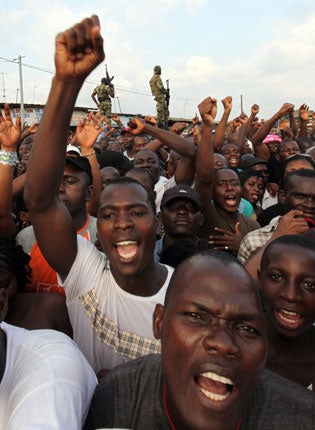
The latest violence follows the events of Thursday, when up to 30 people were killed as supporters of Alassane Ouattara – the internationally recognised winner of the 28 November run-off election – unsuccessfully attempted to wrest control of key state institutions. Marchers in Ivory Coast's main city, Abidjan, tried to take over the national broadcaster only to be beaten back by security forces.
On Sunday Patrick Achi, a spokesman for Mr Ouattara, said the Opposition would continue to attempt to disrupt Mr Gbagbo's rule. "The next move is still to paralyse the whole city and the country," he said, adding that Ouattara supporters would attempt to block transport and administration.
According to Eric Agnero, an Ivorian journalist, Abidjan was quiet yesterday although on Saturday bands of men roamed the streets. "Yesterday night I saw a bunch of guys with sticks and maybe other arms moving from one neighbourhood to another," he said.
Ivory Coast, the world's largest cocoa grower, was once regarded as haven of stability in a troubled region. However a civil war in 2002 and 2003 split the country between north and south.
The elections this year were intended to heal the scars of the war but have instead led to increased tensions and fears of a resumption of outright fighting. The international community hailed Mr Ouattara, whose power base is the north, as the winner of last month's poll with 54.1 per cent of the vote.
However, the constitutional court, Ivory Coast's highest legal body, annulled 10 per cent of the ballots and acclaimed Mr Gbagbo, who draws his support from the south, as winner.
Since then the country has effectively had two presidents. The UN, the US, former colonial power France and the African Union recognise Mr Ouattara, while Mr Gbagbo retains control of the army and most institutions.
Join our commenting forum
Join thought-provoking conversations, follow other Independent readers and see their replies
Comments