A new jail for Bradley Manning – but the controversy rages on

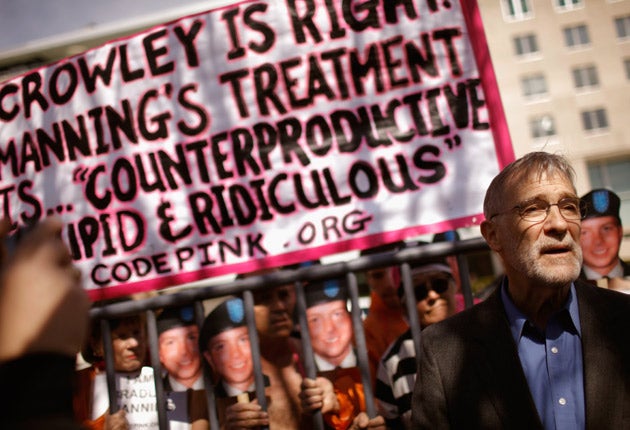
Private Bradley Manning left his tiny cell in a United States Marine Corps prison for a long-term military detention centre in Kansas yesterday, as the Pentagon tried to cut short a deepening controversy that was turning into a stain on the reputation of Barack Obama's administration.
The transfer of Pte Manning, suspected of leaking thousands of classified cables to the WikiLeaks website, from the Marine brig at Quantico, Virginia, where he has been held since last June, to the main Army prison at Fort Leavenworth, was hastily announced by senior Defence Department officials on Tuesday evening. In the last few months, the harsh detention conditions of Pte Manning, as yet convicted of no crime and whose trial appears to be months away, have generated bewilderment and mounting anger in the US and abroad.
Publicly, the Pentagon continues to insist that no mistakes have been made, despite the 23-year-old soldier's confinement in a 6ft-by-12ft cell, removal of his clothes and a regime of intrusive, round-the-clock surveillance. The conditions were "in compliance with legal and regulatory standards in all respects," Jeh Johnson, the Pentagon's general counsel, said on Tuesday.
But critics at home and abroad disagreed. In recent weeks, Amnesty International and the United Nations Special Rapporteur on Torture have spoken out on the issue, with the latter delivering a virtually unprecedented censure of the US after he was denied access to Pte Manning at Quantico.
In a blistering off-the-record attack in March, the then State Department spokesman PJ Crowley described Pte Manning's treatment as "ridiculous, counter-productive and stupid". That language cost Mr Crowley his job – but also forced a discomfited Mr Obama to come to the Pentagon's defence during a White House press conference.
Yesterday Amnesty vowed to keep up the pressure. "We will be watching how he is treated very closely," Susan Lee, the human rights group's Americas programme director, said in a statement. Until such an assessment takes place, "it is still not possible to know... what restrictions he will be under at the new detention centre".
Pte Manning's lawyer, David Coombs, wrote on his blog: "While the defence hopes that the move to Fort Leavenworth will result in the improvement of Pfc Manning's conditions of confinement, it nonetheless intends to pursue redress at the appropriate time for the flagrant violations of his constitutional rights by the Quantico confinement facility."
The last straw may have been a letter due to appear in the next issue of The New York Review of Books, signed by almost 300 US and foreign legal scholars. It denounces Pte Manning's treatment as a violation of the US Constitution's Eighth Amendment ban on "cruel and unusual punishment", and on the Fifth Amendment guarantee against punishment without trial.
As a former professor of constitutional law, it notes, Mr Obama of all people should be aware of these dangers: "The question now is whether his conduct as Commander-in-Chief meets fundamental standards of decency."
It also gives a graphic description of how Pte Manning was held at Quantico, locked alone in his cell for 23 hours each day: "During his one remaining hour, he can walk in circles in another room, with no other prisoners present. He is not allowed to doze off or relax during the day, but must answer the question 'Are you OK?' verbally and in the affirmative every five minutes. At night, he is awakened to be asked again, 'Are you OK?' every time he turns his back to the cell door or covers his head with a blanket so that the guards cannot see his face."
At one point, he was forced to sleep naked and stand naked for inspection in front of his cell for a week. In the day, he also had to undress and wear a kind of smock – all because Pte Manning was considered a suicide risk, a claim that the prisoner himself and military psychiatrists have disputed.
He has told his lawyers he believes his harsh treatment was retribution by the brig authorities after a protest in his support outside Quantico. But many legal experts suspect it was also intended to pressure him into providing evidence that WikiLeaks founder Julian Assange was prime mover in a conspiracy.
Timeline
November 2009 Bradley Manning contacts WikiLeaks founder Julian Assange for the first time.
February-April 2010 Manning allegedly sends damaging footage of a US air strike to WikiLeaks, which publishes it as "Collateral Murder" on 5 April.
July 2010 Manning is charged with leaking the video and secret diplomatic cables to WikiLeaks.
March 2011 Twenty-two new charges are brought against Manning, including "aiding the enemy" (punishable by death). He accuses Virginia brig jailers of "unlawful pre-trial punishment" including stripping him naked every night.
April 2011 Manning is moved to a Kansas jail after international criticism over his treatment in Virginia.
Tough times await him at 'The Castle'
Fort Leavenworth occupies two very different places in US military lore. It is the traditional home of some of the Army's heaviest intellectual firepower, including the Army Command and General Staff College, headed between 2005 and 2007 by General David Petraeus, who is regarded as the country's greatest expert on counter-insurgency warfare. But it is also synonymous with imprisonment.
There are no less than three jail facilities on the sprawling site on the eastern edge of Kansas, some 30 miles north-west of Kansas City. One is a federal civilian prison that once housed some of the country's most notorious criminals. The other two are military – and one of them will have Private Bradley Manning as an inmate for the foreseeable future.
The most forbidding of them is the United States Disciplinary Barracks (USDB), the Army's only maximum-security prison, often referred to as "The Castle". Detainees have been convicted by a court-martial and are serving terms of at least five years. Notable past inmates include Lieutenant William Calley, convicted for the My Lai massacre during the Vietnam war. Charles Graner, who is serving a 10-year sentence in connection with the Abu Ghraib prison abuse scandal in Iraq, is currently held there. It also contains the US military's death row. The last military execution at Fort Leavenworth was in 1961.
The USDB is modern and relatively spacious. But it is maximum security, and perhaps not the ideal destination for someone who has not been tried.
A more suitable alternative might be the Midwest Joint Regional Correctional Facility, also on Fort Leavenworth's grounds. It is medium security, and normally houses those awaiting trial.
Rupert Cornwell
Join our commenting forum
Join thought-provoking conversations, follow other Independent readers and see their replies
Comments